
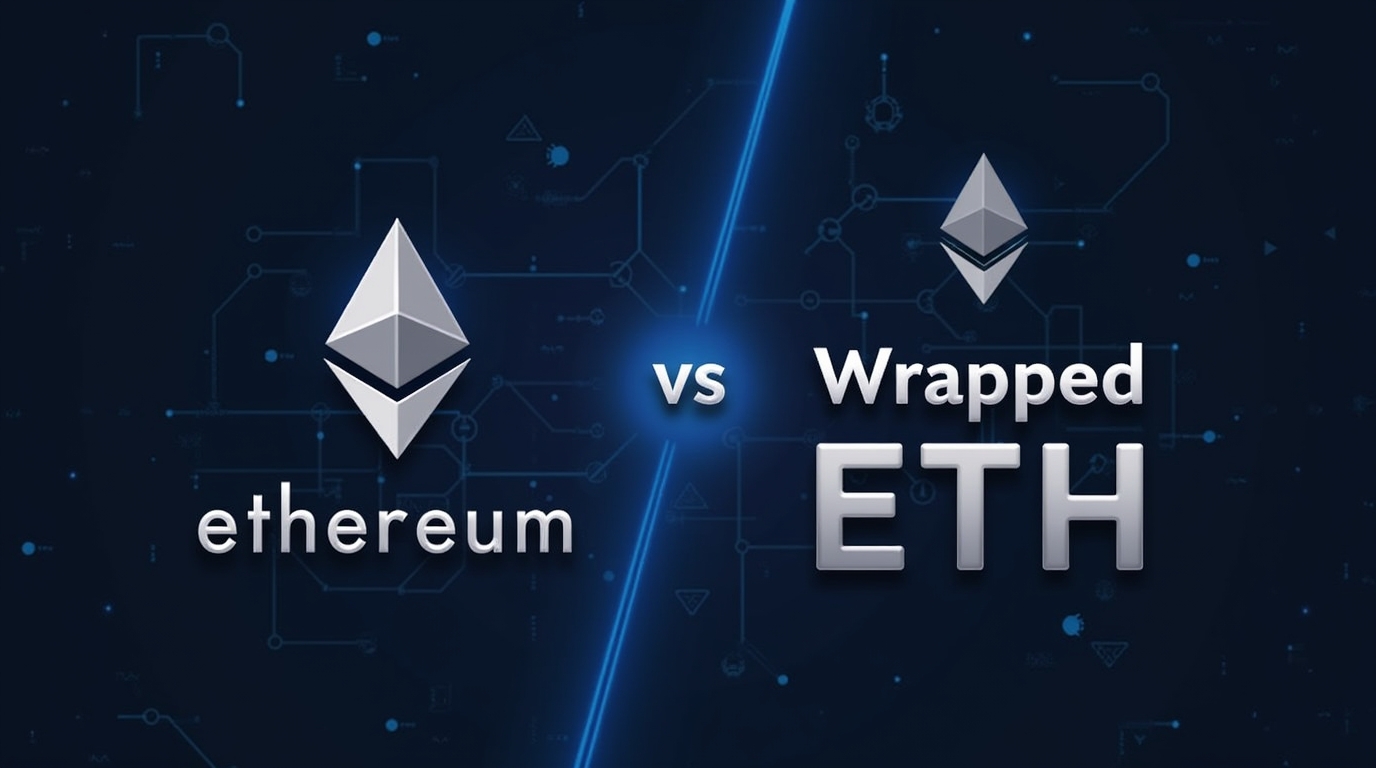
Ethereum’s native currency, ETH, has become a powerful asset in the crypto space. Despite its importance, it still lacks ERC-20 compliance, which poses significant limitations and challenges for decentralized finance (DeFi) applications that rely on the ERC-20 token standard. To overcome this con, developers introduced Wrapped ETH (WETH) that transformed ETH into a fully compatible token without altering its value.
Wrapped ETH works by locking up real ETH in a smart contract and minting an equivalent amount of ERC-20 standard WETH. This 1:1 peg ensures that WETH always mirrors the value of ETH while gaining the functionality that ERC-20 tokens enjoy. By doing so, WETH unlocks seamless integration with DEXs, lending platforms, and yield-farming protocols.
What Is WETH (Wrapped Ethereum) and Why Is It Needed
Wrapped Ethereum is a tokenized version of Eth that follows the ERC-20 token standard, allowing Ethereum’s native currency to interact seamlessly with smart contracts and dApps built on the network. When users “wrap” ETH, they lock their ETH into a smart contract that mints a WETH in return to maintain a 1:1 peg. This doesn’t change the token’s value but makes it compatible with the ERC-20-based system used throughout DeFi. Users can later “unwrap” WETH to redeem their original ETH at any time.
The main difference between the two is in their structure. ETH is Ethereum’s native coin, built into the blockchain protocol and used to pay gas fees, execute smart contracts, and validate transactions. Note that ETH is not an ERC-20 token and does not follow the technical standards of most fungible tokens on Ethereum. Since DEXs like Uniswap, SushiSwap, and LooksRare rely on liquidity pools of ERC-20 tokens, ETH in its native form cannot be traded or paired with other ERC-20 assets without conversion.
Converting ETH into WETH allows users to access the full range of DeFi functionalities, such as improving liquidity, yield farming, lending, borrowing, and NFT trading. WETH ensures interoperability within smart contracts while removing the technical barrier between ETH and ERC-20 tokens.
ETH vs WETH: Key Differences Explained
Introduce this comparison section clearly, setting the expectation for what users will learn next.
Token Standards
The first difference lies between their token standards. ETH is the native currency of the Ethereum blockchain and does not follow the ERC-20 token standards, whereas WETH is explicitly designed to be an ERC-20-compliant token.
This difference is important to understand because many decentralized applications and smart contracts on Ethereum expect token interface functions defined by ERC-20, which native ETH lacks. So, WETH enables ETH value to flow into these ERC-20-based systems.
Use Case Comparison
While both represent the same monetary value, their roles differ. ETH is used for network-level functions like paying gas fees for transactions, securing the network, and transferring value from wallet to wallet. WETH, on the other hand, is used to interact with DeFi protocols, DEXs, lending/borrowing platforms, and NFT marketplaces that expect ERC-20 tokens.
In short, if you’re transferring ETH or paying gas, ETH is the right choice, but if you’re supplying liquidity, swapping tokens, or interacting with ERC-20 only contracts, then go for WETH.
Transaction Costs and Gas Fee Considerations
While both are equal in value, WETH offers an additional service: wrapping and unwrapping. This extra on-chain transaction incurs an additional gas cost. However, note that interacting with WETH in DeFi can sometimes save you from failed transactions that would cost gas and still fail. So it’s recommended to stay cautious while participating in liquidity pools, swaps, or other token-based actions; the overhead of token wrapping/unwrapping is a factor. Sometimes, using WETH directly may save downstream gas by avoiding conversions at each step.
Trust, Custody, and Smart Contract Risks
ETH is native to the Ethereum protocol and resides in the wallet or on-chain as the fundamental unit of account, whereas WETH relies on a smart contract or wrapper that holds ETH in reserve and issues WETH on a 1:1 basis. This introduces additional contract risks, such as bugs, mismanagement, or upgradeability issues arising from contract wrapping.
As WETH must reference a contract that holds the ETH backing it, users must trust that the contract is secure, audited, transparent, and properly maintained. If the contract is compromised, then the backing could be at risk. Moreover, some wrapped implementations introduce further custodial or bridging risks.
Liquidity, Interoperability, and DEX Participation
WETH unlocks liquidity and interoperability that native ETH cannot achieve on its own. Because WETH is an ERC-20 token, it can seamlessly participate in token pairs, liquidity pools, cross-chain bridges, and DeFi apps built on top of the ERC-20 standard.
Native ETH cannot always plug into every smart contract that expects ERC-20 methods or token-token liquidity constructs. By converting ETH into WETH, you can unlock access to a broader ecosystem of token-based interactions.
This interoperability is powerful when it comes to DEX participation, as many wraps ETH internally to WETH when you swap or provide liquidity, because they need ERC-20 tokens under the hood.
Pros and Cons of Using WETH
WETH offers many practical advantages to the DeFi and token-ecosystem world, but it also has some trade-offs. On one side, where WETH is an ERC-20 token, it expands the options it offers to your holdings, like enabling participation in liquidity pools, DEXs, yield-farming, NFT marketplaces, and other smart contract-driven protocols that an ERC-20 token expects, but wrapping ETH into WETH adds extra gas cost and reliance on smart-contract mechanics and custodial trusts.
| Pros | Cons |
| It offers ERC-20 compatibility, where WETH works with tokens, DEXs, and liquidity pools that require the ERC-20 standard | Extra operational step, as when you wrap ETH into WETH, it incurs gas and time |
| Enables full DeFi participation: liquidity provision, token swaps, collateral for lending, and NFT marketplace bids | Smart contract risk/trust risk: WETH depends on the wrap/unwrap contract being sound, audited, and secure |
| Unlocks broader DeFi functionality: lending, borrowing, staking, yield farming, and token swaps where ETH alone would not suffice | For simple uses like paying for gas or transferring value. ETH is simpler, cheaper, and more direct. WETH adds complexity when unnecessary |
| Standardizes ETH for token-based systems: helps Ethereum’s ecosystem by maintaining uniform token handling rather than special-casting native ETH | Gas cost and timing matter: wrapping/unwrapping when the network is congested can lead to high fees or delayed transactions |
How to Wrap and Unwrap ETH
Wrapping and unwrapping ETH is an important step when moving between the native Ethereum token and its ERC-20-compatible version, WETH. Wrapping is done when you deposit ETH into a smart contract or use an exchange/DEX interface that issues WETH in a 1:1 ratio. In contrast, unwrapping reverses this process by sending WETH back and redeeming the underlying ETH. The process makes sense because ETH itself does not conform to the ERC-20 token standard, whereas WETH does, enabling its use in many DeFi protocols.
How to Wrap and Unwrap ETH
- Prepare your Wallet
- Use a Web3 wallet like MetaMask, Trust Wallet, or any wallet that supports ERC-20 tokens.
- Make sure you have enough ETH in your wallet for some amount that will wrap, and a little will go as gas fees.
- Go to a Wrapping Platform
- Use a DEX or a wrapping interface like Uniswap or a similar one.
- If you’re using a wallet like Zengo, you can go for the in-wallet “Swap” function.
- Wrap ETH into WETH
- In the DEX/swap interface, choose ETH -> WETH.
- Enter how much ETH you want to wrap.
- Confirm the transaction by checking the gas fee and approving the wrapping.
- After the transaction confirms, you will see WETH in your wallet.
- Unwrap WETH back into ETH
- On the same or similar interface, select WETH -> ETH.
- Enter the amount of WETH you want to convert.
- Confirm the transaction again by checking the gas.
- Once unwrapped, the contract burns the WETH and returns the same amount of ETH to your wallet.
Will ETH’s Upgrades Remove the Need for WETH?
As Ethereum continues to evolve, it’s unlikely that upcoming upgrades will eliminate the requirement for WETH in the near term. The main reason is that the ERC-20 standards are deeply rooted in the Ethereum ecosystem. WETH acts as a bridge, providing native ETH with the ERC-20 interface that DeFi apps expect. Unless ETH is re-engineered to natively support ERC-20 semantics without losing its fundamental properties, WETH will remain a critical adapter for compatibility.
Some visionaries do talk about a future where ETH could gain more “native ERC-20-like” behavior through major protocol upgrades or account abstraction, reducing the friction around wrapping and unwrapping. Even in this situation, WETH may not disappear but could evolve. As DeFi grows and diversifies, wrap-contracts could adapt or be replaced with newer, more gas-efficient versions, but their role as a canonical, composable representation of ETH could persist.
Moreover, the sheer scale of existing infrastructure that relies on WETH means that any deprecation would need to be gradual and provide backwards compatibility. WETH’s deeply rooted position in the ecosystem gives it a long tail, and, for many practical purposes, it will likely remain part of their DeFi toolkit even if Ethereum’s base layer matures.
Final Thoughts
WETH and ETH play complementary roles in the Ethereum ecosystem, and understanding their difference can help you move through the DeFi space with ease. ETH remains a priority for paying gas fees, sending native transfers, and staking on the Ethereum network. At the same time, WETH is important for interacting with DeFi protocols, DEX liquidity pools, lending platforms, or NFT marketplaces that require ERC-20 token compatibility. WETH functions like any other ERC-20 token, unlocking liquidity, enabling smoother smart-contract interactions, and enabling broader interoperability across the decentralized economy.
Most users use ETH for network operations and switch to WETH while participating in the ERC-20-based trading, liquidity provision, or automated market-making. Knowing when to wrap or unwrap reduces friction, reduces errors, and ensures safe engagement with DeFi apps.
To learn more about crypto, sign up at Dypto Crypto and explore advanced guides, real-world use cases, and expert tips on navigating the DeFi landscape.
FAQs (Frequently Asked Questions)
Q: Can you send WETH to an ETH address?
Yes, you can send WETH to an ETH address both they both use same underlying Ethereum network. The difference between the two is only that WETH is an ERC-20 token while ETH is the native asset. This means the receiving wallet must be able to recognize and display ERC-20 token and if it doesn’t the WETH will still arrive safely on-chain but user may need to import the WETH token contract to see it.
Q: Does WETH affect gas fees on Ethereum?
Wrapping/unwrapping requires on-chain transactions, so it incurs a gas cost relative to a plain ETH transfer. Some UXs batch or automate steps to reduce the number of separate transactions, but wrapping is not gas-free.
Q: Can WETH be used for staking like ETH?
Not directly. ETH staking requires native ETH or protocol-specific staking tokens. WETH is primarily used for ERC-20 interactions and to check each staking protocol’s requirements.
Q: Is WETH safer to use than ETH on DEXs?
Neither is inherently “safer” than the other on DEXs, as they both carry security concerns tied to the Ethereum blockchain; however, WETH introduces an additional layer of smart contract risk.
Q: Why do NFT marketplaces like OpenSea require WETH?
NFT marketplaces require WETH to facilitate certain smart contract functionalities and to enable off-trade bids or offers that can be fulfilled at a later date, without the need for constant, real-time transaction approvals.
Disclaimer
This article is for educational and information purposes, and should not be considered financial advice. For more information visit our disclaimer page
About the Author