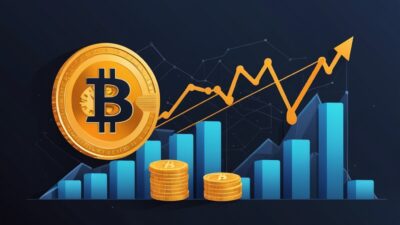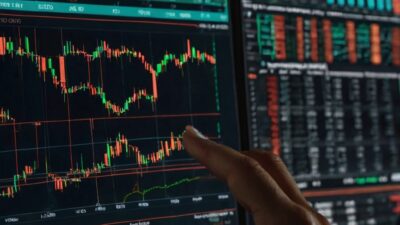

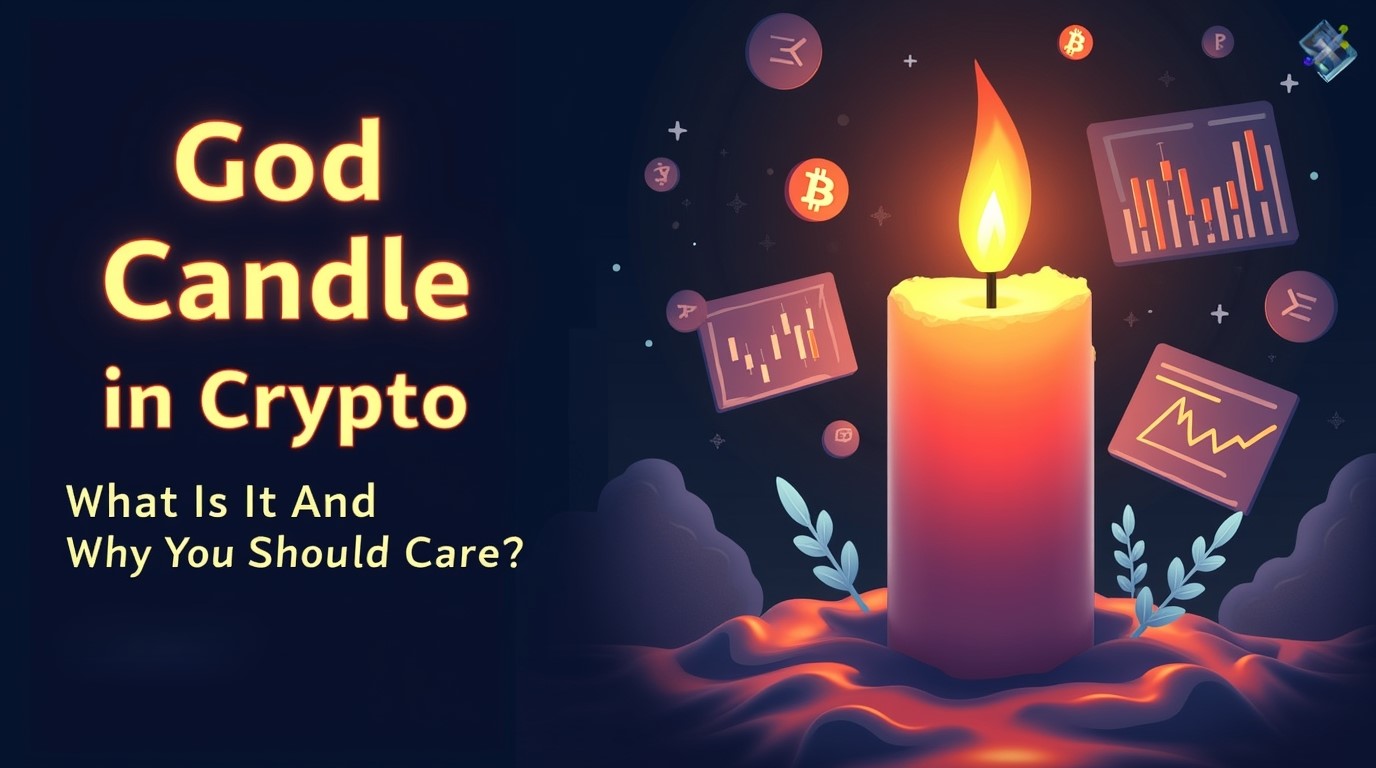
Imagine waking up to see that your favorite cryptocurrency has surged 30%, 40%, or even 50% in a single candle. That towering green spike on the trading chart? It is called a God candle, and it is one of the most dramatic signals in crypto trading.
A God candle represents a sudden, massive price surge within a short period of time, often driven by breaking news, whale activity, or a cascade of liquidations. For traders, it can feel like a golden opportunity or a dangerous trap. These candles can confirm powerful momentum, but they also bring intense volatility and emotional decision-making.
Whether you are new to crypto trading or sharpening your trading edge, understanding God candles is essential. In this blog, we will break down what causes them, how to trade around them, and the risks you should never ignore. Let’s dive in.
What Is a God Candle in Crypto?
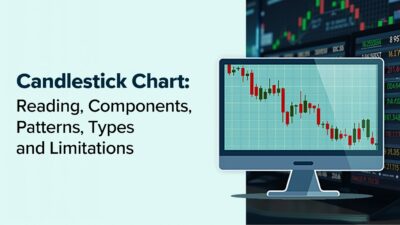
A candlestick is a graphical representation of price data for a given time interval, such as 1 minute, 1 hour, or 1 day, on a candlestick chart, which is widely used in crypto and other financial markets. It has four key parts:
| Part | What It Shows | Visual Description |
| Open | Price at the start of the time period | Bottom of the body (green candle) |
| Close | Price at the end of the time period | Top of the body (green candle) |
| High | Highest price reached | Tip of the upper wick |
| Low | Lowest price reached | Tip of the lower wick |
A green candle represents a price increase, while a red candle indicates a price decrease.
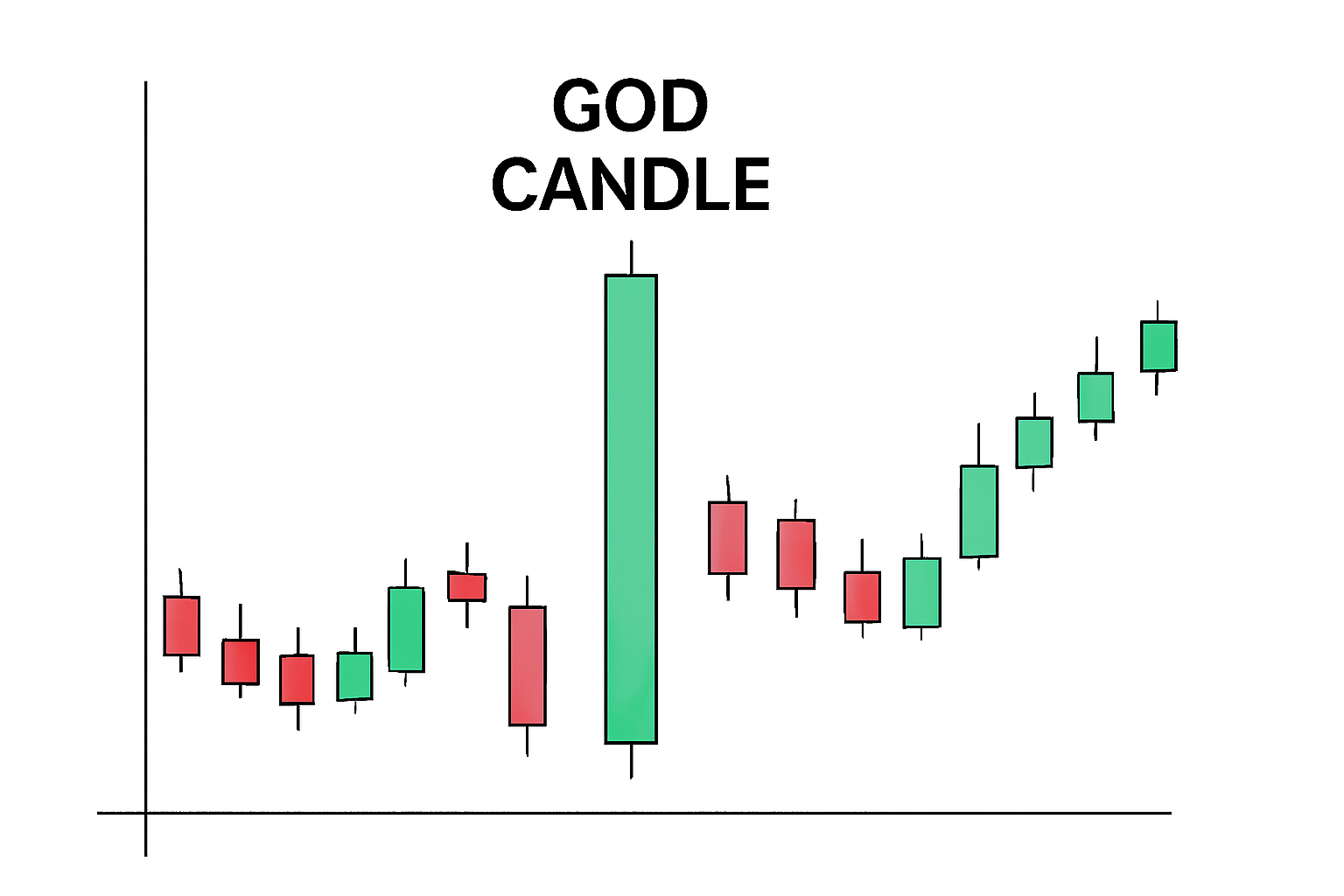
A God Candle is an extraordinarily large green candlestick that appears suddenly on a crypto chart. It is not just a regular bullish candle; it is a market shockwave. Its standout features include;
- Huge Body: The candle’s body is significantly taller than those around it, indicating a substantial price increase in a short period.
- Sudden Spike: It often appears out of nowhere, catching traders off guard.
- Heavy Volume: It is characterized by a surge in trading activity, with numerous buyers entering the market simultaneously.
- Market Impact: It can instantly flip market sentiment, triggering FOMO (fear of missing out) or short squeezes.
A God candle is extremely important because it signals strong bullish momentum. It often marks the start of a breakout or trend reversal. It draws the attention of the traders and can lead to rapid follow-up buying. God candle is not always predictable as it is often driven by news, whale activity, or liquidations.
Why God Candles Matter for Traders
In the fast-paced world of trading, few phenomena grab attention like a “god candle,” a massive, single candlestick that surges far beyond its predecessors. These dramatic price moves often signal major shifts in market sentiment, and they can be both thrilling and dangerous. Whether you are a seasoned trader or just starting, understanding the implications of the God candles is crucial for making informed decisions. Let’s break down why they matter through three key lenses:
Trader Psychology and FOMO
God candles trigger emotional reactions, especially FOMO (Fear of Missing Out), among retail traders.
- Sudden excitement: A towering green candle can appear to signal the start of a major rally, prompting traders to jump in impulsively.
- Social media hype: When influencers or trading communities spotlight a god candle, it amplifies the urgency to act.
- Lack of strategy: Many traders enter positions without thoroughly analyzing the setup, risking capital solely on momentum.
- Overconfidence: Seeing a big move can create a false sense of certainty, leading traders to ignore risk management.
Emotional trading often leads to poor timing. God candles should be a signal to pause and assess, not rush in.
Market Analysis and Trend Signals
Beyond the hype, the God candles can offer valuable insights into market structure and momentum:
- Breakout confirmation: A god candle breaking above resistance may confirm a bullish trend or signal the start of a new leg up.
- Volume surge: These candles often come with high volume, indicating strong institutional interest or news-driven momentum.
- Support/resistance validation: If a god candle bounces off a key level, it can reinforce that level’s significance.
- Trend acceleration: In trending markets, the God candles can mark the beginning of a parabolic move, but also the climax before a reversal.
Always use technical indicators and volume analysis to validate whether the god candle is part of a sustainable trend or a short-lived spike.
Balancing Risk and Reward
While the profit potential is tempting, the God candles come with elevated risks:
- High volatility: Prices can reverse just as quickly as they surged, trapping late entrants.
- False breakouts: Not all God candles lead to sustained moves, as some are liquidity grabs or news-driven blips.
- Risk of overleveraging: Traders may increase position sizes to chase gains, exposing themselves to larger losses.
- Confirmation bias: Traders may ignore contrary signals, believing the God candle guarantees future movement.
Always weigh the reward against the risk. Utilize stop-losses, position sizing, and a broader market context to safeguard your capital.
Main Drivers Behind a God Candle in Crypto?
In the volatile world of cryptocurrency, god candles don’t appear out of nowhere. They sre often the result of a perfect storm of external catalysts, strategic moves by big players, and the mechanics of leveraged trading. Understanding these drivers helps traders decode market behavior and avoid getting caught off guard.
News and Macroeconomic Events
Cryptocurrency markets are highly sensitive to global developments. A single headline can trigger a cascade of buying. Announcements of crypto-friendly regulations or tax reliefs can boost investor confidence and spark buying sprees. Similarly, news of a country adopting Bitcoin or launching a central bank digital currency (CBDC) often leads to bullish sentiment.
During periods of inflation, currency devaluation, or banking crises, investors may turn to crypto as a hedge. Major upgrades, such as Ethereum’s shift to proof-of-stake or partnerships, can drive speculative buying. These events inject optimism and urgency, often causing retail and institutional investors to pile in simultaneously, fueling a god candle.
High-Volume Whale or Institutional Buying
When whales (large holders) or institutions make big moves, the market reacts dramatically. A single buy order worth millions can clear out sell walls and push prices up rapidly. Whales often buy during low-volume periods to maximize impact, triggering breakout candles.
Once the price starts moving, retail traders follow the momentum, amplifying the surge. Large transfers to or from exchanges can signal intent to buy or hold, influencing market sentiment. These players move markets with precision. Their actions often precede or coincide with god candles, making volume analysis essential.
Liquidations and Short Squeezes
Leverage is a double-edged sword in crypto, and god candles often slice through short positions. Traders betting against the market with borrowed funds are vulnerable to sudden price spikes. When prices rise, short positions reach liquidation thresholds, forcing traders to buy back assets at higher prices.
Each liquidation pushes the price higher, triggering more liquidations, a feedback loop known as a short squeeze. In thin order books, even modest buying pressure can lead to exaggerated price movements. These short squeezes are notorious for creating god candles. They are fast, brutal, and often leave retail traders scrambling.
Example: October 2019 Bitcoin God Candle
On October 25, 2019, Bitcoin surged by an astonishing 42% in a single day, marking one of its largest daily gains ever. It was driven by a mix of political endorsement, market mechanics, and trader liquidations.
The rally was ignited by a surprising announcement from Chinese President Xi Jinping, who publicly endorsed blockchain technology as a strategic innovation. During a meeting of the Communist Party’s Central Committee, Xi emphasized that China should “seize the opportunity” and “accelerate the development of blockchain technology”.
- Markets interpreted this as a bullish signal for crypto adoption in China.
- Although Xi didn’t mention Bitcoin directly, the endorsement of blockchain created a wave of optimism across crypto markets.
- Traders speculated that China might ease its stance on cryptocurrency, fueling a surge in buying activity.
The sudden price spike triggered a massive short squeeze, compounding the rally. Many traders had short positions open, anticipating that Bitcoin would continue its bearish trend. As the price surged, these positions hit their liquidation thresholds, forcing traders to buy back Bitcoin at higher prices.
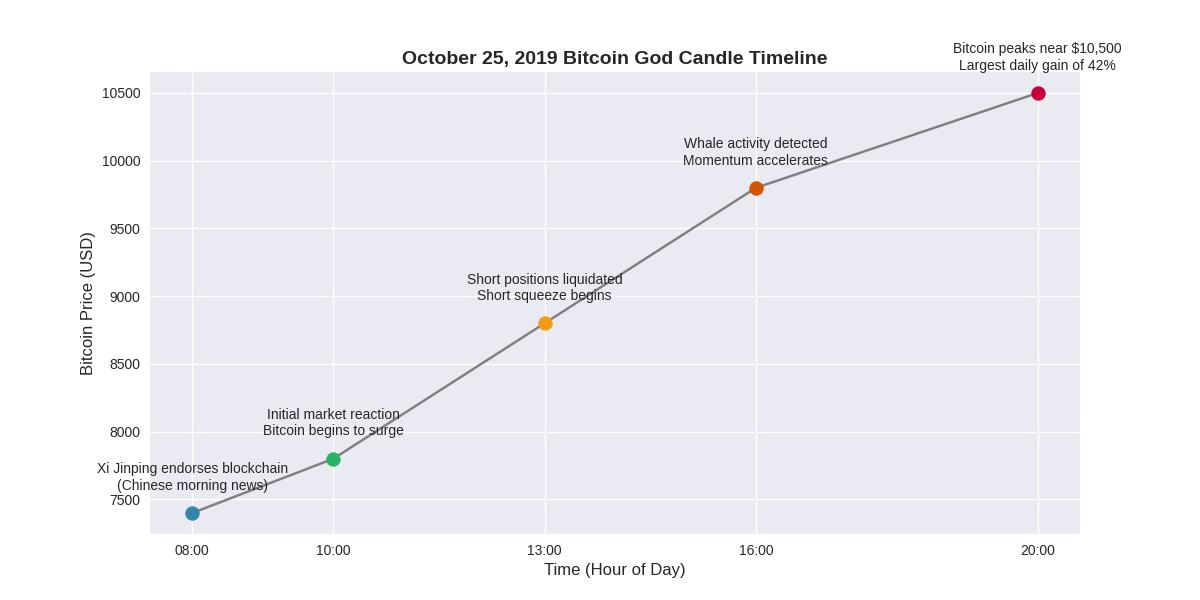
This created a feedback loop as each liquidation pushed prices higher, triggering more liquidations. The result was a vertical price movement, the classic “god candle,” as Bitcoin jumped from around $7,400 to over $10,500 in hours.
Large players (whales) and algorithmic traders likely contributed to the rally. High-volume buys cleared out resistance levels, accelerating the breakout. Once momentum was established, retail traders piled in, further amplifying the surge. The rally was also fueled by low liquidity zones, where even moderate buying pressure can cause exaggerated price moves.
This event is now referred to as the “Xi Pump,” a textbook example of how external political signals, market positioning, and trading mechanics can converge to produce a god candle.
Are God Candles Only Limited to Bitcoin?
No, god candles are not limited to Bitcoin. Altcoins like Ethereum, XRP, and Pi Network have also experienced or are expected to experience the god candles, especially during major events or shifts in sentiment.
While Bitcoin often grabs headlines for its dramatic price moves, altcoins are equally capable of producing the god candles: massive, vertical price surges within a short time frame. These typically occur when multiple bullish factors converge, such as news catalysts, whale activity, and short squeezes.
- Ethereum (ETH): Analysts expect Ethereum to form a God candle due to institutional accumulation post-Merge and potential Ethereum ETF approvals, which could drive demand into the market.
- XRP: Speculation around spot ETF approval and legal clarity has driven XRP to rally sharply in the past. Analysts forecast a potential surge to $10, which could manifest as a God candle.
- Pi Network: Though still emerging, Pi Network is gaining traction. A Binance listing and rising on-chain activity could trigger a dramatic price spike, with targets ranging from $10 to $314, a classic setup for a god candle.
Altcoins are prone to God candles because of their lower market caps. Compared to Bitcoin, altcoins often have thinner liquidity, making them more sensitive to large buy orders. Many altcoins attract retail traders looking for quick gains, which amplifies momentum during bullish news.
A new listing on a major exchange, such as Binance or Coinbase, can instantly boost visibility and demand. Major technical changes, such as Ethereum’s Merge, often lead to renewed investor interest and price spikes.
As a crypto trader, you should look out for;
- Volume spikes: Sudden increases in trading volume often precede God candles.
- News catalysts: Stay informed about regulatory developments, partnerships, and tech upgrades.
- Whale movements: Large wallet activity can signal accumulation before a breakout.
- Short interest: High levels of short positions can set the stage for a short squeeze-driven god candle.
Are God Candles Always Bullish?
While god candles often symbolize explosive upward momentum, they are not always a guaranteed bullish signal. Traders must approach them with caution, as these dramatic price moves can be deceptive, volatile, and even manipulated, especially in crypto markets.
In some cases, God candles do reflect genuine bullish strength:
- Breakout confirmation: A god candle breaking through resistance can validate a trend reversal or continuation.
- Volume-backed surge: When accompanied by high trading volume, it may indicate strong institutional interest or news-driven buying.
- Technical alignment: If the candle aligns with other indicators, such as RSI, MACD, or moving averages, it can support a bullish thesis.
These are the moments when god candles act as reliable signals, but only when supported by a broader market context. However, not all god candles are created equal. In many cases, they are short-lived spikes that trap traders.
A sudden surge may lure traders in, only for the price to reverse sharply, leaving them with losses. In thin markets, whales or bots can artificially inflate prices, creating a false sense of momentum. Similarly, a God candle sparked by hype or rumors may fade quickly once reality sets in. Liquidations and short squeezes can exaggerate price moves, but they don’t always reflect sustainable demand.
Simply put, if a god candle appears without volume, trend support, or clear catalysts, it may be a trap.
Don’t chase the God candles blindly. Wait for confirmation from volume, structure, and follow-through candles. Use stop-losses to protect your capital in case the move reverses. Analyze the context to determine if the candle is part of a larger trend or a standalone spike. Watch for exhaustion, as a god candle at the end of a rally may signal the climax, not the continuation.
God candles are powerful, but they are not infallible. Treat them as signals to investigate, not invitations to jump in.
How to Trade Around a God Candle
God candles can be thrilling to witness, but they are also dangerous if approached recklessly. Instead of chasing hype, smart traders use strategy, tools, and discipline to navigate these volatile moments. Here is how to trade around a god candle effectively:
- Use Technical Tools: Before jumping in, validate the legitimacy of the God candle with reliable indicators. Use volume analysis, as high volume confirms strong participation, while low volume may signal manipulation. Check support/resistance levels to see if the God candle breaks a key level or bounces off one. Overbought RSI or bearish MACD divergence may warn of a reversal. Look for follow-up candles, such as continuation or reversal patterns, to gauge momentum. Use platforms like TradingView or CoinGlass to overlay indicators and track real-time volume.
- Read the Signals: God candles often trigger emotional reactions, but smart traders stay calm. Wait for confirmation and refrain from entering the market during the God candle. Wait for the next few candles to confirm direction. If the God candle breaks resistance, wait for a retest of that level before entering. Avoid FOMO entries as jumping in late often means buying the top. Let the hype settle. Use alerts and watchlists to monitor setups, rather than reacting impulsively.
- Manage Risks: Volatility is high around the God candles, so it is essential to protect your capital with disciplined risk management. Set stop-losses at levels below key support areas or recent lows. Don’t risk more than 1–2% of your capital on a single trade. Avoid leverage unless you are experienced, as it amplifies both gains and losses. Always have an exit plan. Know your profit target and exit strategy before entering the market. Use trailing stops to lock in profits if the move continues.
Stay objective and treat the God candles as signals, not guarantees. Journal your trades to track what worked and what didn’t to refine your strategy. Learn from traps. If you get caught in a reversal, analyze why it happened and adjust your approach next time. Join trading communities or follow analysts who focus on strategy rather than hype.
Risks You Should Be Aware Of
God candles may look like golden opportunities, but chasing them without a plan can be disastrous. These towering price surges often come with hidden dangers that can wipe out gains just as quickly as they appear. Here is what every trader should watch out for:
Sudden Volatility Can Erase Gains
After a God candle, markets often become unstable. Prices may retrace sharply or fluctuate erratically. Fast-moving markets can cause orders to execute at worse prices than expected. If the God candle breaks through resistance but doesn’t establish support, the move may collapse. Don’t assume the momentum will last. Protect profits with stop-losses and avoid entering during peak volatility.
FOMO Leads to Poor Entries
Jumping in after the God candle closes often means buying near the top. FOMO clouds judgment, causing traders to overlook signals and skip thorough analysis. Seeing a significant move can create a false sense of certainty, causing traders to abandon their strategy. To avoid FOMO, always trade with a plan. Let the market settle and look for confirmation before entering.
Over-Leveraging Magnifies Losses
Using leverage during volatile moves can amplify losses if the market reverses. Leveraged positions are vulnerable to sudden drops, which can trigger forced sell-offs. Traders may be forced to add funds or close positions at a loss if the price moves against them. Use leverage cautiously, or not at all, around God candles. Volatility can turn a winning trade into a wipeout.
Stay Grounded
Analyze the setup to see if the God candle is supported by volume, news, or trend. Utilize technical tools to confirm the move using indicators such as RSI, MACD, and moving averages. Know your stop-loss and take-profit levels before entering the market. God candles are signals in crypto markets, not guarantees. Respect the risk, and trade with discipline.
Learn More About Crypto Trading With Dypto Crypto
God candles are just one of the many thrilling and sometimes tricky phenomena in the crypto world. Whether you are fascinated by market psychology, eager to master technical analysis, or simply want to trade smarter, understanding these explosive moves is essential.
At Dypto-Crypto, learning is engaging, practical, and fun. Our platform offers:
- Interactive blogs on trading strategies, market signals, and risk management
- Real-time analysis tools to help you spot opportunities like god candles
- Community support from fellow traders and mentors
Ready to level up your crypto game? Join Dypto-Crypto right now and start your journey toward smarter, more confident trading. Let’s turn hype into strategy, and strategy into success together.
FAQs (Frequently Asked Questions)
Q: Can a god candle appear on lower timeframes like 5-minute or 1-hour charts?
A: Yes, god candles can absolutely appear on lower timeframes like 5-minute or 1-hour charts. These typically reflect sudden surges caused by news, whale activity, or rapid liquidations. While they may not represent long-term trend shifts, they can still trigger short-term volatility and trading opportunities.
Q: Are god candles always a sign of bullish momentum?
A: No, god candles are not always a sign of bullish momentum. While many are large green candles indicating upward price surges, some can be deceptive, especially in low-liquidity or manipulated markets. They may signal a short squeeze, a bull trap, or a temporary spike without sustained follow-through.
Q: How can I spot a potential god candle before it forms?
A: To spot a potential god candle before it forms, watch for rising volume near key support or resistance levels. Monitor whale activity or large buy orders that could trigger a breakout. Look for tightening price action or consolidation zones that often precede explosive moves. News catalysts or macroeconomic shifts can also set the stage. Utilize technical indicators such as RSI, MACD, and Bollinger Bands to confirm the building of momentum.
Q: Is it safe to trade during or after a god candle appears?
A: Trading during or after a God candle can be risky due to heightened volatility and unpredictable price swings. While it may signal strong momentum, entering too early or too late can lead to poor entries or losses. It is safer to wait for confirmation through volume, follow-up candles, or retests of key levels.
Q: Do altcoins experience god candles too?
A: Yes, altcoins can absolutely experience God candles, and often do. Coins like Ethereum, XRP, and Solana have exhibited explosive single-day gains, often triggered by news, exchange listings, or whale activity. Because altcoins typically have lower liquidity and market caps than Bitcoin, they are more sensitive to large buy orders or short squeezes. This makes them prone to dramatic price spikes.
Disclaimer
This article is for educational and information purposes, and should not be considered financial advice. For more information visit our disclaimer page
About the Author