

Liquid restaking is emerging as one of the most transformative ideas in decentralized finance. If liquid staking was the breakthrough that freed stakers from lockups, allowing them to earn rewards while still using their assets in DeFi, then liquid restaking is the next leap forward. It doesn’t just keep your tokens liquid; it also increases their utility by enabling them to secure multiple networks and services simultaneously.
This evolution matters because it shifts staking from a single‑purpose activity into a multi‑layered strategy. With liquid staking, you earn baseline rewards and gain flexibility. With liquid restaking, you extend that flexibility into new domains: shared security for emerging protocols, governance participation, and advanced DeFi integrations. In other words, your assets don’t just sit in one validator; they become part of a broader ecosystem, working harder and opening doors to opportunities that weren’t possible before.
As the DeFi landscape matures, understanding the distinction between liquid staking and liquid restaking is crucial. The two are closely related but differ in functionality, risk, and potential impact. Exploring how they differ sets the stage for grasping why liquid restaking could redefine how users engage with staking, security, and decentralized finance as a whole.
What is Liquid Restaking?
Liquid restaking is a way to earn extra rewards from your staked crypto while keeping your funds flexible and usable. Instead of locking your tokens in one place, liquid restaking lets you “re-stake” them across multiple networks or services, often through special tokens that represent your staked assets.
- Traditional Staking: You lock up your crypto (like ETH) to help secure a blockchain. In return, you earn rewards. But once staked, your tokens are usually stuck and can’t be used elsewhere until you unstake.
- Liquid Restaking: You first stake your crypto, then receive a liquid staking token (LST) that represents your staked position. With liquid restaking, you can use that LST again to secure other protocols or services. This means your staked assets keep working for you in multiple places at once, earning additional rewards without being locked away.
| Feature | Traditional Staking | Liquid Restaking |
| Liquidity | Assets are locked until unstaked | Assets remain usable via liquid staking tokens |
| Rewards | Earn rewards from one blockchain | Earn rewards from multiple networks/services |
| Flexibility | Limited use of staked tokens | Tokens can be redeployed in DeFi apps |
| Risk | Lower, tied to one network | Higher, since securing multiple networks increases the chances of penalties (slashing) |
Liquid staking is unique because your crypto isn’t just sitting idle; it is working in more than one place at the same time. You can stack rewards from different protocols, and liquid restaking tokens can be traded, lent, or used in DeFi apps, making staking more dynamic and versatile.
How Liquid Restaking Works
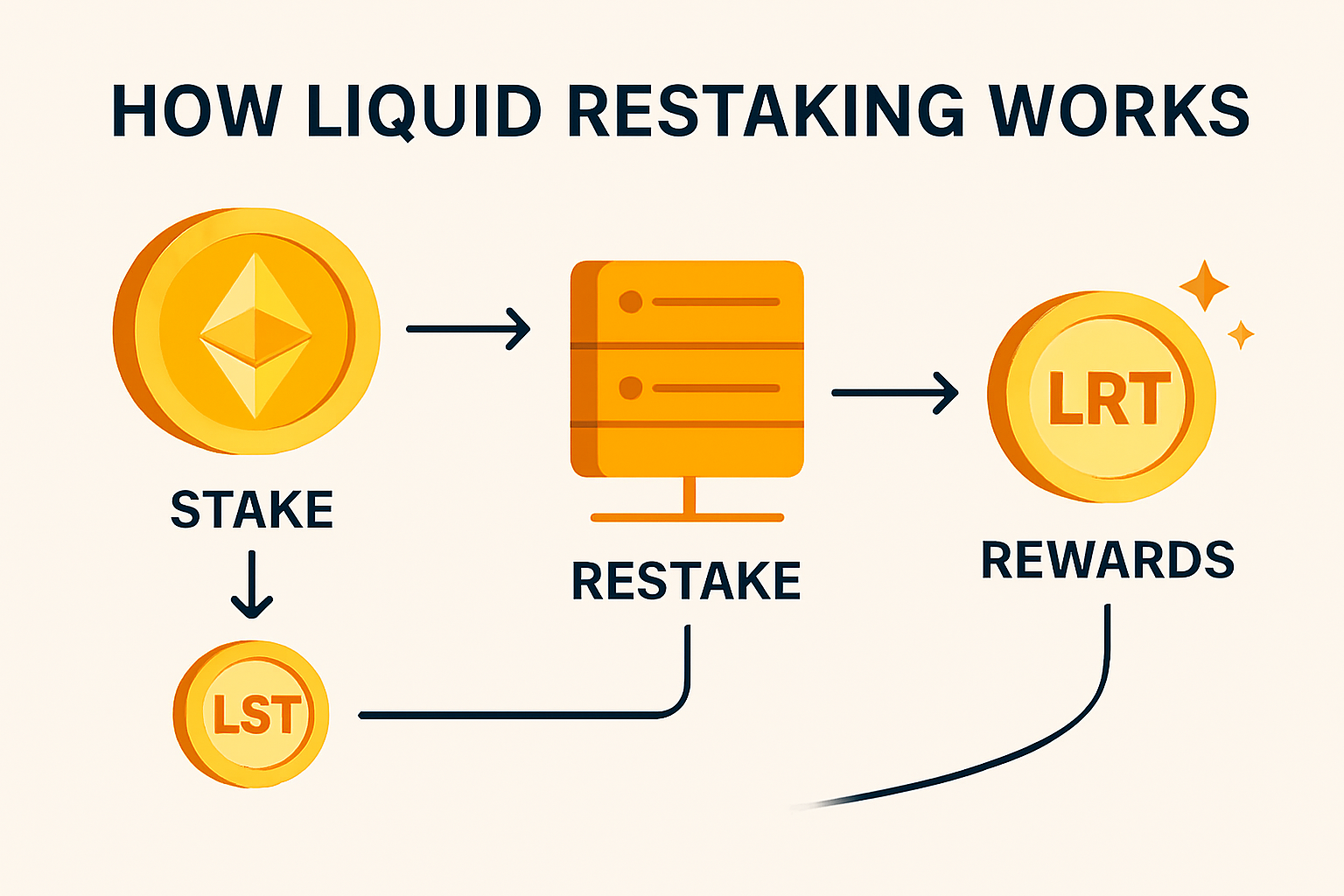
Here is the simple, end‑to‑end flow, from holding LSTs to earning LRTs and stacking rewards.
- Stake base asset: You stake a token (e.g., ETH) with a liquid staking provider.
- Receive LST (your “receipt”): You get a liquid staking token (LST) that represents your staked position and accrues staking rewards.
- Deposit LST into a restaking protocol: You send the LST to a restaking protocol that uses your staked security to help secure additional services or networks.
- Receive LRT (restaking receipt): The protocol issues a liquid restaking token (LRT) to you, representing your restaked position and its additional reward stream.
- Use LRT in DeFi for more yield: You can supply, borrow, LP, or stake the LRT in DeFi apps to earn additional rewards on top of your base staking yield.
- Rewards accrue in layers: Base rewards from the original stake (tracked by your LST). Restaking rewards from the restaking protocol (tracked by your LRT). DeFi rewards from whatever you do with the LRT (e.g., lending or LP fees).
Liquid Restaking vs Liquid Staking: What are the Differences?
| Attribute | Liquid Staking (LSTs) | Liquid Restaking (LRTs) |
| Core Function | Stake a base asset (e.g., ETH) and receive a transferable “receipt” token that accrues network staking rewards. | Deposit staked ETH or LSTs into a restaking protocol to secure additional services/networks and receive a new “receipt” token for those restaked positions. |
| Receipt Token | LST (e.g., stETH, rETH) represents staked ETH plus baseline staking rewards. | LRT represents a restaked position and its additional reward streams/incentives. |
| Reward Sources | Potential rewards come from the underlying PoS network (baseline staking yield). | Potential rewards stack: baseline staking yield + restaking incentives from securing extra services + any DeFi strategy yield using the LRT. Extra rewards usually mean extra risk. |
| Input Asset | Typically, native ETH (or the chain’s base token). | LSTs or staked ETH routed to a restaking protocol; some designs accept multiple LSTs. |
| Primary Use Cases | Liquidity for stakers, DeFi composability (collateral, LPs, lending) while maintaining staking exposure. | Extending security to additional networks/services (AVSs), yield stacking, and advanced DeFi strategies built on LRTs/LST-Fi. |
| Risk Profile | Exposure to validator performance, LST peg/liquidity, and protocol risk. | All of the above plus restaking-specific risks (slashing/penalties across more services, coordination risks, and layered protocol dependencies). |
Underlying Asset: What You Deposit
Liquid staking (LSTs): Typically, ETH is staked via a liquid staking protocol. You receive an LST that tracks your staked position and rewards. This keeps exposure simple, one network, one reward stream, while adding liquidity.
Liquid restaking (LRTs): Your staked ETH or LSTs are deposited into a restaking protocol. That protocol reuses your staked security to help secure additional services or networks, issuing an LRT in return. Because you’re now securing more than one system, flexibility increases, but so can risk.
The input asset shapes both flexibility (LSTs/LRTs are transferable and usable in DeFi) and risk (restaking adds layers, more points at which performance, slashing, or liquidity can affect outcomes).
Receipt Tokens: LST vs LRT
LST (Liquid Staking Token): It represents ownership of staked ETH plus accrued staking rewards. It is transferable, tradable, and widely integrated across DeFi (collateral, LPs, lending).
LRT (Liquid Restaking Token): It represents a restaked position that secures additional services/networks beyond Ethereum’s base layer. It has a similar composability to LSTs, but often aimed at strategies that capture restaking incentives and LST‑Fi opportunities; complexity and dependency chains are higher.
Reward Streams: Where the Yield Comes From
Liquid staking (baseline): Potential rewards come from the PoS network’s staking yield (validator performance, network issuance/fees). This is the foundational return tracked by your LST.
Liquid restaking (stacked): Potential rewards add layers: baseline staking yield + restaking incentives for securing additional services (sometimes called AVSs) + any DeFi yields earned by deploying the LRT (e.g., lending, LP fees). Extra rewards usually mean extra risk because you are exposed to more protocols, slashing domains, and market dynamics.
Liquidity and Redemptions: How You Exit
Liquid staking: Unstaking/redemption depends on the protocol. Some offer native withdrawal queues, while others rely on secondary-market liquidity (selling LST). LST prices can deviate from their reference value (peg) if withdrawal queues are long or liquidity thins, affecting exit costs.
Liquid restaking: For unstaking/redemption, you may need to unwind the restaking position (redeem LRT → reclaim LST → exit base staking), or sell the LRT/LST on secondary markets. Multiple layers can amplify liquidity risk; if either the LRT market, the underlying LST market, or the restaking protocol’s redemption path is congested, exits can be slower or at a discount.
DeFi Utility: How Each Token Is Used On-Chain
LSTs: Typical uses include collateral in lending markets, LP positions, structured yield strategies, and portfolio rebalancing while maintaining staking exposure. It works because LSTs are widely integrated and relatively straightforward, with a single reward source and broad DeFi support.
LRTs: Typical uses include similar DeFi primitives plus strategies designed to capture restaking incentives (e.g., LST‑Fi aggregators, structured products). More strategies and potential yield, but higher complexity, dependency chains, and liquidation/slashing risk if underlying services or validators underperform.
Benefits of Liquid Restaking
Liquid restaking offers enhanced capital efficiency, layered rewards, and greater flexibility for stakers, making it a powerful evolution of traditional staking. Its key benefits include;
- Capital Efficiency: Restaking lets users reuse staked assets (like ETH or LSTs) to secure multiple networks or services. This maximizes the utility of idle capital without requiring additional deposits.
- Layered Rewards: Users earn baseline staking rewards from the original network (e.g., Ethereum). On top of that, they receive restaking incentives from protocols or services secured by their restaked assets. Some platforms also offer DeFi yield by deploying LRTs in lending, LPs, or structured products.
- Liquidity via LRTs: Liquid restaking tokens (LRTs) represent restaked positions and are transferable. This means users can trade, lend, or use them in DeFi while still earning restaking rewards.
- Expanded Network Security: Restaked assets help secure additional services (AVSs), improving decentralization and resilience across the ecosystem. This benefits both stakers and the protocols they support.
- Composability in DeFi: LRTs can be used in advanced DeFi strategies, such as collateral, LPs, and structured yield products, to unlock new ways to earn. This makes restaking a gateway to more sophisticated on-chain financial tools.
- Protocol Incentives and Airdrops: Many restaking platforms offer bonus incentives, points, or airdrop eligibility for early adopters and active participants. These can significantly boost returns beyond standard staking yields.
- Modular Risk Management: Users can choose which services to restake into, tailoring their exposure and risk profile. Some protocols offer slashing protection or diversified validator sets to reduce risk.
Risks & Challenges to Consider
Here is a balanced breakdown of the risks and challenges that come with liquid restaking. While the potential rewards are attractive, participants should weigh these carefully before diving in:
- Technical Risks (Validator & Protocol Performance): Restaking extends validator responsibilities across multiple services. Poor performance or misbehavior can lead to slashing penalties. Bugs or vulnerabilities in restaking protocols may expose funds to smart contract exploits.
- Financial Risks (Liquidity & Market Stress): LRTs may lose their peg or trade at a discount during market stress, making exits costly. Unstaking often requires multiple steps (LRT → LST → base asset), which can be slow and unpredictable. Extra reward streams can amplify exposure to market swings, especially when LRTs are used in leveraged DeFi strategies.
- Systemic Risks (Layered Dependencies): Restaking ties your assets to multiple networks/services. If one fails, it can ripple across the ecosystem. Misalignment between validators, restaking protocols, and AVSs (Actively Validated Services) can destabilize the system. If too much capital flows into a few restaking platforms, systemic vulnerabilities increase.
- Regulatory & Governance Risks: Restaking is new and evolving, as uncertain regulatory treatment could affect participation or liquidity. Governance decisions (protocol upgrades, slashing rules, reward distribution) may unexpectedly affect stakers.
- Complexity & User Error: Managing LSTs, LRTs, and layered DeFi strategies requires advanced knowledge. Mistakes in deployment or risk management can lead to losses. Early adopters may benefit more, while newcomers face steeper learning curves.
- Yield vs. Risk Trade-off: Extra rewards come with extra risk, exposing you to slashing, liquidity challenges, and systemic dependencies. Over-optimizing for yield without proper risk controls can erode capital rather than grow it.
Liquid restaking multiplies both opportunity and risk. It is best suited for participants who understand validator mechanics and DeFi strategies, are comfortable with layered risk exposure, and have a liquidity management plan and downside protection measures in place.
Real-World Use Cases for Liquid Restaking Beyond Yield
Liquid restaking isn’t just about chasing higher yields. It also unlocks structural and ecosystem-level benefits that go beyond pure profit. Here are the top real-world use cases worth highlighting:
- Strengthening Security for Emerging Protocols: Restaked assets can be used to secure Actively Validated Services (AVSs) such as oracle networks, bridges, or rollups. This provides smaller or newer protocols with access to Ethereum’s validator set, improving their resilience without needing to bootstrap their own security. This expands trust and decentralization across the ecosystem.
- Shared Security Infrastructure: Liquid restaking creates a shared security layer in which multiple services rely on a single pool of staked assets. This reduces duplication of validator networks and makes the system more efficient. This also helps scale Web3 by lowering the barrier to launching new projects securely.
- Governance Participation & Voting Power: LRTs can be used in governance systems, enabling holders to influence protocol decisions. This extends beyond yield, as users can shape the rules, upgrades, and risk parameters of restaking protocols or AVSs. This also encourages active community involvement and decentralized decision-making.
- Liquidity & Market Access: LRTs provide tradable exposure to restaked positions, allowing users to enter or exit without waiting for long unstaking periods. This improves market efficiency and makes restaking positions more accessible to a wider audience. This also enhances flexibility and accessibility for institutional and retail participants.
- Innovation in DeFi Composability: Beyond yield, LRTs serve as building blocks for new financial products, including structured risk hedging, insurance pools, and cross-chain collateral systems. Developers can design novel applications that leverage the unique properties of restaked assets. This sparks innovation in DeFi beyond simple lending or farming.
How to Get Started with Liquid Restaking
Liquid restaking may sound complex, but the onboarding process can be broken down into clear, manageable steps. At its core, you begin by staking your crypto with a trusted liquid staking provider, then move those liquid staking tokens (LSTs) into a restaking protocol to earn additional rewards. In return, you receive liquid restaking tokens (LRTs), which can be used across DeFi applications.
By following a structured path, choosing the right LST, selecting a secure restaking platform, depositing your tokens, and managing your LRTs, you can participate in this new layer of decentralized finance with confidence.
Choose a Liquid Staking Token (stETH, rETH, etc.)
The first step in liquid restaking is to obtain a liquid staking token (LST). These tokens are issued by established providers such as Lido (stETH), Rocket Pool (rETH), or Coinbase (cbETH). When you stake ETH through these platforms, you receive an LST that represents your staked position and accrues rewards from Ethereum’s proof-of-stake system. Choosing a trusted LST is critical because it determines the reliability of your base staking rewards and the liquidity of your position. Well-integrated LSTs like stETH and rETH are widely accepted across DeFi, making them easier to trade, lend, or use as collateral.
Beginners should prioritize providers with strong reputations, transparent governance, and deep liquidity pools, as these factors help mitigate risks such as de-pegging or redemption delays. In short, selecting the right LST sets the foundation for a smooth restaking journey.
Pick a Liquid Restaking Protocol (e.g., EigenLayer)
Once you hold an LST, the next step is to choose a liquid restaking protocol. EigenLayer is currently the most prominent option, allowing users to deposit LSTs and extend Ethereum’s security to additional services known as Actively Validated Services (AVSs). When evaluating a protocol, consider three main factors: supported LSTs, yield models, and security guarantees. Some platforms may only accept specific LSTs, so compatibility matters. Yield models differ, as some offer direct rewards, while others provide points or incentives that may later convert into tokens or airdrops.
Security is equally important, as restaking exposes your assets to slashing risks across multiple networks. Look for protocols with transparent validator sets, strong community governance, and clear slashing protection mechanisms. By carefully selecting a restaking platform, you ensure that your assets not only earn additional rewards but also contribute to the broader security of decentralized infrastructure.
Deposit and Restake Your LSTs
After choosing a protocol, you’ll deposit your LSTs into its smart contracts to begin the restaking process. This step is straightforward: connect your wallet, select the amount of LST you want to restake, and confirm the transaction. Once deposited, the protocol uses your staked assets to secure additional services, effectively layering your staking exposure. In return, you receive liquid restaking tokens (LRTs), which represent your restaked position. At this stage, it is important to understand the risks, as your assets are now tied to multiple networks, meaning slashing or performance issues in one service could affect your rewards.
Most platforms provide dashboards that let you track your deposits, validator performance, and accrued rewards. The deposit process is designed to be user-friendly, but participants should always double-check contract addresses and protocol documentation to avoid mistakes. Restaking transforms your LSTs from a passive yield instrument into an active tool securing multiple layers of the ecosystem.
Claim and Manage Your LRTs in DeFi
Once your LSTs are restaked, you will receive liquid restaking tokens (LRTs). These tokens act as receipts for your restaked position and open the door to additional opportunities in DeFi. You can hold LRTs to passively accrue rewards, or actively deploy them in lending markets, liquidity pools, or structured yield strategies. Managing LRTs requires careful monitoring, as their value can fluctuate based on protocol incentives, market demand, and liquidity conditions. Many platforms provide dashboards to track your rewards, validator performance, and potential slashing risks.
Beyond yield, LRTs can also be used as collateral in borrowing protocols or traded on secondary markets, giving you flexibility to exit or rebalance your portfolio. However, with greater utility comes greater complexity, as users must be mindful of liquidation risks, market volatility, and layered dependencies across protocols. By actively managing LRTs, you can maximize opportunities while maintaining control over your exposure in the evolving restaking ecosystem.
Top Liquid Restaking Protocols to Choose From
Here is a list of leading liquid restaking protocols you can explore today. These platforms are built on top of EigenLayer or similar frameworks and offer different approaches to restaking ETH and LSTs.
1. EigenLayer – https://www.eigenlayer.xyz
- The pioneer of restaking, EigenLayer, enables ETH stakers and LST holders to “re-stake” their assets to secure Actively Validated Services (AVSs) such as oracles, bridges, and rollups.
- Key strength: Shared security model that extends Ethereum’s validator set to new protocols.
- Use case: Foundation layer for most liquid restaking strategies.
2. Ether.fi – https://ether.fi
- A decentralized liquid staking platform that integrates directly with EigenLayer for restaking.
- Key strength: Non-custodial staking with user-controlled keys, plus restaking rewards.
- Use case: Ideal for users who want both liquid staking exposure and restaking incentives.
3. Renzo Protocol – https://www.renzoprotocol.com
- A restaking hub designed to simplify access to EigenLayer. Users deposit ETH or LSTs and receive ezETH, a liquid restaking token.
- Key strength: Easy onboarding with a single token (ezETH) representing restaked positions.
- Use case: Beginner-friendly entry point into liquid restaking.
4. Puffer Finance – https://puffer.fi
- Focuses on decentralized validator infrastructure and integrates with EigenLayer for restaking.
- Key strength: Validator decentralization and slashing protection mechanisms.
- Use case: Appeals to users concerned about validator concentration and network resilience.
5. Kelp DAO – https://kelpdao.xyz
- A DAO-driven liquid restaking protocol that issues rsETH as its liquid restaking token.
- Key strength: Community governance and diversified validator sets.
- Use case: Suitable for users who value DAO participation and governance influence.
6. Mellow Protocol (Mellow LRT) – https://mellow.finance
- Offers structured vaults for liquid restaking, allowing users to choose different risk/reward strategies.
- Key strength: Customizable vaults that cater to varying risk appetites.
- Use case: Advanced users seeking tailored exposure to restaking rewards.
7. Symbiotic – https://symbiotic.fi
- A newer entrant offering modular restaking infrastructure, similar to EigenLayer but with more flexibility for different asset types.
- Key strength: Expands restaking beyond ETH, aiming for multi-chain applicability.
- Use case: For users interested in cross-chain restaking opportunities.
Final Thoughts
Liquid restaking represents one of the most exciting evolutions in the staking and DeFi ecosystem. By allowing stakers to reuse their assets across multiple networks, it unlocks capital efficiency, layered rewards, and deeper integration with DeFi applications. Through liquid staking tokens (LSTs) and liquid restaking tokens (LRTs), users gain flexibility to participate in governance, collateral strategies, and shared security models, all while keeping their assets liquid and composable.
That said, the opportunities come with real risks: slashing exposure across multiple services, liquidity challenges during market stress, and the complexity of managing layered dependencies. Participants should approach liquid restaking with a clear understanding of these trade-offs, balancing the pursuit of higher yields and ecosystem participation against the need for risk management and long-term sustainability.
Looking ahead, liquid restaking has the potential to become a foundational layer of Web3 infrastructure, powering decentralized services, strengthening shared security, and sparking innovation in DeFi beyond yield farming. As protocols mature and risk frameworks improve, liquid restaking could redefine how users interact with staking, governance, and decentralized finance, making it not just a yield strategy but a cornerstone of the next generation of blockchain participation.
Frequently Asked Questions
Are liquid restaking protocols safe to use?
Liquid restaking protocols offer innovative opportunities but carry risks like slashing, liquidity stress, and smart contract vulnerabilities. They are relatively new, so safety depends on the protocol’s design, validator performance, and user risk management. Always research thoroughly and diversify before committing significant funds.
How do I earn rewards from liquid restaking?
You earn rewards from liquid restaking by depositing liquid staking tokens (LSTs) into a restaking protocol. In return, you receive liquid restaking tokens (LRTs), which accrue baseline staking rewards plus additional incentives from securing extra services. Using LRTs in DeFi can further boost potential yields.
Can I use LRTs in other DeFi platforms?
Yes, liquid restaking tokens (LRTs) can be used across many DeFi platforms. They function like liquid staking tokens, enabling lending, trading, collateralization, and liquidity provision. However, integration varies by protocol, and using LRTs in complex strategies may increase risks such as liquidation or market volatility.
Which platforms support liquid restaking right now?
Currently, liquid restaking is supported by platforms like EigenLayer, Ether.fi, Renzo Protocol, Kelp DAO, Puffer Finance, Mellow Protocol, and Symbiotic. These protocols allow users to restake ETH or LSTs, earn additional rewards, and access DeFi integrations, each offering unique features and risk profiles.
Can liquid restaking be slashed like regular staking?
Yes, liquid restaking can be slashed like regular staking. Since restaked assets secure multiple services, validator misbehavior or poor performance across any supported network may trigger slashing penalties. This layered exposure increases risk compared to traditional staking, making careful protocol selection and validator trust essential.
Disclaimer
This article is for educational and information purposes, and should not be considered financial advice. For more information visit our disclaimer page
About the Author