
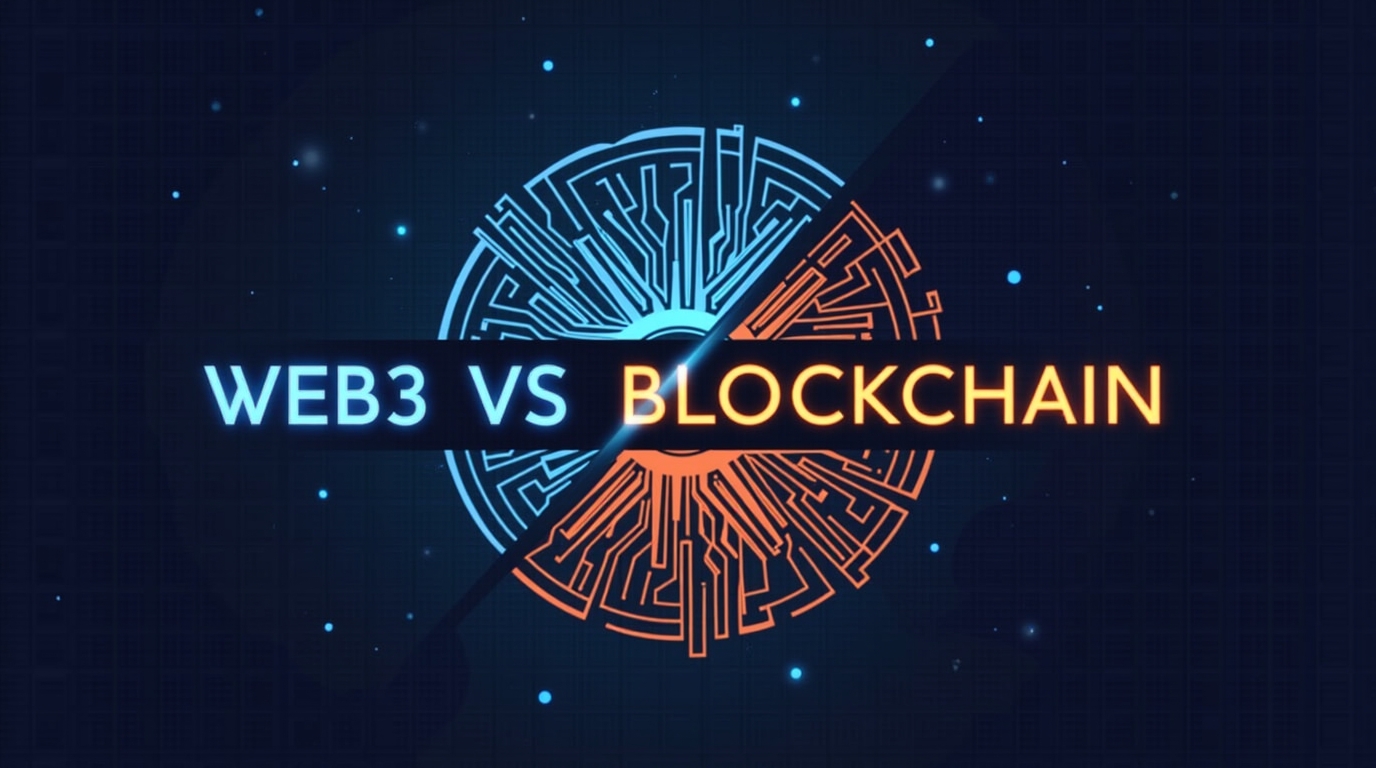
Did you know the global blockchain market is expected to grow from USD 32.69 billion (2024) to more than USD 162 billion (2027)? That rapid expansion underscores how foundational ledger technologies are becoming across industries, yet even though companies invest heavily, many still struggle to distinguish between blockchain and Web3.
While these terms are often used interchangeably but they occupy different layers of the digital stack. Blockchain is the underlying distributed ledger, providing immutability, transparency, and consensus. Web3 is the broader vision of a decentralized, user-centric internet built on top of that ledger infrastructure, incorporating dApps, tokens, and new governance models. As digital transformation accelerates, business leader demands clarity on how these technologies differ to build SaaS solutions, enterprise platforms, or ecosystem strategies.
What Is Blockchain?
Blockchain is a distributed digital ledger that securely records transactions across a network of computers. Instead of depending on a single central authority, every participant in the network holds a synchronized copy of the ledger. Each transaction is grouped into a “block” that is cryptographically linked to the previous one, forming an immutable chain of records. Because the ledger has shared access among participants, it lacks a central authority to control it, making the system resistant to tampering or data loss.
The technology relies on a consensus mechanism to validate transactions, meaning all network members must agree on the accuracy of the data before it is recorded in the ledger. This consensus ensures trust without intermediaries, making blockchain effective for applications such as financial settlements, supply chain tracking, and data verification. After a transaction is recorded, it cannot be altered in subsequent blocks, prioritizing security and transparency.
Blockchain types differ based on permissions and governance models. Each type serves a unique purpose, depending on the required balance between decentralization, privacy, and scalability.
Types of Blockchains:
- Public Blockchain: Openly accessible to anyone for participation and validation. The examples include Bitcoin and Ethereum, which allow any user to join the network, verify transactions, or build applications.
- Private Blockchain: Restricted to specific participants managed by an organization. Examples include Hyperledger Fabric and R3 Corda, used for internal business operations or enterprise data management.
- Consortium Blockchain: Controlled by a group of organizations rather than a single entity. The example includes Energy Web Foundation, where multiple companies share governance to track and verify energy transactions.
- Hybrid Blockchain: Combines elements of public and private models to offer transparency and controlled access. The example includes Dragonchain, which allows businesses to keep sensitive data private while using public verification for security.
What Is Web3?
Web3 is an evolution of the internet where users gain control over their data, digital assets, identity, and interactions. This model uses decentralized ledger technologies, such as blockchain, as its foundational infrastructure. Web3 focuses on moving beyond the traditional Web2 architecture by leveraging concepts such as trustless interactions, tokenized ownership, and community governance in how services are built and consumed.
The Web3 architecture comprises the following components and principles that enable members to engage as co-owners of the network rather than mere users.
Web3 Components:
- Decentralized Applications: These apps run on decentralized networks or blockchains, using smart contracts to execute logic without relying on central servers.
- Decentralized Autonomous Organizations: Organizations governed by smart contracts and community decision-making, and often use tokens for voting or governance rights.
- Tokens: Digital assets that represent value, rights, or access in the Web3 ecosystem. They serve as economic incentives, governance tools, and mechanisms of ownership.
- Decentralized Identity/Self-Sovereign Identity: Systems where users hold and control their digital identity through cryptographic keys, decide data sharing strategy, and avoid depending on centralized identity providers.
Guiding Principles of Web3
Web3 is built on decentralization, reducing reliance on centralized service providers and distributing control among network members. It promotes user sovereignty, ensuring each member can own and transfer digital value without platform restrictions. Transparency and verifiable security are achieved through blockchain-based trust, while interoperability supports seamless movement of data and assets across different networks. These princes work together to create an open, permissionless, and user-empowered internet.
Web3 vs. Blockchain: How Are These Different?
Blockchain and Web3 are closely related, but both serve different purposes within the decentralized technology landscape. Blockchain serves as the core infrastructure: a distributed ledger that securely and transparently records transactions through a consensus mechanism. Web3 is built on the blockchain foundation to create a platform of decentralized applications, governance models, and identity systems focused on reshaping how users interact with the internet.
While blockchain provides data validation and immutability, Web3 extends its use to practical, interactive applications such as DeFi, NFTs, and DAOs. The relationship between the two can be understood as infrastructure and interface: blockchain ensures trust and security, while Web3 converts that trust into user autonomy, interoperability, and new economic models.
Scope and Definition
Blockchain is the underlying distributed ledger technology that records transactions in cryptographically linked chains and provides guarantees such as immutability and consensus-based validation. Web3 is the broader idea of a decentralized internet ecosystem built on ledger technologies that prioritize user autonomy, wallet-based identity, and applications that minimize reliance on centralized intermediaries.
Technical Architecture
A blockchain implementation functions primarily as a ledger and a consensus layer, where nodes validate and store state changes; smart contracts add programmable logic to this layer. The Web3 architecture comprises multiple layers, including ledger/consensus, smart contract logic, decentralized storage and indexing, and user-facing dApp front ends. All these layers merge to form interactive ecosystems rather than a single record-keeping layer.
Governance and Tokenomics
Protocol governance for a blockchain focuses on consensus rules, validator incentives, and network-level protocol upgrades. Web3 governance commonly uses DAOs and governance tokens to enable application-level and community-level decision-making, allowing token holders to participate in funding, parameter changes, and roadmap priorities.
Data Ownership and Privacy
A public blockchain provides transparent, unaltered records, with transaction history visible on-chain and immutability preserving audit trails. Web3, on the other hand, extends ownership concepts through wallet-based identities and self-sovereign identity patterns, enabling users to control which credentials or data they expose and which they keep private, keeping data off-chain while using proofs on-chain.
Interoperability and Ecosystem
Many individual blockchains work as separate networks with their own state and token standards. Web3 approaches prioritize cross-chain interoperability and composability through bridges, decentralized storage, indexing layers, and off-chain protocols that connect multiple layers and services, enabling applications to combine capabilities across different networks.
Blockchain and Web3 Interdependence: Can One Exist Without the Other?
Blockchain and Web3 are closely related but function at different levels. A blockchain operates independently as a secure, distributed ledger that stores and verifies transactions without intermediaries. This structure serves as the foundation for cryptocurrencies like Bitcoin that use blockchain solely for peer-to-peer value transfer and data immutability, without supporting interactive or programmable applications. This means that the blockchain technology can exist without Web3 to build a trustless system that offers transparent recordkeeping and verification.
However, Web3 depends on blockchain technology to deliver its decentralized vision. It uses the blockchain’s trustless infrastructure to power smart contracts, dApps, and a tokenized ecosystem, thereby removing dependencies on centralized authorities. Without blockchain’s consensus mechanism and immutable data storage, Web3 would lose the security, transparency, and ownership claims. Therefore, the clear distinction is that blockchain provides the foundation for trust and validation, while Web3 builds an interactive, user-controlled internet experience on top of it.
How Web2 Transitions to Web3 (And Where Blockchain Fits)
Web2 represents the current centralized internet, where data, identity, and content are managed by platforms such as Facebook, Google Docs, and YouTube. These platforms control user information, content storage, and monetization through proprietary servers and algorithms. The ownership of user data, identity, and digital assets is with the service provider, meaning users depend on the company’s infrastructure and policies to access or share their information.
Web3 introduces a decentralized model that removes intermediaries using blockchain-based frameworks. So, instead of storing information on a centralized server, the data in Web3 applications is distributed across peer-to-peer networks. This setup ensures that user can get direct control over their digital identities, data, and content. Wallet-based authentication replaces username-password systems, giving users individual, verifiable, and portable ownership of their digital presence.
Blockchain serves as the foundational trust layer in this transaction. It records every transaction, content update, or ownership change on an immutable ledger, ensuring transparency and verifiability without relying on a single authority. Actions such as publishing, sharing, or monetizing content are executed automatically by smart contracts. This decentralized structure enables a permissionless environment that preserves ownership and data integrity.
Conclusion
This dynamic crypto world requires you to partner with someone who simplifies complex concepts and supports your growth, and Dypto Crypto is built precisely for this purpose. Dypto Crypto is an educational platform designed to help users at all skill levels navigate the changing world of crypto, decentralized finance, and blockchain technology.
If you’re aiming to strengthen your crypto concepts or sharpen your understanding of decentralized assets, sign up to Dypto today and explore the diverse courses offered, newsletters, and curated insights to help you start your journey today!
FAQs (Frequently Asked Questions)
Q: Is Web3 the same as blockchain?
No. Blockchain is the foundational technology that records and secures data through distributed ledgers, while Web3 uses it to build user-centric applications and ecosystems on top.
Q: Do I need to learn blockchain before using Web3 apps?
No. Most Web3 applications are designed with user-friendly interfaces that hide the complexity of blockchain technology. But you still need to have an understanding of blockchain fundamentals like wallets, transactions, and smart contracts to enhance user experience and decision-making.
Q: What are the main governance differences between a blockchain and a Web3 ecosystem?
Blockchain governance focuses on network maintenance, protocol upgrades, and validator consensus at the infrastructure level. Web3 governance, on the other hand, operates through DAOs and token-based voting, giving communities direct control over platform decisions and development.
Q: Why are blockchain and Web3 often confused with each other?
Both are closely linked, as Web3 relies on blockchain for transparency, security, and decentralization. The overlap in their use within a decentralized system often leads to confusion, even though blockchain is the foundation and Web3 shows the user-facing evolution built on it.
Disclaimer
This article is for educational and information purposes, and should not be considered financial advice. For more information visit our disclaimer page
About the Author