
In the wild world of crypto, where prices can swing 10% in a single hour, and markets never sleep, traders need tools that cut through the chaos. Moving averages are among the most trusted indicators because they simplify noisy price action into clear, actionable trends. But not all moving averages behave the same.
The Exponential Moving Average (EMA) is designed for speed: it reacts quickly to new data, making it a favorite among short-term traders chasing momentum. The Simple Moving Average (SMA), on the other hand, values stability by smoothing volatility and lagging price action, giving long-term traders confidence in the bigger trend.
This blog will break down EMA vs SMA from a crypto trader’s perspective, showing you when faster signals matter, when stability is more valuable, and how to align each tool with your trading style. Expect practical insights, real-world examples, and clear takeaways you can apply directly to your charts.
What Is EMA (Exponential Moving Average)?
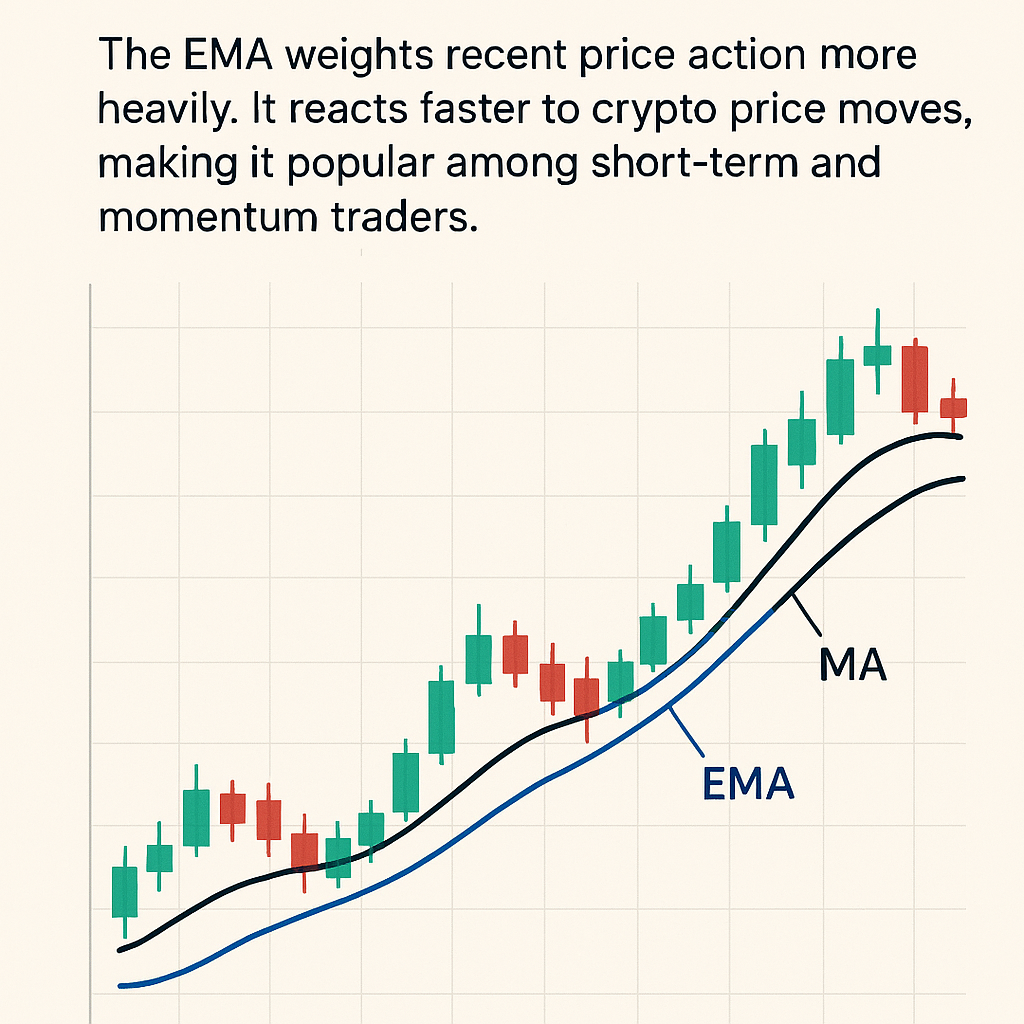
The EMA is a moving average that assigns greater weight to recent prices than to older ones. EMA is important because it reflects the most recent price action. EMA reacts faster to market moves than a Simple Moving Average (SMA).
The Exponential Moving Average (EMA) reacts more quickly to price changes because it assigns greater weight to recent price data than to older data. This weighting system allows the EMA to adjust quickly when the market shifts direction, making it more responsive to short-term volatility and momentum.
Unlike the Simple Moving Average (SMA), which smooths out price movements by treating all data points equally, the EMA prioritizes the latest price action. This speed and sensitivity make it a preferred tool for traders who require timely signals, especially in fast-moving markets such as cryptocurrency, where reacting quickly can mean the difference between profit and loss.
Traders love EMA because;
- Momentum traders: Use EMA to catch fast moves early.
- Scalpers & day traders: Rely on EMA for quick entries/exits.
- Crypto traders: Since crypto is highly volatile, the EMA is better at tracking rapid price swings than the SMA.
What Is SMA (Simple Moving Average)?
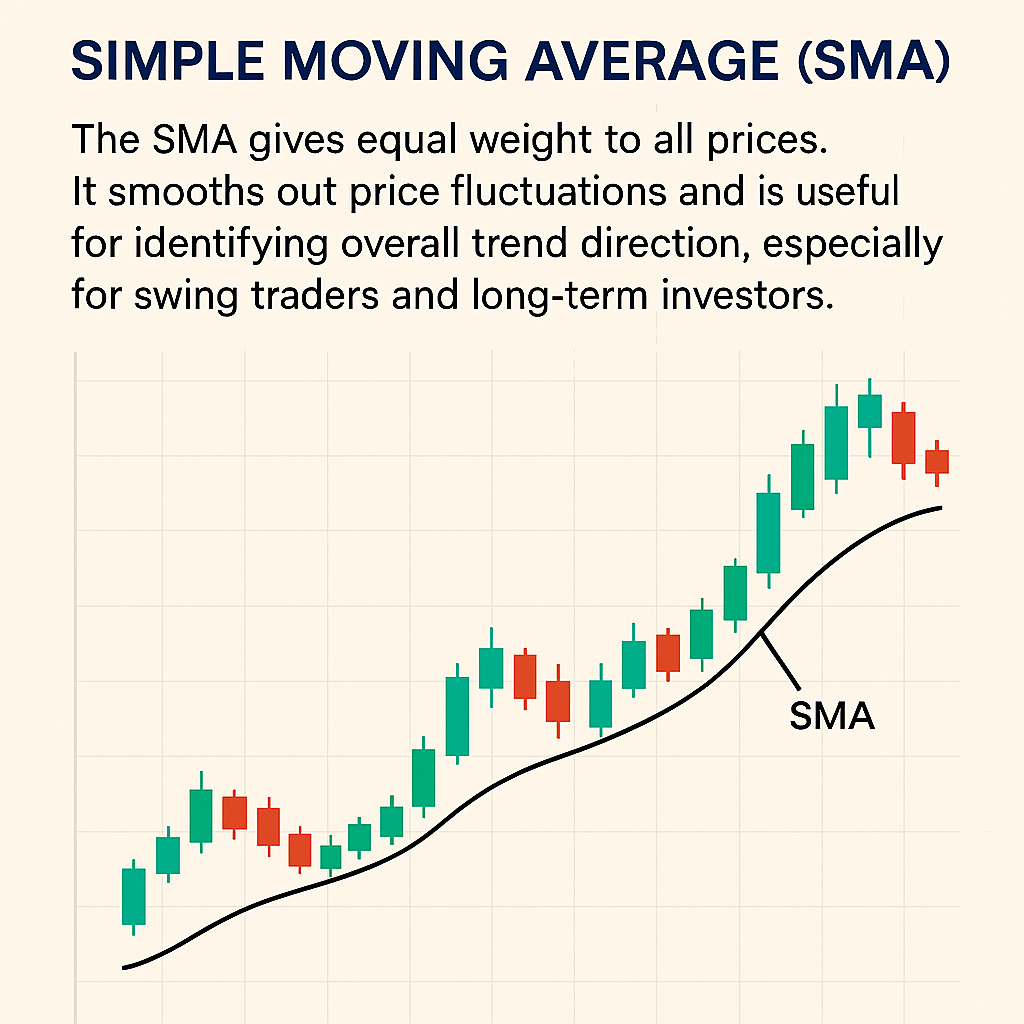
SMA is a technical indicator that shows the average price of a cryptocurrency over a set period, such as 10 or 50 days. It assigns equal weight to each day’s price, smoothing out short-term fluctuations. SMA is smooth and steady because;
- SMA doesn’t react to sudden price spikes or dips.
- It creates a gentle curve that helps traders discern the overall market direction.
- This makes it ideal for spotting long-term trends rather than short-term noise.
The Simple Moving Average (SMA) is widely used by swing traders and long-term crypto investors who prioritize trend clarity over short-term volatility. Swing traders rely on SMA to identify broader price movements and time their entries and exits with greater confidence.
Long-term investors use it to confirm the overall market direction, helping them stay focused on macro trends rather than reacting to daily price noise. Because SMA smooths out fluctuations and provides a steady view of price behavior, it is a trusted tool for those who value patience, strategy, and long-term positioning.
Why EMA and SMA Behave Differently in Crypto Markets
Crypto markets are nonstop, volatile, and news-sensitive, which makes moving averages behave differently than in traditional markets. Their key structural traits include;
- 24/7 trading: No market close means price action never pauses, and momentum shifts can happen anytime.
- High volatility: Sudden spikes and drops are common, driven by whales, liquidations, or sentiment shifts.
- News-driven swings: Tweets, hacks, regulations, and macro headlines can trigger instant price moves.
- Liquidity gaps: Thin order books on some exchanges lead to exaggerated price movements.
EMA is fast, reactive, and momentum-friendly. It;
- Weighs recent prices more → reacts quickly to sudden moves.
- Adapts to volatility → ideal for catching breakouts, reversals, and momentum surges.
- Favored by short-term traders → scalpers, day traders, and algo strategies use EMA to stay ahead of price shifts.
For example, after a bullish tweet or whale buy, EMA curves upward faster than SMA, signaling early entry.
SMA is stable, smoother, and trend-focused. It;
- Equal weighting → filters out noise, reacts slowly.
- Better for long-term trend analysis → shows the macro direction without being whipsawed.
- Favored by swing traders and investors → helps confirm trend strength and avoid false signals.
For example, during sideways chop or fakeouts, SMA stays calm, helping traders avoid premature decisions.
EMA vs SMA: Side-by-Side Comparison
EMA = speed and sensitivity, and is best for traders chasing momentum. While SMA = stability and clarity, it is best for traders focusing on the overall trend direction. Here is a comparison table highlighting the practical differences between EMA and SMA for crypto traders:
| Features | EMA (Exponential Moving Average) | SMA (Simple Moving Average) |
| Weighting Method | Heavier emphasis on recent prices | Equal weight to all past prices |
| Responsiveness | Quick reaction to price changes | Slower, more gradual response |
| Smoothness | Less smooth, tracks volatility closely | Very smooth, filters out short-term noise |
| Trend Stability | Can be whipsawed in choppy markets | More stable, reliable for long-term trends |
| Best Timeframe | Short-term trading (scalping, day trading) | Medium to long-term (swing trading, investing) |
| Signal Frequency | Generates frequent signals | Generates fewer, steadier signals |
| False Signals | Higher risk in volatile conditions | Lower risk, but slower to confirm reversals |
Difference Between SMA and EMA in Calculation
SMA means equal treatment with a slower, steadier trend view. EMA stands for Exponential Moving Average, a price indicator used to provide a faster response to market shifts. That is why swing traders often lean on the SMA for stability, while short-term and momentum traders prefer the EMA for speed.
SMA (Simple Moving Average)
- Formula concept: Add up the closing prices over a chosen period (say 10 days) and divide by 10.
- Weighting: Each day’s price is weighted equally, with no special emphasis on recent data.
- Effect: Produces a smooth line that responds slowly to price changes, making it better at identifying long-term trends.
EMA (Exponential Moving Average)
- Formula concept: Uses a multiplier that gives more weight to the most recent prices while still considering older ones.
- Weighting: Recent data points are weighted more heavily; older ones have diminishing influence.
- Effect: EMA reacts faster to new price moves, making it more sensitive to momentum and short-term volatility.
EMA vs SMA: Sensitivity, Lag, and Whipsaws
EMA reduces lag by giving more weight to recent prices, so it reacts quickly to sudden moves. However, in sideways or “choppy” markets, this speed can backfire, as EMA may generate false signals (whipsaws) that trick traders into entering or exiting too early.
Imagine Bitcoin is bouncing between $40,000 and $41,000 without a clear trend. EMA will keep flipping between up and down, signaling “buy” and “sell” repeatedly, which can lead to losses if you chase every signal.
SMA lags more because it treats all past prices equally, but this slower response filters out short-term noise. The lag means SMA can miss the very start of a breakout or reversal, causing traders to enter later than those using EMA.
If Ethereum surges from $2,000 to $2,200 on strong news, the EMA will quickly curve upward, signaling early momentum. SMA will take longer to catch up, so swing traders may only see the confirmed uptrend after much of the move has already happened.
In short, EMA is like a sports car, fast but twitchy. SMA is like a bus, slower but steady. Traders choose based on whether they value quick reactions or reliable trend confirmation.
EMA and SMA: Pros and Cons
When traders compare EMA (Exponential Moving Average) and SMA (Simple Moving Average), the real difference isn’t just in how they’re calculated; it is in how they behave in live crypto markets. Each has strengths and weaknesses that directly affect trading outcomes, including signal quality, speed, and reliability. Here is a trader-focused breakdown of the strengths and limitations of both moving averages in crypto markets:
Exponential Moving Average
Pros
- Reacts quickly to price changes, with earlier entries and exits.
- Captures momentum shifts faster, ideal for volatile crypto markets.
- Useful for short-term strategies like scalping and day trading.
- Helps traders spot breakouts and reversals in real time.
Cons
- More sensitive to noise and prone to false signals in sideways markets.
- Can whipsaw traders during low-liquidity conditions.
- Less reliable for long-term trend confirmation.
Simple Moving Average
Pros
- Smooths volatility and provides a clearer view of the overall trend.
- Reduces noise, making signals more reliable.
- Strong for swing trading and long-term investing.
- Provides stability on higher timeframes (daily, weekly).
Cons
- Slower to react, as signals lag behind price action.
- May miss the early part of sharp reversals or breakouts.
- Less effective for fast-moving, momentum-driven trades.
How Timeframes Affect EMA vs SMA Performance in Crypto
Timeframes play a huge role in how moving averages behave in crypto trading. Because crypto trades 24/7 with high volatility, the choice between EMA and SMA depends not just on the indicator itself but also on the chart timeframe and your trading style.
EMA on Lower Timeframes
- Why it works: EMA reacts quickly to new price data, making it ideal for short-term charts (1-min, 5-min, 15-min).
- Practical outcome: Traders catch momentum shifts, breakouts, and reversals earlier.
- Best for: Scalpers, day traders, and momentum strategies where speed matters more than stability.
- Drawback: On lower timeframes, EMAs can produce false signals in sideways or illiquid markets because they’re so sensitive.
For example, on a 5-minute Bitcoin chart, EMA will curve upward almost immediately after a sudden pump, signaling entry before SMA even reacts.
SMA on Higher Timeframes
- Why it works: SMA smooths out volatility by treating all past prices equally, making it more reliable on longer charts (4-hour, daily, weekly).
- Practical outcome: Provides a clearer view of the overall trend by filtering out short-term noise.
- Best for: Swing traders and long-term investors who want confirmation of trend direction before committing capital.
- Drawback: SMA lags more, so it may miss the early part of sharp reversals or breakouts.
For example, on a daily Ethereum chart, SMA will confirm a bullish trend only after several days of upward movement, giving investors confidence that the move is sustainable.
EMA vs SMA for Different Trading Styles
The choice between EMA and SMA isn’t one-size-fits-all. It depends heavily on trading style and the type of signals a trader values. Here is how different groups use them:
- Investors & Position Traders (Long-Term Focus): Investors and position traders typically rely on slower SMAs plotted on higher timeframes, such as daily or weekly charts. Because the SMA smooths out volatility and filters short-term noise, it provides a steady view of the overall market direction. For example, a Bitcoin investor might track the 200-day SMA to confirm whether the market is in a long-term bull or bear trend before committing more capital. In this style, SMA often serves as the “macro trend filter,” and traders may ignore short-term EMA signals in favor of stability.
- Swing Traders (Medium-Term Focus): Swing traders often use a combination of EMA and SMA to balance speed with reliability. The EMA helps them catch momentum shifts earlier, while the SMA confirms the broader trend direction. For instance, a swing trader might rely on the 50-day SMA to validate the overall trend but use the 21-day EMA to time entries and exits more precisely. This blended approach allows swing traders to avoid trades against the broader trend while still benefiting from faster signals.
- Day Traders & Scalpers (Short-Term Focus): Day traders and scalpers favor faster EMAs on lower timeframes such as 1-minute, 5-minute, or 15-minute charts. Because EMA reacts quickly to price changes, it is critical for capturing intraday volatility and short bursts of momentum. A scalper trading Ethereum, for example, might use the 9 EMA crossing above the 21 EMA on a 5-minute chart as a buy signal, exiting when the crossover reverses. In this style, traders often layer multiple EMAs to generate rapid signals and typically disregard the SMA, since its slower response is less useful for short-term moves.
Investors and position traders rely on SMA for stability and long-term clarity; swing traders blend EMA for timing with SMA for confirmation; and day traders or scalpers rely heavily on EMA for speed and sensitivity to short-term moves. In practice, many traders combine both indicators, using SMA as the “trend compass” and EMA as the “signal trigger,” depending on their trading style and timeframe.
Which Moving Average is the Better Choice?
When it comes to choosing between the Exponential Moving Average (EMA) and the Simple Moving Average (SMA), the truth is that neither is universally “better.” The right choice depends on your trading goals, timeframe, and risk tolerance.
When EMA Makes Sense
EMA is the go-to option for traders who need speed and sensitivity. Because it reacts quickly to recent price changes, it’s especially useful in fast-moving crypto markets where momentum shifts can happen within minutes. Short-term traders, such as scalpers and day traders, often prefer EMA because it helps them catch breakouts, reversals, and momentum surges earlier. The trade-off is that EMA’s sensitivity can lead to false signals in sideways or low-liquidity conditions, so it requires tighter risk management.
When SMA is Preferable
SMA is better suited for traders and investors who value stability and clarity over speed. By giving equal weight to all past prices, SMA smooths out volatility and filters noise, making it more reliable for confirming long-term trends. Swing traders and position investors often rely on the SMA to avoid being whipsawed by short-term fluctuations. The downside is that SMA lags price action, so signals arrive later and can miss the very start of a move; however, the signals are generally more reliable.
Combining EMA and SMA
Many traders find balance by using both together. For example, they might use SMA as the “trend compass” to confirm the overall market direction, while relying on EMA as the “signal trigger” for entries and exits. This combination helps reduce false signals while still allowing traders to react quickly when momentum shifts.
How Dypto Crypto Can Help You Get Better at Technical Analysis in Crypto
Technical analysis in crypto can feel overwhelming. Between EMAs, SMAs, timeframes, and trading styles, there is a lot to process. The key takeaway is that no single indicator is perfect: EMA offers speed and momentum sensitivity, while SMA provides stability and long-term clarity. The real edge comes from knowing when to use each tool and how to align them with your trading goals, timeframe, and risk tolerance.
Dypto Crypto is built to make this learning curve easier. By breaking down complex concepts into clear, trader-friendly insights, we help you understand not just the “what” but the “why” behind technical analysis. Whether you are a scalper chasing quick moves or an investor focused on long-term trends, Dypto gives you the frameworks, examples, and strategies to apply moving averages and other tools confidently in real-world crypto markets.
Frequently Asked Questions
What is the main difference between EMA and SMA?
The main difference between EMA and SMA is how they weight price data. EMA places greater weight on recent prices, making it faster and more responsive to market changes. SMA treats all past prices equally, creating a smoother line that lags but better confirms long-term trends.
Is EMA better than SMA for crypto trading?
EMA isn’t universally better than SMA in crypto trading; it depends on style and goals. EMA reacts faster, making it useful for short-term traders chasing momentum. SMA lags but filters noise, offering stability for swing traders and long-term investors. Many combine both for balanced signals and confirmation.
What period EMA or SMA should I use?
The period you choose depends on your trading style. Short-term traders often use faster EMAs, such as 9 or 21, for quick signals. Swing traders may prefer mid-range SMAs such as 50. Long-term investors typically rely on slower SMAs, such as 100 or 200, to confirm overall market trends.
Disclaimer
This article is for educational and information purposes, and should not be considered financial advice. For more information visit our disclaimer page
About the Author