

The real-world asset (RWA) tokenization market has experienced explosive growth, with total tokenized assets surpassing $30 billion by 2025 after growing fivefold over three years. Institutional demand is a major driver behind this growth as banks, asset managers, and funds increasingly explore the blockchain-based issuance and settlement of traditional assets like fixed income, real estate, and private credit.
Asset tokenization uses blockchain and smart contracts to convert ownership rights of physical and financial assets into digital tokens, enabling tradability, programmability, and global access that traditional systems struggle to match. Institutions are implementing this model because it reduces friction, improves liquidity, and delivers faster settlement, while embedding compliance and identity verification into the infrastructure.
What is an Asset Tokenization Platform?
An asset tokenization platform is a technology solution that enables real-world assets (RWAs) to be represented as digital tokens on a blockchain. These platforms give assets an environment to legally, technically, and operationally convert ownership or economic rights of traditional assets into on-chain tokens that can be issued, managed, transferred, and sometimes traded.
These platforms are responsible for performing the given four critical operations:
- Asset Onboarding and Structuring:
The platform supports legal and financial structuring required to link an off-chain asset (such as real estate, private credit, funds, or treasuries) to an on-chain token. This typically includes SPV setup, contractual frameworks, and rights mapping so that each token corresponds to a defined claim on the underlying asset.
- Token Issuance and Lifecycle Management:
Once structured, the platform mints digital tokens that represent ownership, yield rights, or repayment claims. It manages the full lifecycle of these tokens, including issuance, transfers, corporate actions (distributions, redemptions), and in some cases, burn or settlement events.
- Compliance, Identity, and Investor Controls:
Asset tokenization platforms embed regulatory compliance directly into the system. This includes KYC/AML checks, investor accreditation rules, transfer restrictions, jurisdictional controls, and audit trails to ensure tokens move only between eligible participants and comply with applicable securities and financial regulations.
- Blockchain and Integration Layer:
The platform connects assets to one or multiple blockchains, enabling programmable ownership, automation through smart contracts, and near-real-time settlement. Many of these platforms integrate with custodians, payment rails, data providers, and secondary marketplaces.
In simple words, asset tokenization platforms act as a bridge between traditional finance and blockchain infrastructure. They allow institutions, asset managers, and enterprises to bring real-world assets (RWA) on-chain in a compliant, scalable solution, unlocking benefits like fractional ownership, operational efficiency, and broader investor access while staying aligned with existing legal and regulatory frameworks.
8 Best Asset Tokenization Platforms for RWA in 2026
The following section includes leading asset tokenization platforms in 2026 that enable compliant issuance, management, and distribution of RWAs on blockchain infrastructure. These platforms are chosen based on real-world adoption, regulatory readiness, supported asset classes, and relevance across institutional and enterprise use cases.
1. Securitize
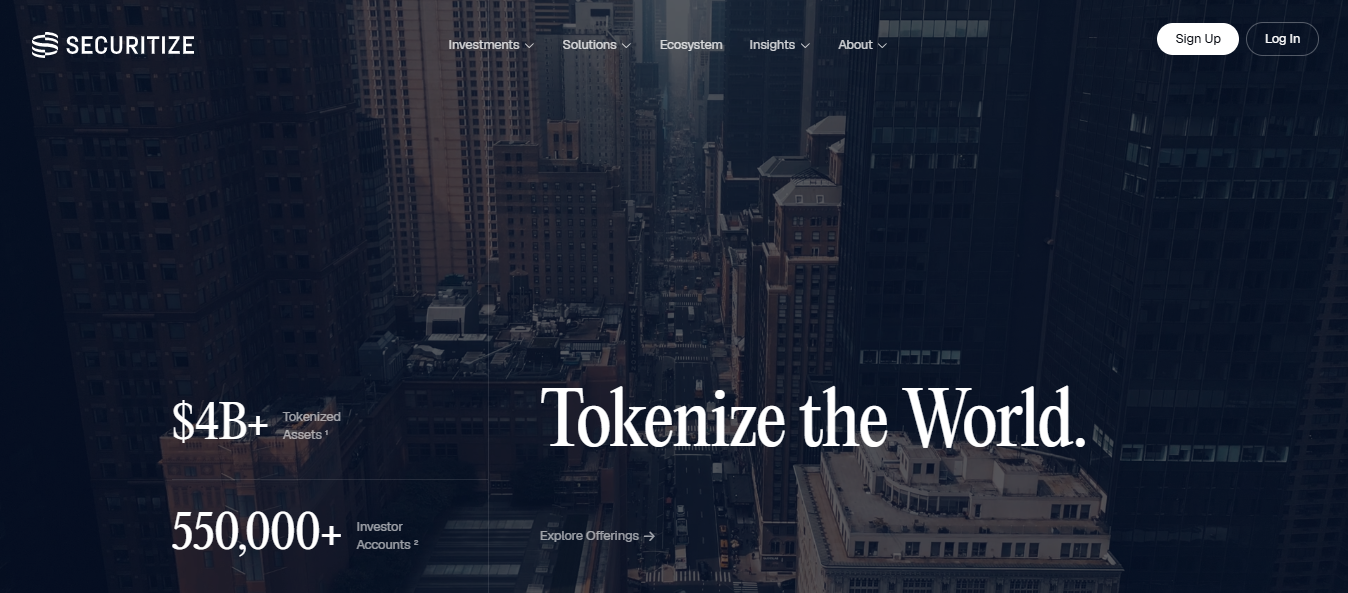
- Overview of Platform: Securitize is a digital securities platform that enables companies to issue, manage, and trade regulated assets on a blockchain. It serves as an “all-in-one” platform for asset tokenization, providing the technology to create tokens and the legal framework for their trading.
- Supported assets: The platform focuses on RWAs, including equity (shares in private companies or startups), funds (venture capital, private equity, and hedge funds), real estate (ownership stakes in commercial or residential properties), and fixed income.
- Key features: The key features include:
- Primary issuance: Tools for companies to raise capital by selling tokenized assets.
- Secondary market: A regulated Alternative Trading System where investors can buy and sell tokens from one another.
- Investor dashboard: A simple portal for investors to manage their portfolio, sign documents, and track distributions.
- Transfer agent services: Automated management of shareholder records and dividend payments on-chain.
- Blockchains supported: This is a multi-chain platform that works across multiple networks, including Ethereum, Solana, Avalanche, Polygon, Algorand, and Base.
- Compliance approach: Securitize adheres to strict financial regulations, including regulatory status, automated KYC/AML, and the DS protocol.
- Regulated status ensures that they are an SEC-registered Transfer Agent and a FINRA-member broker-dealer.
- The automated KYC/AML system verifies that every investor must pass identity and anti-money-laundering checks before they can trade.
- The DS protocol ensures that tokens can be transferred only to “whitelisted” investors, making compliance automatic.
- Best for: The platform is best for asset managers and institutions, companies and startups, and accredited and institutional investors.
2. tZERO
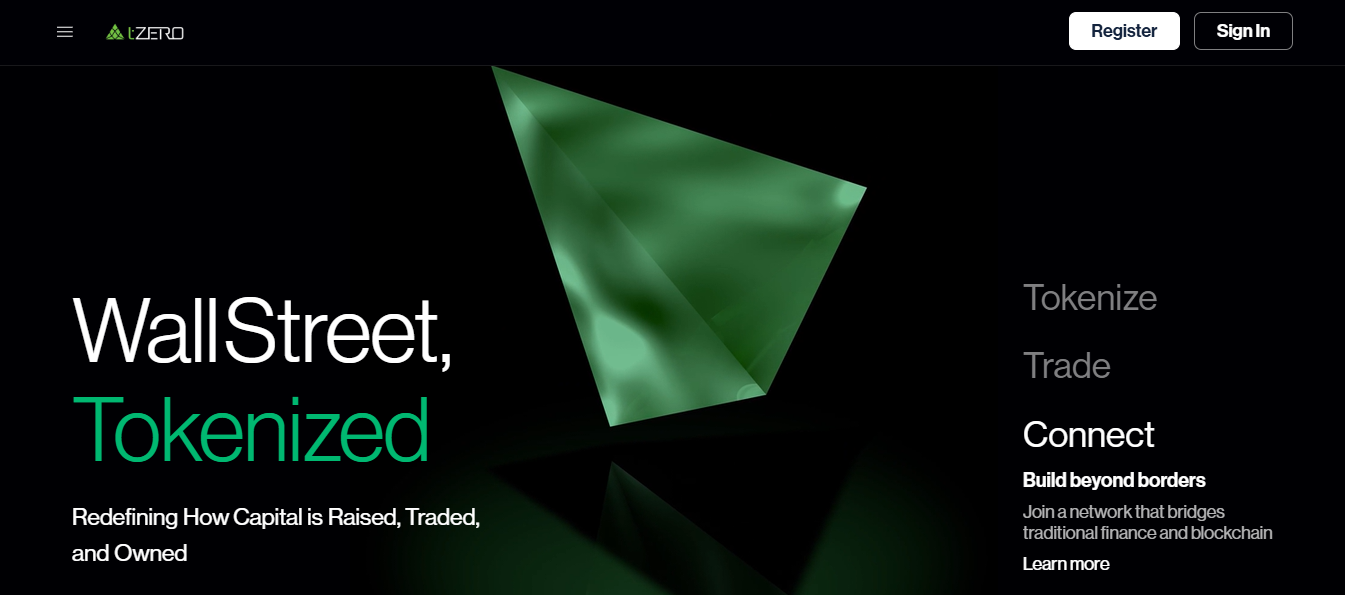
- Overview of Platform: tZero is a financial technology company that provides a regulated platform for the issuance and secondary trading of tokenized assets. It serves as a bridge between traditional capital markets and the digital economy by offering a high-tech ecosystem where private assets can be traded with liquidity and transparency.
- Supported assets: The platform is a multi-asset platform that supports tokenized securities, real estate, corporate debt, cryptocurrencies, and investment funds.
- Key features: The key features include:
- Alternative Trading System (ATS): An Active US-regulated marketplace for trading tokenized securities 24/7.
- Digital wallet and custody: It offers a hybrid custody model where investors use the platform’s regulated custody to keep assets in their own wallets.
- White-label solutions: It provides technology for other companies to launch their own branded tokenization platforms.
- Atomic settlement: It uses blockchain to settle trades more quickly than the traditional day standard.
- Blockchains supported: Multiple chains, including Ethereum, Stellar, Algorand, XDC Network, and Ravencoin.
- Compliance approach: The platform operates under a “compliance-first” mandate with strict regulatory oversight.
- It operates through SEC-registered and FINRA-member subsidiaries (tZERO Securities).
- It is authorized to directly custody digital asset securities.
- It uses smart contracts to enforce trading restrictions automatically on the blockchain.
- Best for: tZero is best for private companies, institutional issuers, and retail and professional investors.
3. Bitbond
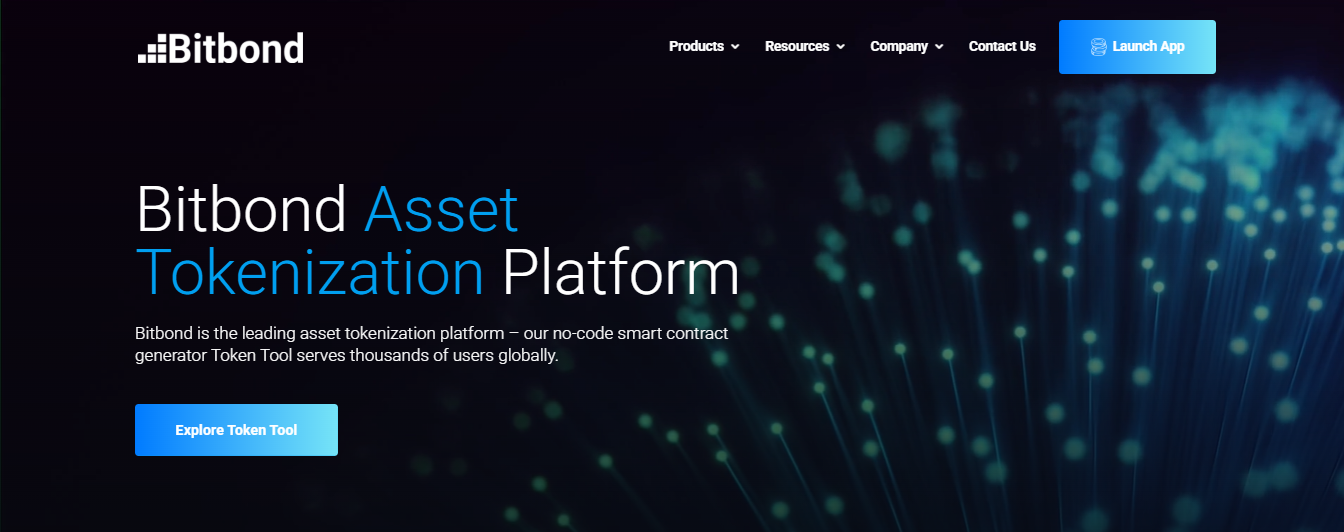
- Overview of Platform: This German-based pioneer provides bank-grade tokenization technology. Bitbond offers a web-based “plug-and-play” platform called “Token Tool” that allows users to create, manage, and distribute tokens without needing to write any code. This makes it more of a technology infrastructure provider for others to build on.
- Supported assets: It supports security tokens, real-world assets, stablecoins, NFTs, and governance tokens.
- Key features: The key features include:
- No-Code Token Creation: It offers a simple interface to mint ERC-20 or ERC-721/1155 tokens in minutes.
- Tools to set up and manage initial token offerings (STOs/ICOs).
- It securely locks teams or liquidity tokens to build investor trust.
- A feature to distribute tokens to different wallets in a single transaction to save time and gas fees.
- Allows businesses to integrate tokenization directly into their own websites or apps.
- Blockchains supported: It focuses primarily on EVM-compatible networks and payment-efficient chains, including Ethereum, BNB Chain, Stellar, Polygon, Avalanche, Arbitrum, Optimism, and Base.
- Compliance approach: The website focuses on European regulatory standards and institutional trust.
- Bitbond was the first to receive approval from BaFin (Germany’s financial regulator) for a blockchain-based bond.
- Their “token tool” includes features for whitelisting/blacklisting, ensuring that only verified users hold or trade specific security tokens.
- Their smart contracts are audited by top firms to ensure they meet institutional safety standards.
- Best for: Bitbond is ideal for banks and financial institutions, SMEs and Web3 startups, and asset managers.
4. DigiShares
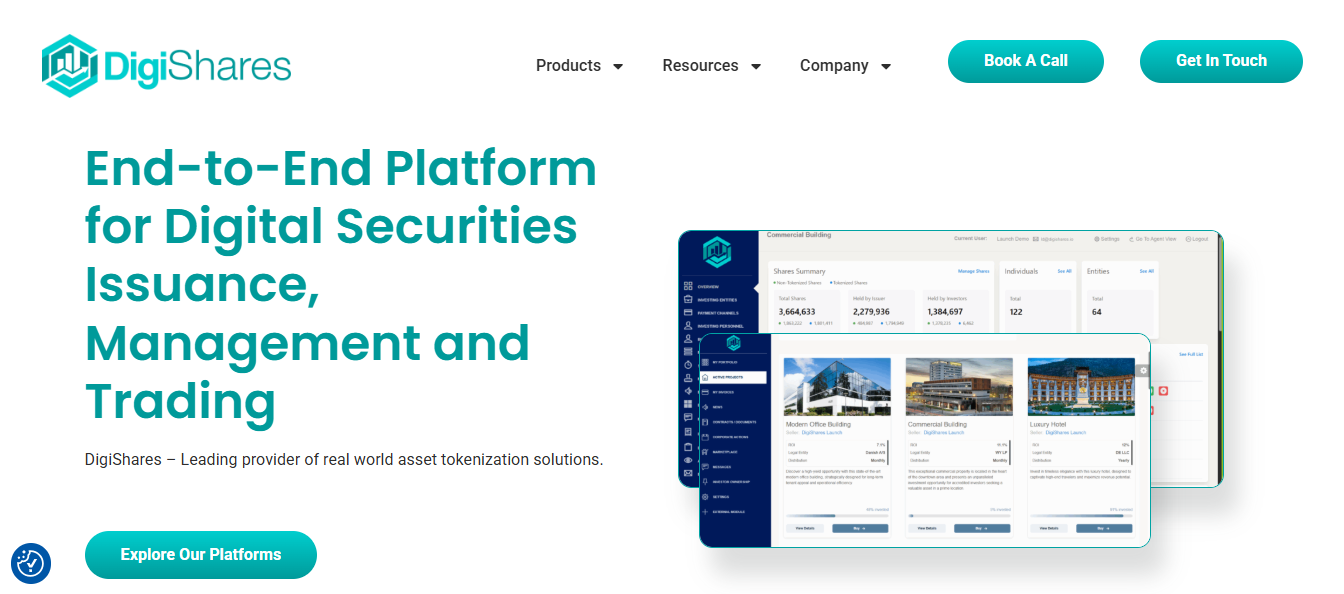
- Overview of Platform: DigiShares is a white-label tokenization platform that enables asset owners and fund managers to issue, manage, and trade digital securities. It is designed to automate the administrative “back-office” tasks of private placements, making it cheaper and easier to manage large groups of small investors.
- Supported assets: DigiShares is heavily optimized for Real-World Assets (RWAs), including real estate, private equity, funds, and commodities.
- Key features: The key features include:
- White-label portal: Companies can use DigiShares technology unders their own brand and logo.
- Cap table management: a real-time, blockchain-based record of ownership.
- Internal bulletin board: An “OTC-style” marketplace where investors can trade tokens directly with each other without requiring a full exchange.
- Automated distribution: Tools to pay out dividends or rental income to hundreds of investors simultaneously in fiat or stablecoins.
- Blockchains supported: Multiple networks, including Ethereum, Polygon, Algorand, Avalanche, Stellar, and Polymesh.
- Compliance approach: DigiShares focuses on “programmatic compliance” to meet international securities laws:
- It connects with third-party providers to automatically verify investor identities.
- It uses protocols like ERC-1404 to ensure tokens can only be held by verified, “whitelisted” investors.
- It works with a network of 80+ legal firms to ensure token offerings comply with local regulations.
- Best for: DigiShares is recommended for real estate developers and syndicators, investment managers, and entrepreneurs.
5. Matrixdock
- Overview of Platform: Matrixdock provides access to institutional-grade traditional assets. It uses a “Special Purpose Vehicle” (SPV) structure to ensure the assets are legally separate from the company, protecting investors even if the company faces financial distress.
- Supported assets: The platform supports U.S. Treasury Bills (STBT), physical gold (XAUm), and precious metals.
- Key features: The key features include:
- Proof of Reserve: It uses Chainlink’s technology to provide real-time, on-chain verification that the tokens are fully backed by assets.
- Daily Yield (STBT): Holders of the Treasury Bill token see their balances increase daily as interest accrues.
- Physical redemption: XAUm holders can redeem their tokens for physical gold bars in Singapore or Hong Kong.
- Smart-invest: An automated tool that allows users to “Dollar Cost Average” (DCA) into gold using stablecoins.
- Blockchains supported: Matrixdock is built on Ethereum, BNB Chain, Sui, and Arbitrum.
- Compliance approach: It operates with a strong focus on institutional standards and transparency:
- It has restricted access to “accredited investors” who must clear identity and wealth verification.
- Assets are held in an “orphan” SPV, meaning that as they are not on Matrixdock’s balance sheet, they cannot be claimed by the company’s creditors.
- Regular audits are conducted by reputable firms to confirm the underlying gold and cash reserves.
- Best for: This is best for stablecoin holders, conservative crypto investors, institutions and treasury managers.
6. RealT
- Overview of Platform: RealT allows investors to purchase fractional shares of U.S. rental properties using blockchain tokens. Each property is owned by a legal entity, and users buy tokens that represent ownership in that entity. Token holders earn rental income from the properties.
- Supported assets: The platform supports residential and commercial real estate assets like single-family homes, multi-family apartments, and commercial properties.
- Key features: The key features include:
- Fractional ownership: The properties are owned by a specific LLC, and “RealTokens” represent your shares in that company.
- Weekly rental income: Compared to traditional real estate with monthly rental, RealT pays our weekly rental yields in stablecoins.
- RMM: A DeFi platform built on Aave allows you to use real estate tokens as collateral to borrow stablecoins.
- No property management: RealT manages all maintenance, tenant issues, and tax filings.
- Blockchains supported: RealT uses Gnosis Chain and Ethereum.
- Compliance approach: RealT follows a strict legal framework to ensure global accessibility while remaining compliant with U.S. law.
- LLC structure: Each property is held in a separate series LLC, ensuring that the legal liabilities of one property do not affect the others.
- Reg D and Reg S: They use U.S. SEC exemptions to offer digital securities legally to both U.S. accredited investors and non-U.S. investors.
- Whitelisting: Investors must clear a KYC process and tokens can only be held by verified, compliant wallets.
- Best for: retail and global investors, and passive income seekers.
7. Polymesh
- Overview of Platform: Polymesh is a public permissioned Layer-1 blockchain built for regulated assets and real-world asset tokenization. Its Layer-1 design makes issuing, managing, and settling tokenized securities and other RWAs easier and compliant with financial regulations.
- Supported assets: The network supports assets like equity, debt, fixed income, real estate, investment funds, and structured products.
- Key features: The key features include:
- Identity-first design: Every user must complete KYC to obtain an on-chain identity.
- Confidentiality: While the blockchain is public, Polymesh uses specialized technology to keep trade amounts and balances private while staying auditable by regulators.
- Deterministic finality: Transactions are instantly settled and cannot be reversed or forked.
- Native asset creation: Assets are created at the protocol level, making them more secure and easier to manage.
- Blockchains supported: Polymesh is itself a Layer 1 blockchain, which allows it issue and manage assets directly on the network instead of on Ethereum or other chains.
- Compliance approach: Polymesh uses compliance as a built-in feature that strictly adheres to the specified requirements.
- Compliance rules are enforced by the blockchain itself, allowing only trades that follow protocol-level rules to execute.
- Only licensed financial entities can act as node operators, ensuring the infrastructure is managed by professional, accountable parties.
- The network is governed by a council that ensures the chain evolves in line with global financial regulations.
- Best for: Polymesh is best for financial institutions, security token issuers, and regulators.
8. Zoniqx
- Overview of Platform: Zoniqx is a Silicon Valley-based fintech firm that offers Tokenization Platform as a Service (TPaaS) for real-world asset tokenization. It provides end-to-end infrastructure for the lifecycle management of digital securities. It is designed to act as the “middleware” layer that connects traditional legacy financial systems with decentralized networks.
- Supported assets: It supports assets like real estate, private equity and funds, energy, and ESG, and alternative assets like fine art, IP, and supply-chain invoices.
- Key features: The key features include:
- Tokenization Asset Lifecycle Management (TALM): A 14-step automated framework that manages everything from asset intake and minting to investor distribution.
- AI-powered automation: It uses AI to automate manual tasks.
- zPayRails: A specialized tool that connects fiat currency and on-chain tokens.
- White-label solution: Allows banks and fund managers to launch their own branded tokenization portals using Zoniqx technology.
- Blockchains supported: Zoniqx is chain-agnostic, integrating with multiple blockchain networks, including XRP Ledger, Hedera, Ethereum, Polygon, Arbitrum, and Base.
- Compliance approach: Zoniqx strictly adheres to its token standard to ensure compliance with regulatory rules at the protocol level.
- The Dynamic Compliant Interoperable Security Token (DyCIST, ERC-7518) embeds legal rules directly in the token.
- The system automatically adjusts rules based on the investor’s region and country.
- A reusable on-chain identity solution that ensures only KYC-verified investors can hold or trade tokens.
- Best for: The platform is ideal for asset managers, banks, real estate developers, and institutional arrangers.
Red Flags and Due Diligence Checklist Before You Invest
Before investing in or engaging with an asset tokenization platform, conduct thorough due diligence. While tokenization can improve efficiency, a poorly structured platform introduces operational, financial, and legal risks.
While a credible asset tokenization platform should make compliance, asset backing, and investor protections easy to understand and verify, there are still practical checklists and red flags to watch for.
Due Diligence Checklist
- Regulatory and Legal Structure: Verify if the platform operates within a clearly defined regulatory framework. Legitimate platforms disclose their legal entities, operating jurisdictions, and regulatory regimes. Platforms focused on RWA should clearly explain how tokens are classified and under which laws they are issued.
- Asset Ownership and Legal Enforceability: Confirm how assets are held, how tokens are classified, and the applicable laws under which they are issued.
- Proof of Asset Backing: Ensure there is no transparent mechanism that demonstrates tokens are backed 1:1 by the stated RWA. This includes third-party attestations, asset registries, audited financial statements, or regular reporting linked to custodial or trustees. A lack of verifiable backing is one of the most significant risk factors in RWA tokenization.
- Compliance and Investor Onboarding: Check if the platform enforces KYC/AML, sanctions screening, and investor eligibility rules. Platforms, institutional or regulated markets, embed compliance directly into token transfers, restricting token holders and traders based on jurisdiction and investor status.
- Custody and Safekeeping Arrangements: Examine how digital tokens and underlying assets are held in custody. Digital assets require institutional-grade solutions, multi-signature controls, and clear key-management policies. Off-chain assets need confirmation on qualified custodians, trustees, or regulated financial institutions.
- Smart Contract Security and Transparency: Review if the platform’s smart contracts have undergone independent security audits and whether the results are publicly disclosed. A well-known platform explains how contracts can be upgraded, paused, or governed in response to bugs or regulatory changes.
- Secondary Market and Liquidity Model: Understanding how and whether the tokens can be transferred or traded. Some platforms support regulated secondary markets or alternative trading systems, while others are intentionally illiquid. Clarity around transfer restrictions, lock-ups, and resale options is important for setting realistic expectations.
- Track Record and Partnerships: Evaluate the platform’s operating history, clients, and partnerships. Platforms with active institutional partnerships, completed issuances, and repeat customers carry lower execution risk than unproven or purely conceptual offerings.
Red Flags to Watch Out
- Unclear, vague, or missing details about legal structure, jurisdiction, or compliance obligations.
- Unverified asset claims without any independent verification, audits, or credible custodial arrangements.
- Liquidity guarantees or aggressive claims in the absence of a regulated or functional secondary market.
- When there is no clarity on who controls the platform, how decisions are made, and how investor interests are protected.
- Platforms that allow unrestricted participation without HYC/AML or jurisdictional controls for regulated assets.
- When there are no independent smart contract audits, financial audits, or third-party validation.
What Real-World Assets Can Be Tokenized?
Real-world assets (RWA) tokenization can be applied to a wide range of traditional asset classes. Based on current market adoption and platform support as highlighted in the referenced industry reports, the following categories show the most active tokenized assets.
Treasuries/Cash Equivalents
Government bonds, short-duration cash-equivalents, and U.S. Treasuries are among the fastest-growing tokenized assets. These instruments are commonly tokenized to provide on-chain yield products backed by low-risk, off-chain financial instruments, with clear.
Credit
Credit assets such as private debt, corporate bonds, structured credit, and loan portfolios are tokenized to improve capital efficiency and distribution. The tokenization enables fractional exposure to credit products and supports programmable interest payments and maturity schedules.
Real Estate
Residential, commercial, and income-producing properties are widely tokenized assets. These tokens represent fractional ownership or economic rights, enabling broader investor access and simplified cross-border participation.
Equities and Funds
Private equity, venture capital interests, and fund shares can be tokenized to streamline issuance, ownership tracking, and transfer restrictions. Tokenized funds often integrate compliance logic directly into smart contracts to manage investor eligibility and jurisdictional rules.
Commodities
Commodities like gold and other precious metals are tokenized to provide digital ownership backed by vaulted reserves. These commodities are designed to track spot value while offering improved transferability and settlement efficiency.
Intellectual Property and Royalties
Intellectual property rights, music royalties, licensing revenues, and other cash-flow-generating IP assets can be tokenized to allow fractional ownership and automated revenue distribution based on predefined rules.
Collectibles
Collectibles like art, luxury goods, and rare items are tokenized to improve liquidity and accessibility. These tokens represent fractional economic interest rather than physical possession, supported by custodial and valuation frameworks.
Trade Finance
Invoices, receivables, and supply-chain financing assets are tokenized to shorten settlement cycles and improve transparency. Tokenization in this category is often used to unlock liquidity in traditionally illiquid short-term assets.
Benefits and Risks of Asset Tokenization
Asset tokenization introduces a new layer of financial infrastructure that affects both issuers and investors. By representing RWAs like blockchain-based tokens, organizations can modernize capital formation and asset management, while investors gain new access and efficiency.
Key Benefits
- Fractional Ownership: Tokenization enables high-value assets, such as real estate, private funds, and credit instruments, to be divided into smaller digital units. This lowers minimum investment thresholds, enabling broader participation and allowing issuers to tap into a larger investor base.
- Increased Liquidity: By enabling assets to be issued and transferred digitally, tokenization can improve liquidity relative to traditional private markets. Tokenized assets may be traded on compliant secondary markets or alternative trading systems, reducing reliance on lengthy exit cycles.
- Global Investor Access: Blockchain-based issuance supports cross-border distribution, allowing issuers to reach qualified investors globally. For investors, this opens access to asset classes and markets that were previously difficult or impossible to enter due to geographic or operational barriers.
- Faster Settlement and Operational Efficiency: Traditional asset transfers often involve multiple intermediaries and settlement periods of several days. Tokenization enables near-real-time settlement and reduces reconciliation costs through shared ledgers and automated processes.
- Automation via Smart Contracts: Smart contracts can automate corporate actions, including dividend distributions, interest payments, redemptions, and compliance checks. This reduces administrative overhead for issuers and minimizes manual errors.
- Improved Transparency and Auditability: Blockchain records provide an immutable transaction history, improving transparency for investors and auditors. Issuers can offer clearer visibility into ownership, transfers, and asset performance, increasing trust and reducing information asymmetry.
Risks
- Regulatory Uncertainty: Regulatory frameworks for tokenized assets differ across jurisdictions and continue to improve. Issuers may face compliance complexity when offering tokens across borders, while investors risk exposure to assets that may later be reclassified or restricted by regulators.
- Liquidity Constraints: Tokenization increases liquidity but does not guarantee active secondary markets. While many tokenized assets still trade infrequently and investors may face limited exit options, particularly in early-stage or niche offerings.
- Smart Contract Vulnerabilities: Smart contracts are software code and may contain bugs or security flaws. Exploits or design errors can lead to financial losses, incorrect asset transfers, or halted contract functionality if not properly audited and maintained.
- Custody and Key Management Risks: Tokenized assets rely on digital wallets and private keys. Loss, theft, or mismanagement of keys can result in irreversible loss of assets. Institutional-grade custody solutions help mitigate this risk, but custody remains a critical consideration.
- Jurisdictional and Legal Complexity: Tokenized assets often involve a combination of on-chain tokens and off-chain legal rights. Ensuring that token ownership is enforceable under local laws, especially in insolvency or dispute scenarios, can be complex and varies by jurisdiction.
- Adoption and Infrastructure Challenges: Despite growing interest, tokenization infrastructure remains in early stages of development. Limited standardization, integration challenges with legacy systems, and varying levels of market education can slow adoption for both issuers and investors.
Conclusion
Asset tokenization has moved beyond experimentation and now serves as the primary mechanism for issuing, managing, and accessing RWAs on-chain. In 2026, platforms that combine regulatory readiness, institutional-grade infrastructure, and practical real-world use cases are considered leaders.
These platforms show how tokenization is enabling fractional ownership, faster settlement, improved transparency, and global investor access while still operating within existing legal and compliance frameworks. At the same time, due diligence further strengthens the success by demonstrating how assets are structured, compliance is enforced, and custody and liquidity are handled.
As adoption continues to accelerate, asset owners, financial institutions, and Web3 companies aim to choose the right tokenization partner, and this is where Dypto Crypto comes in to help. With detailed research, Dypto helps learners stay updated with the latest market trends to streamline operations and future-proof their asset strategies.
Frequently Asked Questions
Are tokenized real-world assets considered securities?
Yes. Most tokenized assets that represent ownership or financial interest are often regulated as securities in many jurisdictions.
How do I verify a tokenized asset is actually backed 1:1?
To verify a tokenized asset check for public proof-of-reserve audits, legal asset documentation, and custodian attestations provided by the platform.
What custody risks exist with tokenized assets (and how do I reduce them)?
Custody risks include hacks or loss of keys. Use platforms with institutional custody partners and multi-sig wallets.
How do I check whether a tokenization platform is legit or regulated?
Perform due diligence by verifying a token’s licenses, its compliance with relevant laws (KYC/AML, securities), and reputation to check whether a tokenization platform is legit or regulated.
Disclaimer
This article is for educational and information purposes, and should not be considered financial advice. For more information visit our disclaimer page
About the Author