

In 2026, crypto traders are waking up to a new reality: Binance is no longer the one-size-fits-all solution it once was. With tighter regulations, surprise withdrawal limits, and reduced fiat access in key regions, many users are seeking platforms that offer more freedom, enhanced features, and stronger compliance.
Whether you are a beginner looking for simplicity, a pro chasing leverage, or an altcoin hunter seeking early gems, this blog breaks down the 9 best Binance alternatives to consider right now. From Coinbase and Kraken to Bybit, OKX, Bitget, KuCoin, Gate.io, Gemini, and MEXC, we will help you find the perfect fit for your crypto goals in 2026. Let’s dive in.
Why Traders Are Exploring Alternatives to Binance
Traders are shifting away from Binance due to tightening regulations, evolving platform policies, and rising competition. Here is a concise breakdown of the key reasons:
- Regulatory Crackdowns: Binance has faced lawsuits and enforcement actions from regulators like the U.S. SEC, leading to increased scrutiny and operational limitations.
- Stricter KYC Requirements: Enhanced identity verification and compliance measures have frustrated users seeking faster onboarding or more privacy.
- Limited U.S. & EU Access: Binance’s services have been restricted or modified in major markets, resulting in reduced functionality for users in the U.S. and certain parts of Europe.
- Rising Competition: Exchanges like MEXC and others offer lower fees, broader token listings, and more flexible trading options, attracting disillusioned Binance users.
- Local Fiat & Transparency Needs: Traders are seeking platforms with better fiat onramps, clearer fund security policies, and more transparent operations.
What to Look for in a Good Binance Alternative
Here is a practical checklist to help you evaluate any crypto exchange before switching from Binance:
- Security & Compliance: Verify that the exchange you are interested in holds regulated licenses in major jurisdictions, such as the EU, the U.S., and the UAE. Check their proof of reserves, audits, cold wallet transparency, and insurance coverage for custodial assets or hacks.
- Trading Fees: Ensure the exchange has a transparent maker/taker fee structure with no hidden withdrawal or deposit fees. They should offer discounts for native token holders or high-volume traders.
- Supported Assets: Ensure the exchange you are interested in deals with a wide range of altcoins, stablecoins, and DeFi tokens. They should offer access to new listings and low-cap gems with cross-chain support (e.g., Ethereum, Solana, BNB Chain).
- User Experience: The exchange must offer an intuitive interface that is both beginner-friendly and professional-grade. It must have a fast and responsive mobile app with trading tools, alongside customizable dashboards and alerts.
- Fiat On/Off Ramps: The exchange must offer support for local currencies, such as PKR, EUR, or USD. It should have multiple payment methods, including bank transfer, cards, and mobile wallets. The exchange must offer reasonable transaction limits and processing times.
- Customer Support & Transparency: The exchange must offer a 24/7 live chat or ticketing system to the customers. They should have public team profiles and clear company info with transparent policies on outages, updates, and fund safety.
9 Best Binance Alternatives for Crypto Traders
As Binance faces increasing regulatory pressure and evolving compliance demands, many traders are exploring other centralized exchanges that offer comparable or even superior experiences. The platforms below were chosen based on their security practices, licensing, asset variety, fee structures, and user satisfaction.
Here are 9 top Binance alternatives for crypto traders in 2025, each selected for their strong regulatory standing, user trust, and competitive features.
| Exchange | Key Strengths | Trading Fees | Regulation | Staking/Earn | Best For | Available in Countries |
| Kraken | Highly regulated with advanced trading tools | 0.16%-0.26% | US/UK/Canada/Australia licensed | Yes | Regulated traders and high-volume professionals | 190 countries, including the US, UK, Canada, Australia, and Japan |
| KuCoin | Massive altcoin selection, low trading fees, advanced tools | 0.1% for spot trading, 0.02%-0.06% for futures | Mixed | Yes | Altcoin enthusiasts and traders outside the US/UK | Over 200 countries, including Pakistan, India, Nigeria, Brazil, and Turkey. Restricted in the United States, China, Hong Kong, and Singapore |
| Bybit | High leverage, advanced trading tools, and robust liquidity | 0.1% for spot trading, 0.02%-0.05% for derivatives | Mixed | Yes | High-volume traders | Over 180 countries, including Pakistan, India, Brazil, the UAE, and Turkey. Restricted in the United States, Canada, France, the Netherlands, and China |
| OKX | OKX ear, OKX pay, and advanced trading tools | 0.08%-010% for spot trading, 0.02%-0.05% for derivatives | Licensed in the UAE, Hong Kong, and Brazil. Pending authorization in the EU and the US. | Yes | Traders looking for advanced derivatives. | Over 180 countries, including Pakistan, India, the UAE, Brazil, and Turkey. Restricted in the United States, Canada, and some EU regions (pending full MiCA rollout) |
| Coinbase | Educational rewards and strong Fiat support | 0.5%-0.15% with as low as 0.4%-0.6% for pro users | US, UK, and EU licensed | Yes | First-time crypto users | United States, UK, EU, Canada, Singapore, Australia. Restricted in Pakistan, India, and some African and Middle Eastern countries |
| Bitget | Wide asset support with industry-leading security | 0.1% for spot trading, 0.02%-0.06% for futures | Mixed. Not licensed in the EU, the US, or Canada | Yes | Users outside the US and mobile-first users | Over 100 countries, including Pakistan, India, Brazil, Turkey, and the UAE. Restricted in the United States, Canada, and some EU jurisdictions |
| Gate.io | Massive asset variety and a robust startup launchpad | 0.2% for spot trading, 0.015%-0.05% for futures | Mixed. Restricted in the US, the EU, and Canada | Yes | Advanced users requiring deep altcoin exposure | Over 200 countries, including Pakistan, India, Brazil, Turkey, and Southeast Asia. Restricted in the United States, Canada, and some EU jurisdictions |
| Gemini | SOC 1 Type 2 and SOC 2 Type 2 compliant, regulated trust company | 0.5%-1.49% | Licensed in the US, the EU, Canada, Singapore, Hong Kong, and Australia. Restricted in Asia | Yes | Institutional clients seeking maximum security | Available in the United States, the UK, Canada, Singapore, Hong Kong, and Australia. Restricted in Pakistan, India, and several African and Middle Eastern countries |
| MEXC | No mandatory KYC and zero maker fees | 0%-0.1% | Mixed | Yes | Early-stage investors | Over 200 countries, including Pakistan, India, the UAE, Brazil, and Southeast Asia. Restricted in the United States, Canada, and some EU jurisdictions |
1. Kraken — The Most Regulated Global Exchange
Kraken is a U.S.-based cryptocurrency exchange founded in 2011, recognized for its robust regulatory compliance, strong security, and institutional-grade infrastructure. It offers spot trading, futures, margin, staking, and fiat on/off ramps. Its main strengths include;
- Regulated in multiple jurisdictions (U.S., Canada, EU, UK, Australia)
- High security standards with cold storage and proof of reserves
- Advanced trading tools and APIs for professionals
- Strong fiat support (USD, EUR, GBP, CAD, AUD, JPY)
- Educational resources and transparent operations
Kraken charges a 0.16% maker fee and a 0.26% taker fee. For pro users, these fees are 0% and 0.10% respectively. Kraken is registered with FinCEN (USA), FCA-registered in the UK, licensed in Canada, Australia, and several EU countries. It also offers regular audits and proof-of-reserves verification.
Kraken offers staking for over 15 assets, including ETH, DOT, ADA, and SOL. Its yields range from 1% to 20% APY, depending on the asset. The rewards are paid on a weekly or bi-weekly basis. Kraken is best suited for traders who prioritize security and regulatory compliance, as well as institutions and high-volume professionals, and users requiring robust fiat access and staking options.
2. KuCoin — Best for Altcoin Variety and Low Fees
Founded in 2017 and headquartered in the Seychelles, KuCoin is a global cryptocurrency exchange recognized for listing emerging tokens early, offering spot, futures, margin, and peer-to-peer (P2P) trading services. It supports over 900 cryptocurrencies and has a strong presence in Asia, Africa, and Latin America. Its key strengths include;
- Massive altcoin selection: Over 900+ assets, including low-cap gems and new launches
- Low fees: Base spot trading fee of 0.1%, with discounts for KuCoin Token (KCS) holders
- Advanced tools: Trading bots, margin, futures, and copy trading
- Passive income: Offers staking, lending, and dual investment products
- Mobile-friendly: Highly rated app with full trading functionality
KuCoin charges a 0.1% spot trading fee. For futures, it charges 0.02% maker and 0.06% taker fees. However, withdrawal fees vary depending on the asset. It is not licensed in the U.S. or the EU, which limits access for users in those regions. KuCoin operates under the jurisdiction of the Seychelles and has faced scrutiny over its KYC enforcement and past security breaches. However, it introduced mandatory KYC for all users in 2023 to improve compliance.
KuCoin offers staking for assets like ETH, DOT, ATOM, and KCS. It offers flexible and fixed-term options, as well as lending and dual investment products, for generating passive yield. However, APYs vary widely, from 2% to 25% depending on asset and lock-up period.
It is ideal for Altcoin enthusiasts and early-stage token investors, as well as traders seeking low fees and advanced tools, and users outside the U.S., EU, and Singapore.
3. Bybit — Best for Derivatives and Advanced Traders
Founded in 2018 by Ben Zhou, Bybit has grown into one of the world’s largest crypto exchanges, now serving over 60 million users. Headquartered in Dubai, it offers spot, margin, futures, options, copy trading, and advanced automation tools like trading bots and TradeGPT. Its key strengths include;
- High leverage: Up to 100x on futures and margin markets
- Advanced trading tools: Copy trading, bots, TradeGPT, and MetaTrader 5 integration
- Robust liquidity: Deep order books and fast execution
- Security upgrades: Cold storage, multi-factor authentication, and post-hack improvements
- Web3 expansion: Launchpad, NFT marketplace, and DeFi integrations
Bybit offers competitive trading fees across its platforms. For spot trading, both maker and taker fees are set at 0.1%, making it straightforward for users to calculate costs. Derivatives trading is even more attractive for active traders, with maker fees at 0.02% and taker fees at 0.055%.
Bybit is a MiCAR-compliant platform launched for EU users in 2025. It is also in-principle approval for operations in the UAE, but exited Canada and the Netherlands due to regulatory hurdles.
Bybit offers Bybit Earn with flexible and fixed-term products. Its assets include ETH, USDT, BTC, and stablecoins, with APYs ranging from 2% to 15% depending on the lock-up period and asset. Additional features include crypto loans, savings, and dual investments.
It is best suited for professional and high-volume traders, users focused on derivatives, copy trading, and automation, as well as traders seeking access to Web3 and launchpad opportunities.
4. OKX — Best All-Round Exchange for Earn, Web3, and NFTs
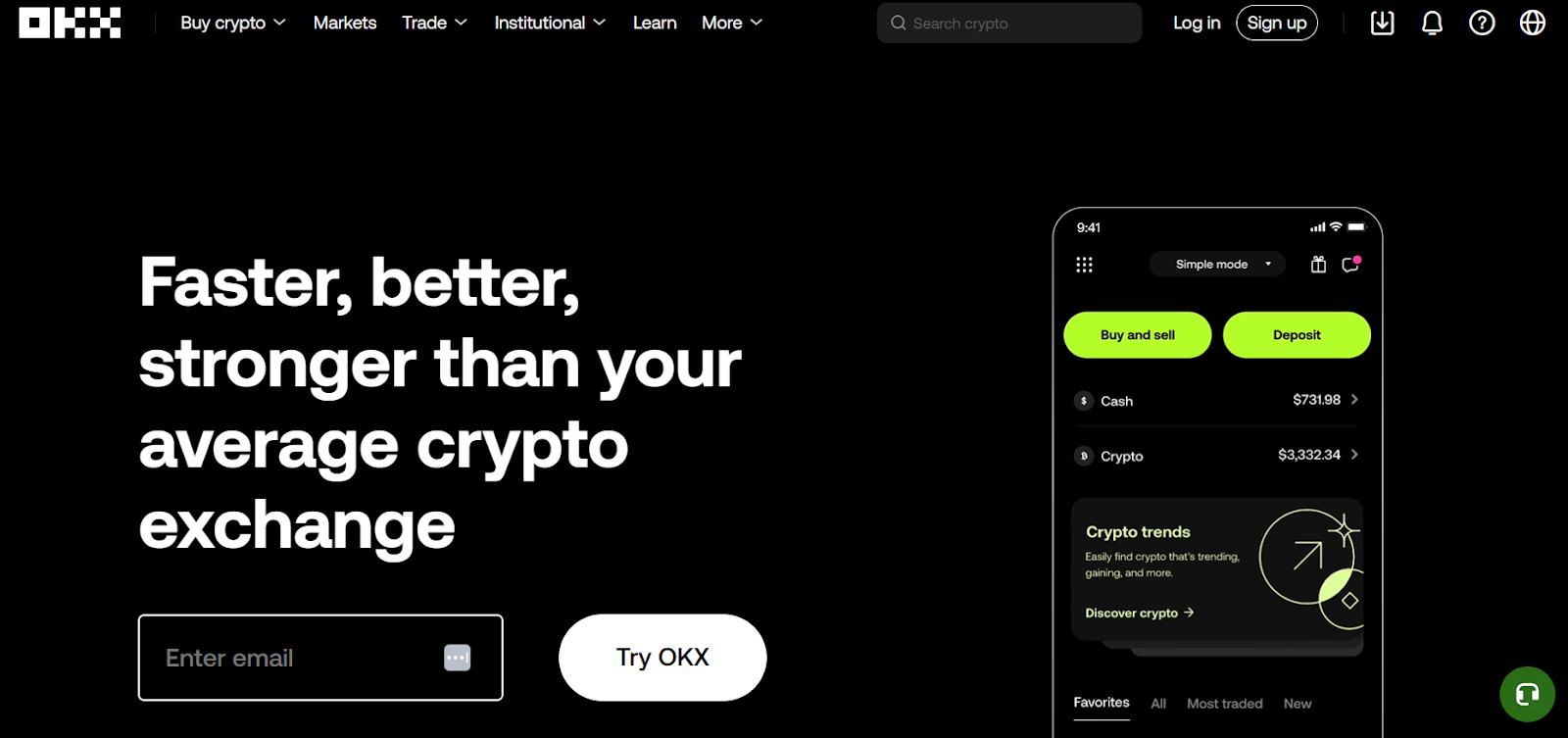
Founded in 2017 and formerly known as OKEx, OKX is a global crypto exchange headquartered in Seychelles with operational hubs in Dubai and Hong Kong. It offers spot, futures, options, staking, and a full Web3 ecosystem, including a multichain wallet, NFT marketplace, and DeFi integrations. Its key strengths include;
- Multi-chain Web3 wallet with support for Ethereum, BNB Chain, Polygon, and more
- NFT marketplace with curated drops and creator tools
- OKX Earn platform offering flexible and fixed staking, savings, and dual investments
- OKX Pay for zero-fee USDC/USDT transfers on its X Layer
- Advanced trading tools, including bots, options, and perpetuals
For spot trading, maker fees start at 0.08% and taker fees at 0.10%, with discounts for OKB token holders. Derivative fees are even lower, starting at 0.02% for makers and 0.05% for takers, making it competitive for active traders.
OKX is the First exchange to receive MiCA pre-authorization in the EU and has compliant operations in Hong Kong, the UAE, and Brazil. It implements multi-factor authentication, cold wallet storage, and regular audits with transparent proof-of-reserves and user fund segregation.
OKX offers staking for ETH, SOL, DOT, USDT, and more. It has flexible and fixed-term options with APYs ranging from 2% to 25%. It also offers dual investment and savings products for passive income. Rewards are paid daily or weekly, depending on the product.
It is best for users seeking Web3 access, NFT trading, and DeFi tools. It is also suitable for traders seeking low fees and advanced derivatives, as well as investors looking for passive income through staking and savings.
5. Coinbase — Best Binance Alternative for Beginners
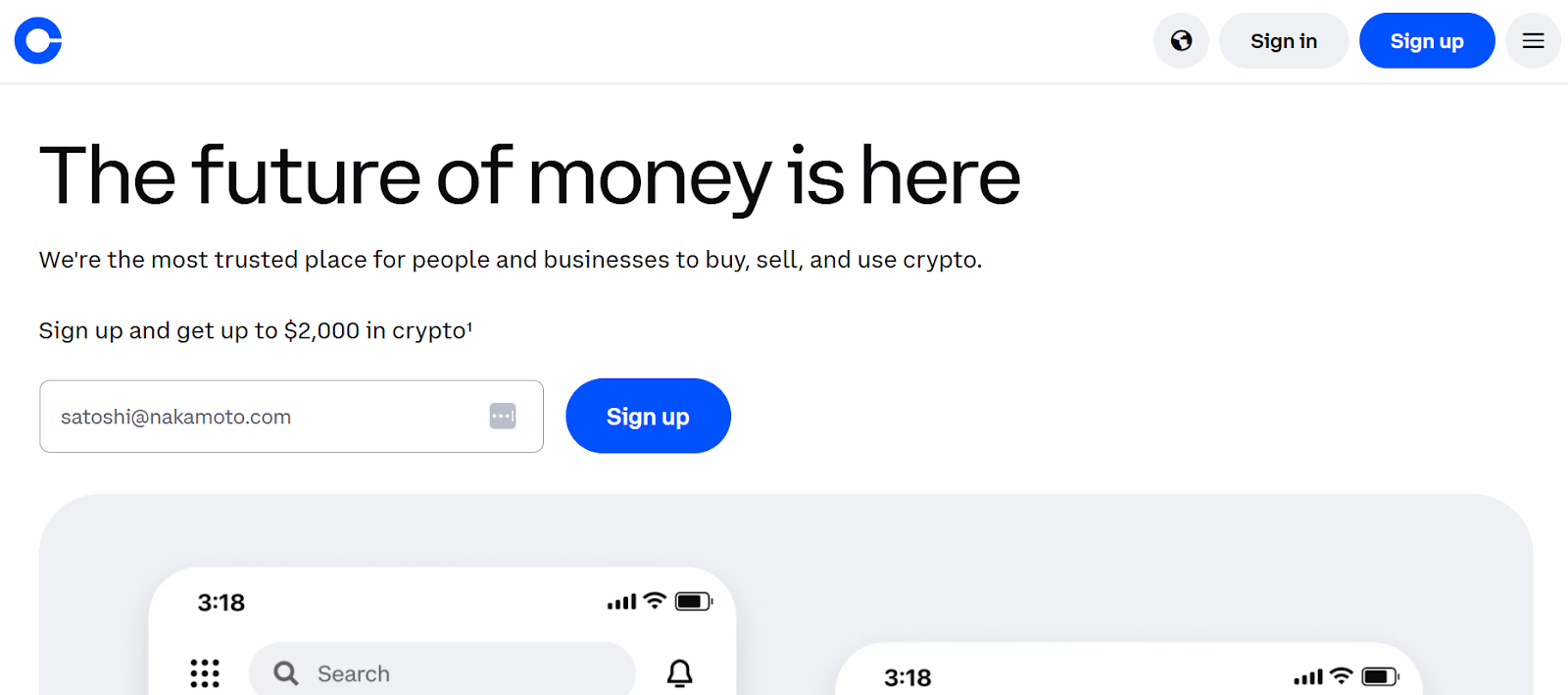
Founded in 2012 and headquartered in San Francisco, Coinbase is the largest regulated crypto exchange in the United States. It’s publicly traded (NASDAQ: COIN) and is known for its intuitive design, robust security, and educational tools that help newcomers understand the basics of cryptocurrency. Its key strengths include;
- User-friendly interface across web and mobile
- Over 240 assets available for trading, including major altcoins and stablecoins
- Educational rewards: Earn crypto by completing learning modules
- Strong fiat support: USD, EUR, GBP deposits via bank, card, PayPal
- Public company transparency with quarterly financial disclosures
Fees range from 0.5% to 1.5% depending on payment method and trade size. Coinbase Pro offers lower fees for advanced users, starting at 0.4% for makers and 0.6% for takers, with volume-based discounts.
Coinbase is registered with FinCEN and licensed in over 40 U.S. states. It is compliant with the SEC, FCA, and EU MiCA frameworks and offers FDIC insurance on USD balances. It also implements cold storage, two-factor authentication (2FA), and insured online wallets.
Coinbase supports staking for ETH, ADA, SOL, XTZ, and more. APYs range from 2% to 6%, paid weekly with no lock-up periods for most assets. Coinbase’s “Earn” program allows users to earn small cryptocurrency rewards by watching educational tutorials.
It is best for first-time crypto users and casual investors, U.S. residents seeking regulated fiat access, and users who value simplicity, security, and education.
6. Bitget — Best for Copy Trading and Futures
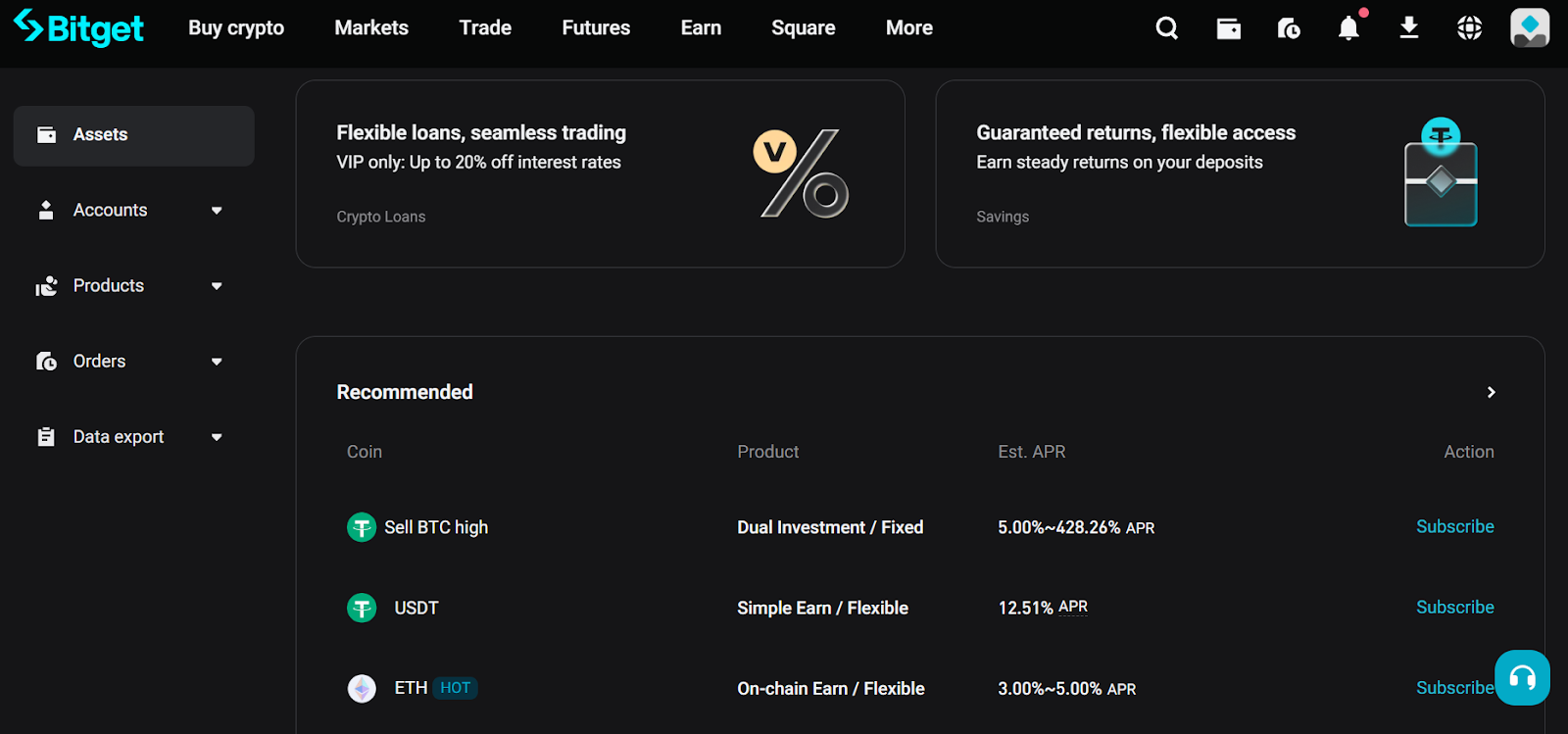
Founded in 2018 and headquartered in Singapore, Bitget has grown rapidly to serve over 45 million users worldwide. It is known for its robust futures platform, copy trading features, and strategic partnerships, including being an official crypto partner of LaLiga in SEA and LATAM regions. Its key strengths include;
- Copy trading: Follow top-performing traders with automated strategies
- High leverage: Up to 125x on futures contracts
- Wide asset support: Over 700 coins, including major altcoins and trending tokens
- Security: Cold wallet storage, multi-factor authentication, and transparency reports
- Mobile-first experience: Intuitive app with full trading functionality
Spot trading fees are 0.1% for both maker and taker, while futures trading fees are 0.02% for makers and 0.06% for takers. Bitget is headquartered in Singapore, with growing compliance efforts in Asia and LATAM. It is not licensed in the U.S., and U.S. clients are currently not accepted. It publishes quarterly transparency reports and maintains proof-of-reserves.
Bitget offers staking and savings products for select assets. APYs vary based on asset and lock-up duration. Its additional passive income tools include dual investment and crypto loans.
It is best suited for Traders focused on futures, high leverage, and automated copy trading; users outside the U.S. seeking low fees and access to altcoins; and mobile-first users who want a streamlined trading experience.
7. Gate.io — Best for Altcoin Hunters
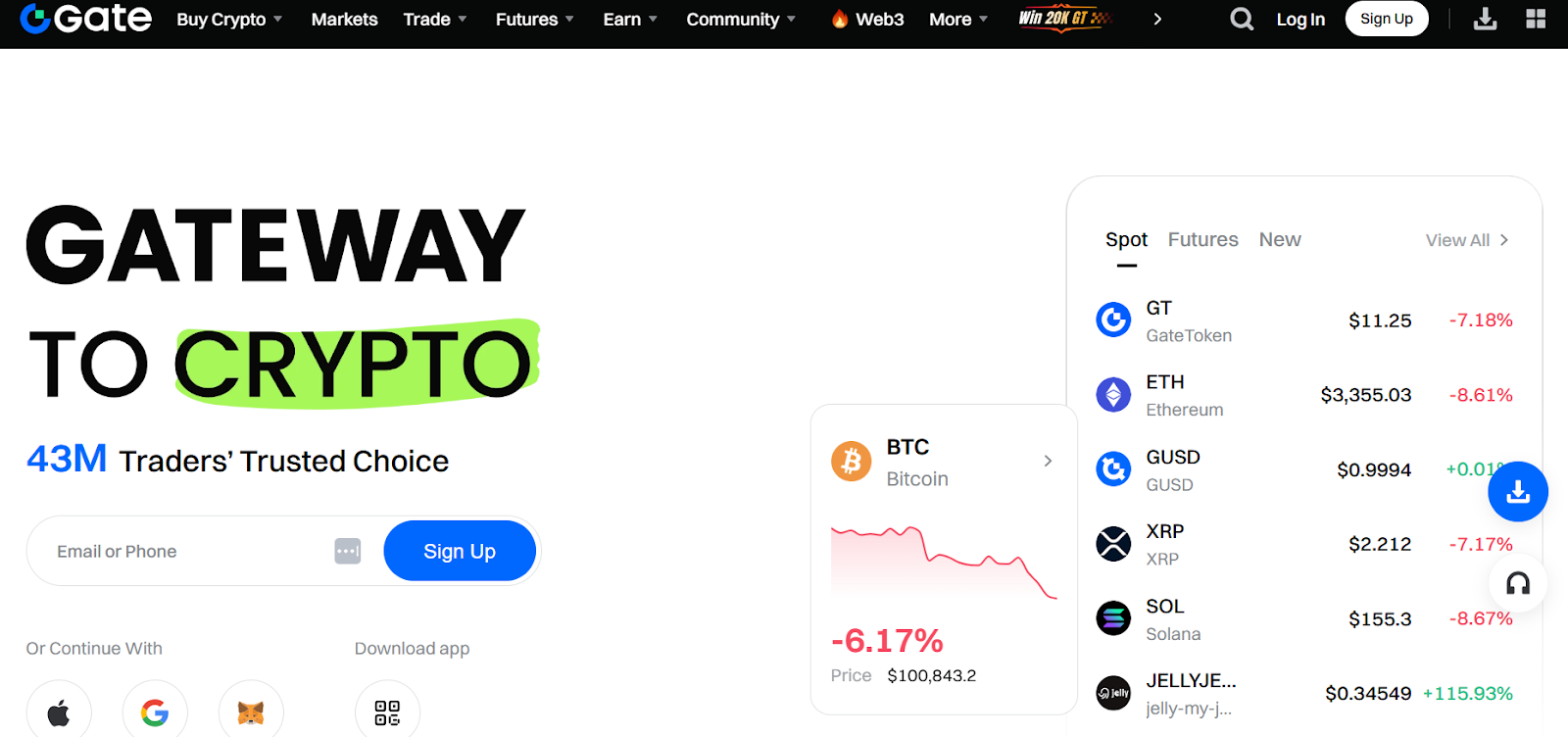
Launched in 2013, Gate.io is one of the oldest crypto exchanges still in operation. Headquartered in the Cayman Islands, it has built a reputation for listing emerging tokens early and supporting a wide range of trading products, including spot, margin, futures, and startup token sales. Its key strengths include;
- Massive asset variety: Over 1,700 cryptocurrencies and tokens listed
- Startup Launchpad: Early access to new token sales and IEOs
- Advanced trading tools: Margin, futures, copy trading, and quantitative strategies
- Security: Cold wallet storage, multi-signature protection, and regular audits
- Innovation-focused: Offers AI trading bots, structured products, and dual investments
Spot trading fees start at 0.2%, with discounts available for GT holders. Futures trading fees are 0.015% for makers and 0.05% for takers, making it competitive for derivatives traders. Gate.io operates under the jurisdiction of the Cayman Islands and is not licensed in the U.S., Canada, or mainland China. It implements mandatory KYC for withdrawals and higher trading limits.
Gate.io offers HODL & Earn, staking, and liquidity mining. It also supports flexible and fixed-term products with APYs ranging from 3% to 30%, and has introduced structured products and dual investment tools to facilitate passive income.
It is ideal for traders seeking early access to new tokens, users looking for in-depth exposure to altcoins and startup investing, as well as advanced users seeking customized trading strategies and automation.
8. Gemini — Best for Institutional-Grade Security
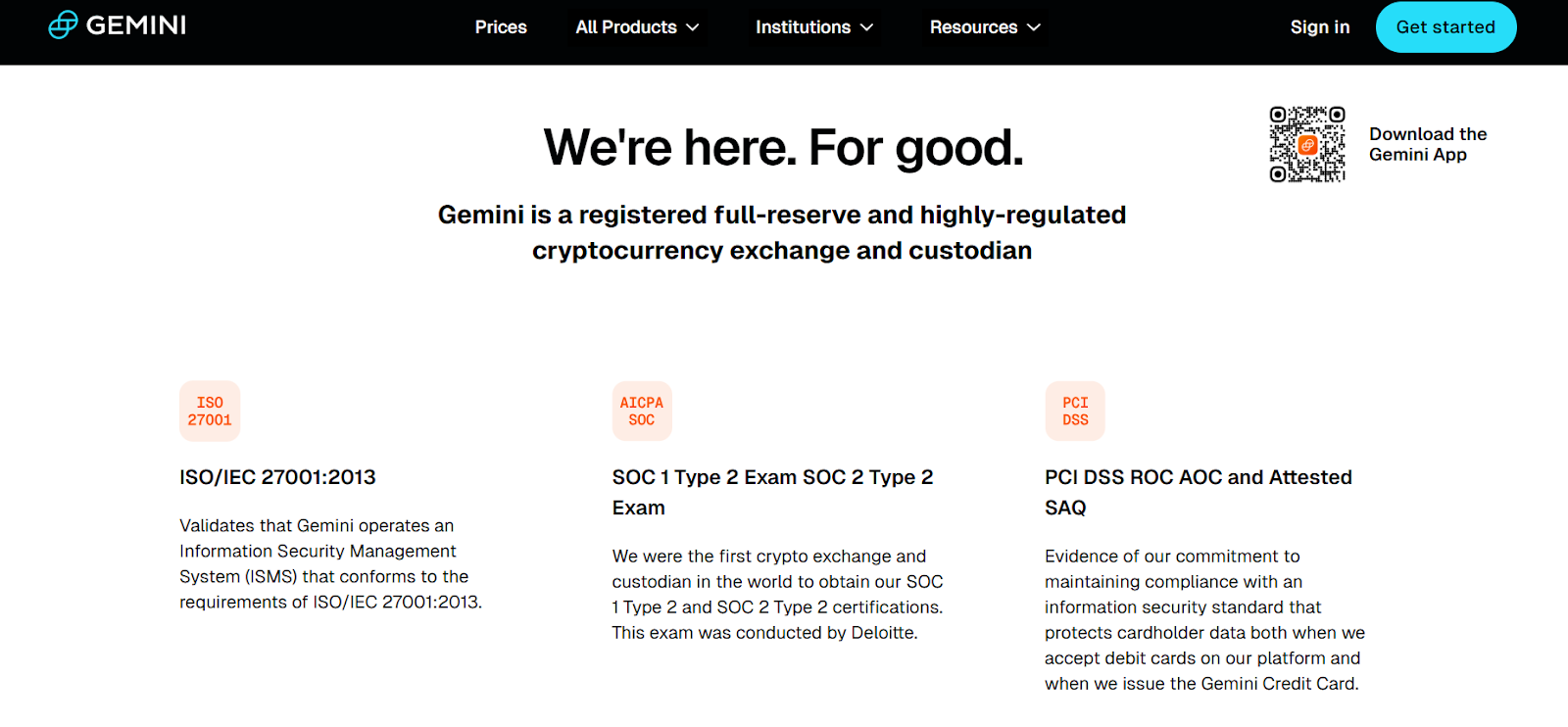
Founded in 2014 by the Winklevoss twins, Gemini is a New York-based crypto exchange and custodian. It is recognized for its regulatory-first approach, secure infrastructure, and commitment to serving both retail and institutional clients. Gemini offers spot trading, staking, a crypto rewards credit card, and a regulated custody service. Its key strengths include;
- Regulated trust company under the New York State Department of Financial Services (NYDFS)
- SOC 1 Type 2 and SOC 2 Type 2 compliant, which is rare among crypto exchanges
- Gemini Custody: Institutional-grade cold storage with $200M insurance coverage
- Gemini Dollar (GUSD): Fully backed stablecoin with monthly attestations
- User-friendly app with strong fiat support and recurring buy options
Fees on Gemini range from 0.5% to 1.49% depending on trade size. It is licensed as a New York trust company and is registered with FinCEN and compliant with the Bank Secrecy Act (BSA). It operates under strict cybersecurity and financial controls, with regularly audited and transparent financials.
Gemini offers staking for ETH, MATIC, SOL, and more via Gemini Staking. APYs range from 2% to 8%, depending on the asset and the lock-up period. Rewards on Gemini are paid monthly. It is best suited for Institutional clients and high-net-worth individuals, as well as U.S. users seeking maximum regulatory protection, and Investors who value security, transparency, and fiat integration.
9. MEXC — Best for Low Fees and No-KYC Access
Founded in 2018 and headquartered in Seychelles, MEXC (formerly MXC) is a fast-growing global exchange known for its aggressive token listings, low trading fees, and no-KYC access for basic trading. It supports spot, futures, staking, and launchpad participation, making it a versatile option for both beginners and experienced traders. Its key strengths include;
- No mandatory KYC for spot trading and small withdrawals
- Zero maker fees on spot and futures markets
- Over 1,600 listed assets, including trending altcoins and meme tokens
- Launchpad and Kickstarter programs for early access to new projects
- Multilingual support and strong presence in Asia, MENA, and LATAM
0%-0.1% for spot trading and 0%-0.03% for futures trading. MEXC operates under the Seychelles jurisdiction, but it is not licensed in the U.S., Canada, or the EU. It implements basic KYC tiers for higher withdrawal limits and fiat access. It also publishes proof-of-reserves and security transparency reports.
MEXC offers MEXC Earn with flexible and fixed staking. It supports ETH, USDT, DOT, and numerous altcoins, with APYs ranging from 3% to 25%, depending on the asset and duration. Some additional tools include Launchpool, dual investment, and DeFi mining.
It is ideal for Traders seeking low fees, access to altcoins, and no-KYC flexibility. It is also suitable for users in Pakistan, India, Turkey, Brazil, and Nigeria, as well as early-stage investors looking for launchpad opportunities.
Are These Binance Alternatives Safe?
Yes, many Binance alternatives offer strong security, but it’s essential to evaluate each platform carefully. Here is how to assess their safety:
- Proof-of-Reserves: Verifies that the exchange holds enough assets to cover user balances. Look for platforms that publish regular audits, such as Kraken, OKX, and Gate.io.
- Two-Factor Authentication (2FA): Adds an extra layer of security to the login process. Most reputable exchanges support two-factor authentication (2FA) via apps like Google Authenticator.
- Cold Storage: Ensures the majority of user funds are kept offline, reducing the risk of hacks. Exchanges like Gemini and Kraken lead in this area.
- Insurance Coverage: Some platforms offer insurance for custodial assets or hot wallet breaches, such as Gemini Custody, which has $200 million in coverage.
- Regulatory Licensing: Exchanges registered with financial authorities, such as Kraken with FinCEN, and Coinbase with SEC oversight, are more likely to follow strict compliance and consumer protection standards.
Examples of security-focused exchanges include;
- Kraken: It is SOC 2 audited, has proof of reserves, and is licensed in multiple jurisdictions.
- Gemini: It is NYDFS-regulated, offers insured custody, and is SOC 1 & 2 compliant.
- Coinbase: It is publicly traded, has FDIC-insured USD balances, and is SEC-compliant.
- OKX: It is MiCA pre-authorized, has transparent reserves, and offers cold wallet protocols.
How to Choose the Right Alternative
Choosing the right exchange depends on your trading goals, location, and experience level. Here is a quick guide to help you match your needs with the best platform:
For beginners, recommended exchanges include Coinbase, Kraken, and Gemini. These exchanges offer simple interfaces, strong fiat support, educational tools, and regulated environments. They are ideal for first-time crypto users, casual investors, and those who prioritize ease of use.
For advanced traders, recommended exchanges include Bybit, OKX, and Bitget. These exchanges offer high leverage, low fees, advanced trading tools, and a range of derivatives markets. They are best for pro traders, algorithmic strategies, and copy trading enthusiasts.
For Altcoin enthusiasts, recommended exchanges include KuCoin, Gate.io, and MEXC. These exchanges offer a massive token variety, early listings, launchpads, and low fees. They are best for users seeking exposure to emerging projects and niche tokens.
For security-focused users, recommended exchanges include Kraken, Gemini, and Coinbase. These exchanges offer regulatory licenses, cold storage, insurance coverage, and proof of reserves. They are best for institutions, high-net-worth individuals, and conservative investors.
To make a final informed choice,
- Check regional availability: Some exchanges restrict access based on your country, such as the U.S., EU, and Pakistan.
- Review KYC policies: Decide if you prefer full verification or no-KYC flexibility.
- Compare fees and features: Look at trading costs, staking yields, fiat support, and mobile usability.
- Prioritize transparency: Select platforms that clearly outline their security practices and regulatory disclosures.
Want to be a Part of an Engaging and Insightful Community? Join Dypto Crypto Today!
If you are serious about leveling up your crypto journey, the Dypto-Crypto community is where you belong. Here is what you will gain by joining:
- Real exchange reviews from users worldwide; no hype, just honest insights
- Trading strategies and market trend discussions to help you stay ahead
- Security tips and wallet best practices to protect your assets
- Learning from experienced traders who share their wins, losses, and lessons
- Global perspectives from Pakistan to Brazil, all in one vibrant space
Whether you are choosing your next exchange, refining your trading strategy, or simply want to connect with others who share your passion for crypto, Dypto-Crypto is your home base. Join us right now and start making smarter, safer crypto decisions.
FAQs (Frequently Asked Questions)
Q: Are Binance alternatives safe for storing large amounts of crypto?
A: Binance alternatives can be safe for storing large amounts of crypto, but only if they offer strong security features. Look for platforms with proof-of-reserves, cold wallet storage, two-factor authentication (2FA), and regulatory licensing. Exchanges like Kraken, Gemini, and Coinbase are known for institutional-grade security and transparent operations. However, for long-term storage, using a hardware wallet is generally safer than keeping funds on any exchange.
Q: Do Binance alternatives offer similar features, like staking and futures trading?
A: Yes, most Binance alternatives offer similar features, including staking, futures trading, margin, and launchpads. Exchanges like Bybit, OKX, and Bitget excel in derivatives, while Kraken, KuCoin, and MEXC provide robust staking options. Many also support copy trading, trading bots, and passive income tools. Feature availability may vary by region and KYC level; therefore, please check access based on your location.
Q: Can U.S. users legally use Binance alternatives like KuCoin or Bybit?
A: No, U.S. users cannot legally use Binance alternatives like KuCoin or Bybit, as these platforms are not licensed to operate in the United States. Both exchanges have restricted access for U.S. residents due to regulatory non-compliance.
Q: Are decentralized exchanges (DEXs) good alternatives to Binance?
A: Decentralized exchanges (DEXs) can be good Binance alternatives for users who value privacy, self-custody, and no-KYC access. Platforms like Uniswap, PancakeSwap, and dYdX allow peer-to-peer trading directly from wallets. However, DEXs often lack fiat support, advanced trading tools, and may have lower liquidity for large trades. They are best suited for experienced users comfortable with Web3 wallets and gas fees.
Q: How do Binance alternatives handle KYC and verification?
A: Binance alternatives vary in how they handle KYC (Know Your Customer) and verification. Regulated exchanges, such as Coinbase, Kraken, and Gemini, require full identity verification for trading and withdrawals. Others, such as MEXC and KuCoin, allow limited access without KYC, but impose withdrawal limits and restrict fiat services.
Q: Which Binance alternatives support fiat deposits and withdrawals?
A: Several Binance alternatives support fiat deposits and withdrawals through bank transfers, credit/debit cards, and third-party providers. Coinbase, Kraken, Gemini, and OKX offer strong fiat on/off ramps in USD, EUR, and other major currencies. KuCoin and Gate.io support fiat transactions through third-party services, including Banxa and Simplex.
Disclaimer
This article is for educational and information purposes, and should not be considered financial advice. For more information visit our disclaimer page
About the Author