
Blockchain technology has evolved from the simple transactional paradigm pioneered by Bitcoin to the programmable smart-contracting paradigm enabled by Ethereum. Scalability is another challenge as adoption increases. Conventional, or monolithic, blockchains cannot meet international demand because they attempt to implement all key functions on a single layer: execution, consensus, settlement, and data availability. This introduces bottlenecks, high fees, slow processing speeds, and limited developer flexibility.
To overcome these restrictions, a new architectural paradigm has emerged: the modular blockchain. Instead of placing all components in a single chain, modular blockchains distribute roles across several layers of specialization. This new structure is a radical boost in performance, flexibility, and security. It also reinvents decentralized system construction, allowing effective rollups, application blockchain, and networks.
Scalable decentralized applications, cross-chain interoperability, and cost-effective transactions are emerging across modular blockchains as Web3 seeks mass adoption. The fact that they can serve millions of users in real time makes them a future of blockchain infrastructure.
This article gives a detailed overview of modular blockchains, their functionality, the importance of their development, the most popular projects based on this architecture, and prospects and challenges. The article provides a comprehensive view of this Web3 paradigm shift across the entire stack, from execution layers to settlement networks.
Why Are Blockchains Shifting to a Modular Architecture?
Modular blockchains are a response to the fundamental limitations of traditional monolithic blockchains like Ethereum, Bitcoin, and early L1s. In a monolithic chain, all core functions occur on the same layer, creating bottlenecks as usage grows.
Modular designs decompose these functions, allowing each layer to specialize and scale independently. Let us unpack the problems and see how modularity addresses them.
- Scalability Bottlenecks: Traditional monolithic blockchains struggle to scale because they handle execution, consensus, settlement, and data availability on a single layer. As more users and applications compete for limited block space, the system becomes overloaded. This creates a natural throughput ceiling that prevents the network from processing transactions quickly or efficiently. The result is a chain that cannot scale proportionally with demand, thereby limiting its ability to support high-volume applications such as gaming, social networks, or global payments.
- High Gas Fees: Because block space is scarce and all activity occurs on a single layer, users must bid against each other to have their transactions included in a block. During periods of high demand, this competition drives gas fees upward, making even simple transactions expensive. High fees create a barrier to entry for everyday users and make many Web3 use cases economically impractical. This is especially problematic for consumer-facing applications that rely on frequent, low-cost interactions.
- Network Congestion: When all traffic passes through a single execution environment, a single popular application can congest the entire network. Heavy workloads, such as NFT mints, airdrops, or high-volume DeFi trading, consume disproportionate resources and slow down unrelated applications. This shared-resource model means that the performance of the entire ecosystem can degrade due to a single high-traffic event, resulting in unpredictable user experiences and reducing the network’s reliability.
- Developer Limitations: Developers building on monolithic blockchains are constrained by the base chain’s architecture, execution environment, and resource limitations. They cannot customize the virtual machine, gas model, or data availability layer to suit their application’s needs. All dApps must coexist within the same environment and compete for the same block space, thereby restricting innovation and preventing developers from optimizing performance for specific use cases. This lack of flexibility impedes experimentation and makes it more difficult to develop specialized or high-performance applications.
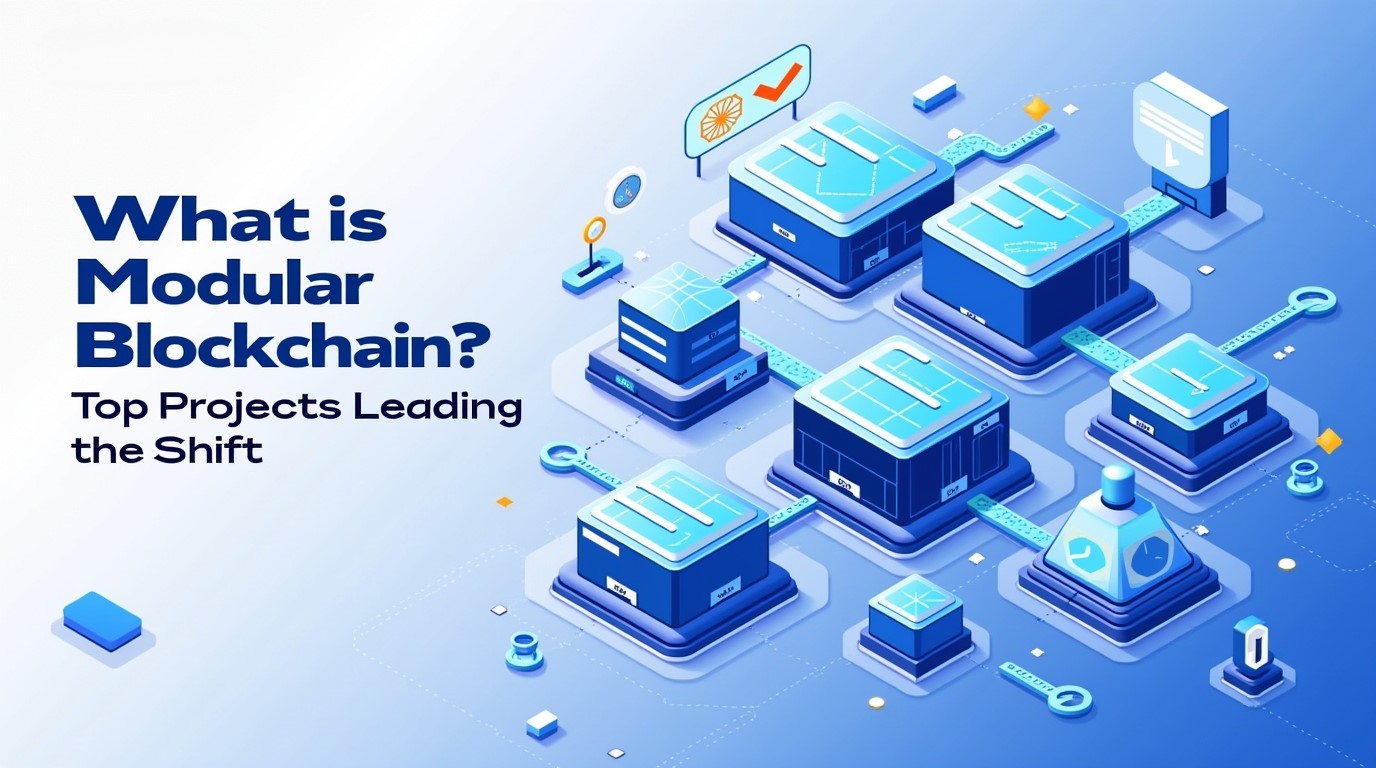
Modular blockchains decompose a blockchain’s core functions into specialized layers. Rather than a single chain performing all tasks, multiple layers collaborate. Think of it like moving from a single-lane road to a multi-lane highway system.
How Does Modular Blockchain Work? Four Layer Architecture
| Layer | Role | Examples |
| Execution | Runs transactions & smart contracts | Rollups (Arbitrum, Optimism, zkSync) |
| Consensus | Orders transactions | Ethereum, Celestia |
| Data Availability | Stores/verifies transaction data | Celestia, EigenDA, Avail |
| Settlement | Provides security & dispute resolution | Ethereum, Bitcoin |
Modular blockchains break the traditional “all-in-one” design of monolithic chains into four specialized layers: execution, consensus, data availability, and settlement. Each layer focuses on a single core function, allowing the entire system to scale more efficiently while preserving decentralization and security. By separating responsibilities, modular architectures enable higher throughput, lower fees, and greater flexibility for developers building next‑generation Web3 applications.
Execution Layer
The execution layer processes transactions, executes smart contracts, and governs the logic of decentralized applications. In monolithic blockchains, this occurs right on the main chain, which soon becomes congested. Modular blockchains can be deployed to other environments, such as optimistic rollups, zk-rollups, or app-chains, which can run concurrently.
Modular blockchains enable multiple apps to run simultaneously by offloading execution and avoiding competition for block space. Developers may develop bespoke execution layers optimized for gaming, DeFi, enterprise applications, or other use cases. The isolation ensures that even if the execution layer is busy, the network beneath remains unaffected.
Consensus Layer
The consensus layer ensures that the network agrees on the transaction sequence. It is the decision-making organization that validates the blocks and maintains the chain. In a modular architecture, the consensus layer only needs to order and validate transactions rather than process them.
This specialization enhances network capacity and network decentralization. Modular blockchains do not combine heavy processing and consensus loads; instead, they assign consensus to specific chains or protocols. This yields a more effective design in which consensus is lightweight, fast, and secure. Some modular networks support a single consensus layer being used by multiple execution layers to improve interoperability.
Data Availability Layer
The data availability (DA) layer verifies the availability of published, stored, and verifiable transaction data. Insufficient data availability does not guarantee network security, because nodes must access all necessary data to authenticate blocks. In a modular blockchain, the functions of DA, execution, and consensus are managed independently, and each can be scaled separately.
Projects such as Celestia have popularized this layer by offering a specialized DA network that rollups and app-chains can plug into. By separating DA from the core blockchain, modular systems can be massively scaled. Rollups need to publish data only once, and the DA layer ensures that the data is publicly accessible; therefore, other layers do not need to store it, nor does this improve performance.
Settlement Layer
The settlement layer provides the ultimate confirmation of transactions and serves as the point of truth for the modular ecosystem. It ensures that the execution layers and rollups can safely complete the results. Most modular designs convert platforms such as Ethereum into state-of-the-art settlement layers where rollups are published and transitions finalized.
When two or more layers interact, the settlement layer is essential in ensuring security. Rollups are built on settlement layers to verify proofs, resolve disputes, and ensure that all data in execution conforms to the final canonical chain. Settlement layers are increasingly significant as the modular ecosystem grows, helping ensure trust across interconnected chains and environments.
Modular vs Monolithic Blockchains: What’s the Difference?
Monolithic blockchains bundle every core function, execution, consensus, settlement, and data availability into a single layer. This design is simple and secure, but it becomes inefficient as demand grows. All applications share the same block space, resulting in congestion, high fees, and limited throughput.
Modular blockchains take the opposite approach. Instead of forcing a single chain to perform all tasks, they distribute responsibilities across specialized layers. Execution can occur on rollups or app‑chains; dedicated DA networks can ensure data availability; and settlement can occur on a secure base layer such as Ethereum. This separation significantly improves scalability, reduces costs, and provides developers greater control over their environment.
| Feature/Dimension | Monolithic Blockchains | Modular Blockchains |
| Architecture | All functions are handled on one layer | Functions are split across multiple specialized layers |
| Scalability | Limited by single‑chain throughput | Scales horizontally via rollups, app‑chains, and DA layers |
| Performance | Congestion affects the entire network | High throughput; heavy apps run on separate execution layers |
| Gas Fees | Increase sharply during demand spikes | Lower and more predictable due to off‑chain execution |
| Developer Flexibility | Must use the base chain’s VM, gas model, and constraints | Choose custom VMs, DA layers, settlement layers, and execution environments |
| Security Model | Security is tied to the base chain only | Layers inherit security from settlement/consensus layers |
| Upgrades & Innovation | Slow and risky as changes affect the whole chain | Faster iteration; each layer can evolve independently |
| User Experience | Slower, more expensive during peak load | Faster, cheaper, and more consistent |
| Examples | Bitcoin, Solana, and early Ethereum | Ethereum rollups, Celestia, Avail, EigenDA, Cosmos app‑chains |
Benefits of Modular Blockchains Over Traditional Designs
Modular blockchains introduce a fundamentally different architecture that breaks apart the tightly coupled components of monolithic chains. By separating execution, consensus, settlement, and data availability, modular systems unlock major improvements in scalability, performance, and developer freedom. These benefits directly address the structural limitations that have constrained earlier generations of blockchain.
- Improved Scalability: Modular blockchains scale horizontally by enabling execution across multiple rollups or app‑chains, rather than forcing all activity through a single base layer. This dramatically increases throughput and removes the bottleneck created by limited block space. Instead of competing for the same lane, applications can operate in parallel, enabling the ecosystem to support millions of users without sacrificing decentralization. It is important because monolithic chains reach hard throughput limits, as every transaction must be processed on the same layer.
- Reduced Network Congestion: Because execution is offloaded to specialized layers, heavy workloads, such as gaming, social interactions, or high‑volume DeFi, no longer congest the main chain. Each rollup or app‑chain handles its own traffic, preventing network‑wide slowdowns and ensuring consistent performance even during peak demand. It is important because in monolithic systems, a single popular dApp can congest the entire network and spike fees for everyone.
- Lower & More Predictable Fees: With execution occurring on scalable rollups and data availability managed by optimized DA layers, transaction costs decrease significantly. Users no longer compete for scarce block space on the base chain, resulting in cheaper and more stable fees across the ecosystem. It is important because monolithic chains experience fee spikes whenever demand increases, making everyday usage expensive and unpredictable.
- Greater Customization for Developers: Modular architectures enable developers to select their execution environment, virtual machine, data availability layer, and settlement layer. Teams can build app‑specific chains tailored to their performance, security, or economic needs. This flexibility accelerates innovation and allows developers to optimize for their exact use case rather than conforming to the constraints of a single L1. It is important because monolithic chains require all developers to use the same VM, gas model, and resource limits.
- Easier Upgrades & Faster Innovations: Since each layer is independent, upgrades can be made without disrupting the entire network. Execution layers can evolve rapidly, DA layers can scale independently, and settlement layers can focus on maximizing security. This modularity enables faster iteration and safer upgrades compared with monolithic chains, in which changes are slow, risky, and require broad consensus. It is important because monolithic blockchains struggle to upgrade, as every change affects the entire system.
- Enhanced Security Through Specialization: Modular blockchains enable each layer to focus on its primary function. Settlement layers maximize economic security, DA layers ensure data integrity, and execution layers optimize performance. This specialization reduces attack surfaces and strengthens the overall trust model. It is important because monolithic chains must balance all functions simultaneously, often compromising performance and security.
Top Modular Blockchain Projects Leading the Industry Shift
Several blockchain projects are leading in modular design, and each plays a different role in developing scalable, flexible, and secure networks. These projects show that separating the execution, consensus, data availability, and settlement layers can revolutionize the blockchain environment.
Celestia
One of the first all-modular data availability networks is Celestia. It provides a dedicated blockchain for storing and validating transaction data and enables rollups and standalone blockchains to securely relay information. The architecture of Celestia allows developers to isolate data availability and execution, enabling them to deploy sovereign rollups that use Celestia to ensure the security of their data at rest while executing in independent environments. Celestia is the core infrastructure that enables the creation of modular blockchain ecosystems by allowing scalable data sampling without sacrificing security.
Polkadot
Polkadot is an innovative modular network that connects multiple parachains to a central relay chain. Each parachain operates as a separate execution environment and relies on the relay chain for consensus and shared security. This design is highly scalable, interoperable, and customisable, enabling developers to build chains that best suit their requirements while preserving the security and finality of the relay chain. The modular architecture of Polkadot demonstrates that several single-purpose chains can coexist without conflict within a single ecosystem.
Ethereum
Ethereum is increasingly adopting a modular approach as it shifts to a layered ecosystem. It is increasingly viewed as a settlement layer and a data availability layer, with the emergence of rollups such as Optimism, Arbitrum, zkSync, and StarkNet. Rollups conduct off-chain transactions and submit proofs to Ethereum, leveraging Ethereum’s high security while significantly enhancing throughput and reducing costs. The Ethereum roadmap, which includes proto-danksharding, full sharding, and related features, underscores the network’s commitment to modularity, enabling it to scale with the expanding DeFi, NFT, and Web3 ecosystems.
Cosmos
Cosmos is a hierarchical ecosystem that provides a structure comprising interconnected application chains based on the Inter-Blockchain Communication (IBC) protocol. Each Cosmos chain remains fully sovereign, with developers able to modify execution environments, governance, and performance, even as it interoperates with other chains. The Cosmos Hub serves as a central settlement layer, and ecosystem chains can interact freely via IBC, forming a modular yet integrated blockchain network. The design facilitates dedicated applications and enhances the network’s detailed flexibility and extensibility.
EigenLayer
EigenLayer also introduces restaking, which enables Ethereum stakers to provide their security coverage to other networks and modular layers. By leveraging existing staking infrastructure, EigenLayer is developing a scalable, security-focused marketplace that benefits rollups and independent modular blockchains. By minimizing the separation of the validator set, reducing operational overhead, and enhancing the security of modular ecosystems, it has become a significant enabler of future modular architectures.
Polygon 2.0
Polygon is becoming a modular, multi-chain ecosystem based on zk. Polygon 2.0 will seek to bridge multiple execution layers via zero-knowledge proofs to establish interoperability and shared governance. The platform’s modular design enables rollups and app-chains to run effectively on common settlement and bridging infrastructure. Such a model enhances scalability, reduces transaction costs, and establishes a single framework for decentralized applications.
Dymension
Dymension is working on RollApps, rollups that are being customized as independent application chains. They are RollApps, built on common settlement and data availability layers, enabling developers to deploy decentralized applications efficiently and quickly. Dimension enables execution layers to run independently of one another while providing network security and interoperability through a completely modular stack. This enables developers to test specialized app chains without the burden of building full-sized monolithic networks.
Limitations and Challenges of Modular Blockchain Systems
While modular blockchains offer significant advantages in scalability, flexibility, and performance, they also introduce new challenges for developers and users. These limitations don’t undermine the value of modular architectures, but they do highlight areas where the ecosystem is still maturing.
Increased Architectural Complexity
Modular systems are inherently more complex than monolithic blockchains. Instead of a single chain handling all functions, multiple layers, such as execution, consensus, settlement, and data availability, must work together seamlessly. This creates a more intricate architecture that requires deeper technical understanding, more sophisticated tooling, and careful design choices. Developers must consider how each layer interacts, how data flows between them, and how to maintain reliability across a distributed stack.
This complexity can raise the barrier to entry for new teams and increase the risk of misconfigurations or design flaws.
Interoperability Challenges
Because modular ecosystems often involve multiple independent layers and chains, ensuring smooth interoperability becomes a major challenge. Rollups need to communicate with settlement layers, DA networks must integrate with execution environments, and cross‑chain messaging must remain secure and reliable. Without strong interoperability standards, fragmentation can occur, making it harder for applications to interact across different modular stacks.
Poor interoperability can limit composability, a core strength of Web3, and create siloed ecosystems.
Coordination Between Layers
Each layer in a modular blockchain has its own upgrade cycles, governance processes, and performance characteristics. Coordinating changes across these layers can be difficult, especially when different teams or communities operate them. A change in a DA layer, for example, may require adjustments in rollups or settlement logic. Ensuring compatibility and stability across the entire stack becomes an ongoing challenge.
Misaligned upgrades or governance decisions can introduce downtime, bugs, or unexpected behavior across dependent layers.
Potential Security Trade‑offs
Modular blockchains rely on multiple layers to provide security guarantees. While this allows specialization, it also introduces new attack surfaces. For example:
- Rollups depend on DA layers to publish data correctly.
- Settlement layers must verify proofs accurately.
- Cross‑layer communication must be trustless and tamper‑resistant.
If any layer fails or is compromised, the entire system can be affected. This creates a more distributed security model that requires careful auditing and robust cryptographic guarantees.
Security becomes a shared responsibility across layers, increasing the importance of strong standards and rigorous testing.
How These Challenges Are Being Addressed
The modular ecosystem is evolving rapidly, and many of these issues are being actively mitigated through:
- Standardized interfaces (e.g., rollup frameworks, DA APIs)
- Shared security models and proof systems
- Cross‑chain messaging protocols with formal verification
- Better developer tooling for modular stack deployment
- Ecosystem‑wide coordination through open governance and collaboration
While progress is significant, these challenges remain important considerations for anyone building or deploying modular blockchain solutions.
What’s Next for Modular Blockchains?
The future of modular blockchains is bright, as their use continues to increase. Rollups are emerging in the Ethereum ecosystem as a new scaling option, with modular networks coming online to serve millions of users. The fields of shared security, zk proofs, and data availability sampling are driving modular architectures to unprecedented scale.
More chain-specific applications, sovereign rollups, and multi-chain systems built on modular frameworks can be expected. This will enhance interoperability, refined through cross-chain messaging protocols. In the meantime, modular blockchains can be adopted by enterprises and Web2 companies because they provide scalable solutions in real-life applications, such as supply chain, identity, and finance.
With ongoing research and development, modular blockchains can become the standard architecture of Web3, with monolithic chains phased out as they cannot sustain heavy demand.
Final Thoughts
A significant development of blockchain design is modular blockchains. Their isolation of execution, data availability, consensus, and settlement into layers allows them to establish scalable, secure, and flexible ecosystems that can support the next generation of decentralized applications. Celestia, Polkadot, Cosmos, and Ethereum are among the leading projects spearheading this change, offering new solutions to address the challenges of monolithic systems.
With the growth of Web3, the modular approach offers the performance, cost-effectiveness, and developer freedom required to scale to global usage. Although some difficulties remain, ongoing innovation suggests that modular blockchains will be highly relevant to building a decentralized future.
Frequently Asked Questions
What is the impact of modular blockchain architecture on transaction fees?
Compared to conventional monolithic chains, the modular blockchain architecture can dramatically reduce transaction costs. Workloads are spread across multiple environments by isolating execution, consensus, and data availability across three layers. Off-chain execution layers (rollups or app-chains) process transactions, thereby preventing the leading network from becoming overloaded. Users benefit from lower gas fees and shorter confirmation times because minimal computational effort is required on the settlement and consensus layers.
What is a rollup, and what is its role in modular blockchain?
Rollups are Layer-2 scaling protocols that process transactions off-chain while using a security and finality layer on the main chain (settlement layer). They aggregate multiple transactions into a single batch and verify correctness with the settlement layer. Rollups are usually used as execution layers in modular blockchain systems. They enable developers to build custom execution environments tailored to their application requirements without overloading the consensus and data availability layers.
What is the role of modular blockchains in ensuring security in the case of functions being separated by layers?
In modular blockchains, security is achieved through specialization and shared responsibility. All layers are dedicated to one of three objectives: implementation, consensus, or data availability, thereby minimizing workload risks and complexity. Layers of settlement, including Ethereum, are the ultimate source of truth; that is, they validate execution and data availability layers. Additionally, projects such as EigenLayer enable multiple layers of restaking by validators, providing a standardized security model without requiring each layer to maintain its own validator set.
Will the modular blockchains be able to eliminate layer-1 chains?
The use of modular blockchains does not exclude Layer-1 chains; they simply repurpose them as specialized layers. In a modular architecture, Layer-1 chains are commonly settlement or consensus layers that finalize and secure execution environments. Although execution and specific data processing are offloaded to Layer-2 support systems such as rollups, Layer-1 is still required to preserve the canonical blockchain state.
How do modular blockchains solve inter-layer or inter-chain interoperability?
Modular blockchain ecosystems have interoperability as a fundamental attribute. Layers use standardized protocols and cryptographic verifications to communicate. For example:
- Execution layers provide transaction proofs to settlement layers.
- Layers of data availability provide access to transaction data for verification.
- Cosmos uses Inter-Blockchain Communication (IBC) protocols to enable independent chains to exchange information.
This layered communication ensures that all modular components are aligned, enabling developers to deploy multi-chain applications without compromising security or scalability. Also, bridges and unified wallets are increasingly being built to streamline cross-layer interactions and enhance the user experience in modular blockchain networks.
Disclaimer
This article is for educational and information purposes, and should not be considered financial advice. For more information visit our disclaimer page
About the Author