
Did you know that the crypto market is over 3.6 times more volatile than gold and almost 5 times more volatile than global equities? In such an unstable environment, one moment could be riding a bullish surge, and the next, protecting your gains. This calls for a smart mechanism, such as a trailing stop, to move with market shifts so you don’t lock in early or lose control when the trend reverses.
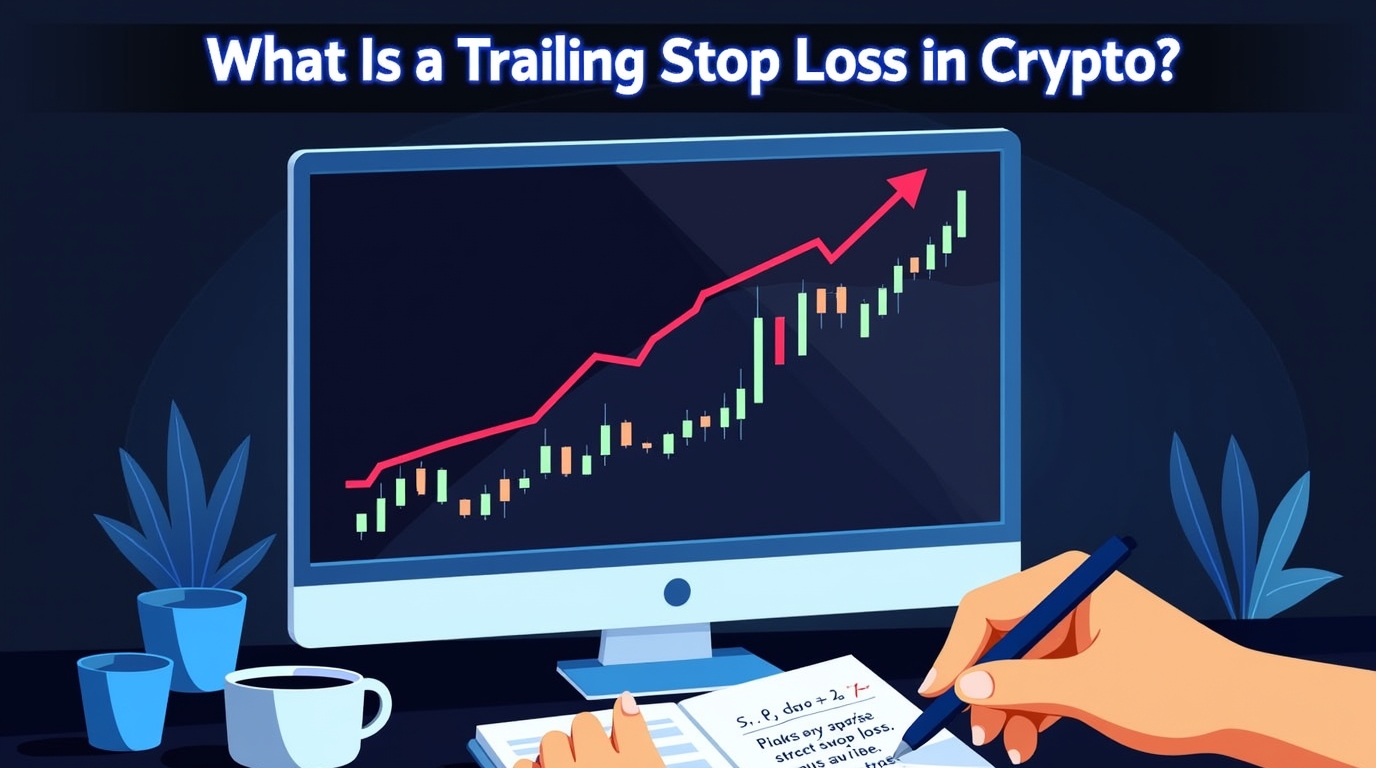
Take a trailing stop loss as an adaptive exit strategy. When you buy a coin and set a trailing stop, the stop level climbs as the market price increases, but stays at a fixed distance behind the peak. However, if the price falls by a preset amount, the stop triggers and you exit, locking in whatever profit you’ve earned. This dynamic flexibility makes it different from a fixed stop loss.
This tool enables beginner and intermediate traders to grow their profits without constantly monitoring the charts, while still maintaining a safety net in place when the market shifts.
Trailing Stop Loss vs Fixed Stop Loss: What’s the Difference?
A trailing stop loss is a dynamic risk-management tool that automatically moves the market when the price increases. Instead of keeping the level fixed, it keeps a fixed distance below the highest price reached—the stop “trails” behind when the market shifts upward, allowing individuals to lock in profits. If the price decreases by the predefined trailing amount, the order triggers and closes the trade, locking in profits without requiring constant manual monitoring.
However, a fixed stop loss stays precisely where you place it. It protects against downside risk, but doesn’t adjust when market shifts in your favor. To understand this better, consider that you set a stop at 5% below your entry point, and the price rallies 30%. In this scenario, your stop remains at the original level, so you risk giving back those unrealized gains in the event of a market crash.
A trailing stop provides traders with more flexibility in the highly volatile cryptocurrency market. The tool combines downside protection with the ability to ride profitable moves longer, while stops offer more simplicity but less adaptability.
The table below shows a comparison between a trailing stop loss and a fixed stop loss:
| Feature | Trailing Stop Loss | Fixed Stop Loss |
| Adjust with price movement | Moves up automatically when the price increases | Stays at a fixed level |
| Protects unrealized profits | Locks in gains during uptrends | Does not adjust to protect profits |
| Best suited for | Trending or volatile markets | Range-bound or uncertain markets |
| Risk of early trigger | Higher if the trail is too tight in volatile shifts | Lower as price fluctuations don’t shift orders |
| Effort required | Minimal | Minimal but requires manual updates for profit locking |
| Suitable for new traders | Yes, but requires an understanding of trail settings | Yes, but set to set and use |
| Primary purpose | Maximize gains + manage downside | Prevent large losses from a bad move |
How Trailing Stop Loss Orders Work
A trailing stop follows price fluctuations in real-time and adjusts automatically when the market moves in your favor. Once you enter a trade, set a trailing value (either as a percentage or a fixed amount), and when the price increases, the stop moves up with it, maintaining the same distance from the current high. This fluctuation creates a dynamic exit strategy that adapts to market trends rather than adhering to a fixed level.
The trailing stop only reacts to upward price movement for a long position or downward movement for a short position. If the market trends upward, the stop rises to secure gains. The order triggers and exits once the market reverses by the set distance. This is a valuable strategy in the volatile crypto market.
Choosing the Initial Stop Price and Trailing Distance
When setting the trailing stop loss, select an initial stop level based on your maximum acceptable risk. The next step is to choose the trailing distance, which acts as a buffer between the current market price and your stop. This can be expressed as a percentage or a fixed dollar value.
A smaller trailing distance ensures strong protection and locks in gains quickly, but increases the chance of being stopped out by normal market noise. A wider trailing distance offers more flexibility and helps capture bigger moves while securing profit before the stop triggers.
Using an Activation Price vs. Immediate
You can activate the trailing stop immediately, which means it starts following the price as soon as the order is placed. This is ideal when you want instant downside protection.
Similarly, you can set an activation price, which permits the trailing stop to begin tracking only when assets reach a specified trigger point. This helps traders gain more control, but it requires a clear strategy and a well-defined market thesis.
How the Stop Adjusts and Executes
Once the tool is active, it continuously adjusts upward with the market, rather than moving down. When the asset price increases, the stop follows at the fixed trailing distance while preserving more profit. Alternatively, when the price drops by a trailing amount, the stop triggers and the system executes an exit.
This strategy removes emotions from decision-making, so instead of guessing whether to take profit or hold longer, the trail stops and automatically locks in gains while leaving room to grow your position.
Types of Trailing Stop Orders in Crypto Trading
Trailing stop orders can be executed differently depending on the trader’s preference, trading goals, and platform capabilities. However, the core logic is the same: following price movement and locking in profits when the market moves downward. Understanding these types helps traders select the most suitable strategy for risk control, execution reliability, and automation requirements.
Given below are three commonly used trailing stop order types in crypto trading:
- Trailing Stop Market Order
The trailing stop market order triggers a market sell or buy (for a short position) once the price reverses by a predefined trailing distance. This type prioritizes execution speed and ensures the position exists once the stop level is hit, regardless of the next available price. It is the most straightforward and widely used type, focusing on fast execution over price control.
However, in highly volatile conditions, the execution price can slip below your expected level due to quick price swings. Traders choose this type when they want certainty that the exit will be executed immediately, even if it means some slippage. This is especially useful during strong uptrends or high-momentum breakouts where the focus is on staying in the move until momentum fades.
- Trailing Stop Limit Order
Once the trailing threshold is met, a trailing stop limit order triggers a limit order instead of a market order. This gives traders more control over the minimum price they’re willing to accept when exiting. The trailing limit approach is ideal for protecting profits without risking an unexpectedly low execution price.
The trade-off of this type is that if the market drops quickly below the limit price, it could lead to a falling position. Traders use trailing limit orders in less volatile conditions or for assets with strong liquidity. This type is best suited for strategies focused on precision and price discipline, rather than guaranteed execution.
- Bot-Executed Trailing Stops
Bot-executed trailing stops utilize automated trading tools or crypto trading to manage the trailing logic, rather than relying solely on the exchange’s built-in order system. This provides advanced controls, such as customized triggers, risk rules, layered trailing logic, and pairing trailing stops with take-profit and scaling strategies. Bots also adjust levels in real-time, even if the trader is offline.
When Should You Use a Trailing Stop in Crypto?
Trailing stops are useful when the market is showing momentum and you aim to capture upside while staying protected from sudden reversals. For example, if Bitcoin moves from $55,000 to $65,000, a trailing stop ensures you don’t exit too early, but if momentum suddenly fades, the price reverses, and your profits are protected automatically.
The tools are especially useful during breakouts and high-volatile shifts, where equally swift corrections can follow the rapid price expansion. Instead of guessing how far the rally might go, a trailing stop lets you ride the breakout and exit only when the trend stalls. Consider a breakout from a long consolidation zone: enter the trade, set a trailing distance that fits the volatility, and allow the trend to run while managing risk precisely.
Intraday and swing traders benefit from trailing stops during short-term momentum shifts, especially on highly volatile crypto pairs. Take this as entering a trading during a sharp intraday surge, a trailing stop allows you to capture fast gains and protects if the move snaps back due to profit-taking. Even during news catalysts or sudden volume spikes, trailing stops help manage trades efficient when price action becomes unpredictable.
Trailing stops aren’t only for manual traders, as they are widely used in bot-driven strategies. Automated bots monitor markets 24/7, and trailing stops help them secure profits without emotional bias.
Pros and Cons of Using Trailing Stops
Trailing stops are useful because they help automate exit decisions and protect profits without constant monitoring. By automatically adjusting as prices shift in your favor, they allow you to stay in winning trades longer instead of closing too early. They also help remove emotional bias by enforcing a disciplined exit plan, which is valuable in a highly volatile market where impulsive decisions can be costly.
However, trailing stops are not perfect and require thoughtful configuration. In the fast-moving market, price swings can trigger stops prematurely, causing you to exit good trades before the trend continues. Market orders, commonly used by many trailing stop systems, can also lead to slippage, meaning your exit price may be worse than expected, especially during sharp drops or periods of low liquidity. Moreover, trailing stops offer limited value in sideways or consolidation phases where price changes within a range; frequent triggers can lead to multiple small losses or missed opportunities.
| Pros | Cons |
| Automatically secures profits as the price moves up | Can trigger too early during volatile pullbacks |
| Reduces emotional selling decisions | Slippage risk when markets move fast |
| Allows you to ride strong trends | Less effective in sideways/choppy markets |
| Useful for semi-passive and automated trading | Requires careful selection of trailing distance |
| Works well with bot-based and 24/7 trading systems | Not a guaranteed profit-protection mechanism |
Useful Tips for Using Trailing Stops Effectively
Trailing stops help protect profits, reduce emotional decision-making, and stay aligned with market momentum. Given below are some useful tips for using trailing stop effectively:
- Start with small trailing values when testing the feature to understand how your stop reacts to price shifts in real time.
- Adjust your trailing distance to match volatility—tighter trails for steady markets and slightly wider trails for highly volatile price action.
- Use a blend of trailing stops and take-profits to secure gains at key price levels while still allowing positions to run if momentum continues.
- Consider adding an activation price to prevent the trigger from triggering too early during market noise or minor fluctuations.
- Avoid placing stops at obvious levels where liquidity clusters, market makers, and large players often target predictable zones.
- Do not rely on a single indicator; instead, combine trailing spots with a trend confirmation tool such as moving averages, RSI, or price-action levels.
- Refine your stop distance based on asset behavior. Keep in mind that what works best for BTC may not be suitable for altcoins.
- Utilize market depth insights to prevent triggering during periods of thin liquidity or rapid price fluctuations.
- Test different strategies in a demo or paper-trading environment to improve your trail settings before applying them to larger positions.
Want to Learn More About Crypto Trading the Smart Way? Join Dypto Crypto!
Dypto Crypto offers a complete learning ecosystem, even if you’re just opening your first wallet or have already traded a few altcoins. The platform offers structured, beginner-friendly courses to help improve crypto strategies. Their team helps users navigate the fundamentals, including how cryptocurrency works, getting started, and what to know before placing trades.
Apart from this, Dypto Crypto offers a community-driven platform where you can explore in-depth guides on various complex topics and engage in discussions with other learners and traders. So if you’re serious about improving your trading strategies, then joining Dypto Crypto should be your immediate move.
FAQs (Frequently Asked Questions)
Q: What is the difference between stop loss and trailing stop loss?
A stop loss is a fixed price that closes a position to limit losses. In contrast, a trailing stop loss is a dynamic order that automatically adjusts its price as the market moves in your favor, locking in profits while protecting against losses.
Q: Can I use a trailing stop for long and short positions?
Yes. For a long position, you trail the stop below the market price once you lock in profits as the price increases. For a short position, you trail the stop above the market price once you lock in profits, when the price falls.
Q: What’s the best trailing stop strategy for volatile markets?
Considering the highly volatile markets, go for a wider trailing distance (a larger percentage) to prevent being stopped out by price fluctuations. Analyzing the asset’s Average True Range (ATR) will help you set a distance based on its typical volatility.
Q: Are trailing stop losses guaranteed to protect profits?
No. Despite being a powerful risk-management tool, it does not guarantee to protect profits. The slippage, market gaps, low liquidity, or sharp reversals can disrupt the execution.
Q: Can I use a trailing stop on a crypto bot?
Yes. Many dedicated crypto trading bots and third-party trading platforms use trailing stop functionality as a standard or advanced feature to help manage risk and automatically lock in profits in the volatile crypto market.
Disclaimer
This article is for educational and information purposes, and should not be considered financial advice. For more information visit our disclaimer page
About the Author