
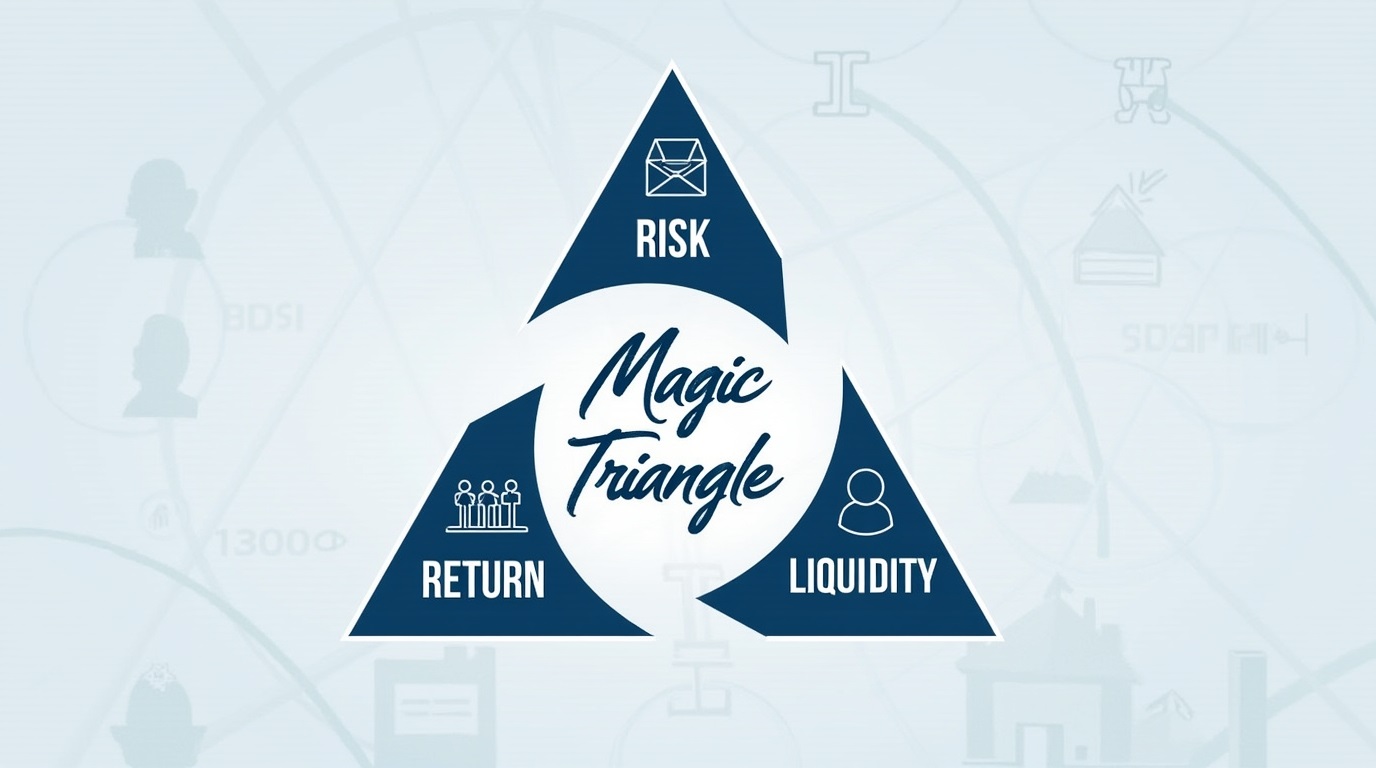
Did you know that over the past half-century, stocks with lower liquidity have consistently delivered higher expected returns. This liquidity premium can add as much as 7.5% per year to performance, even after adjusting for market, size, and value factors. This relationship hints the fact that you can’t have everything while investing funds.
The investment triangle or “magic triangle of investing” is a simple framework that forces investors and institutions to decide between three core factors, risk, return, and liquidity. The triangle shows that you cannot maximize everything at once and if you push too hard on one, you will compromise on another.
What Is the Investment Triangle?
The investment triangle is a simple framework that places risk, return, and liquidity in three corners.
- Risk: Uncertainty and potential for loss
- Return: Profit or gain that an investment generates
- Liquidity: The ease and speed with which an asset can be converted to cash without loss of value
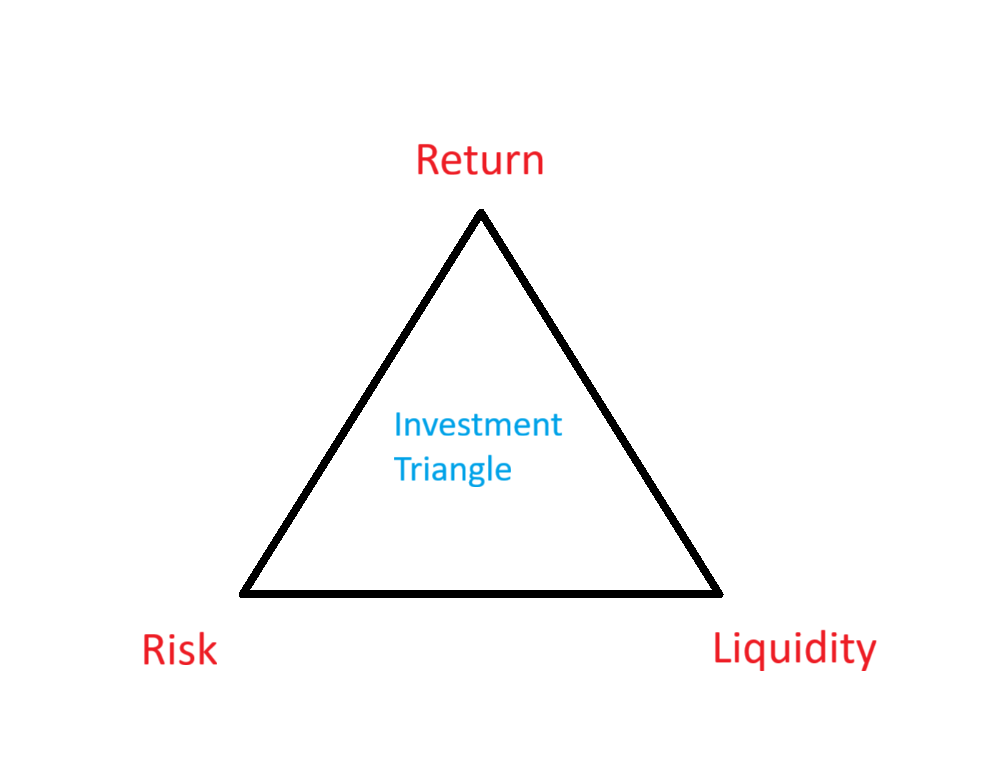
This helps investors see the inherent trade-offs, as there are no real investment guarantees, and deliver maximum return, minimum risk, and perfect liquidity together. For example, you can pull back on risk or liquidity if you only chase high returns. Similarly, returns will be suppressed if you aim for low risk and full liquidity. The golden triangle demonstrates that investment choices are about prioritization. If you focus on two sides, you must compromise on the third.
The triangle can be used as a decision framework to clarify, especially when evaluating a potential investment. You can choose which factor to sacrifice.
Investment Triangle vs. Investment Pyramid: What’s the Difference?
While both of these are foundational investment frameworks, they serve different purposes. The investment triangle is a strategic tool that evaluates individual assets or an overall portfolio strategy to identify trade-offs and the balance between any investment’s core properties. The main concern is what the fundamental characteristics of this investment are and how they align with our goals.
In contrast, the investment pyramid is a tactical asset allocation model that structures a portfolio in layers, from a broad, safe base to a narrow peak. The base of the pyramid contains low-risk, highly liquid assets (cash or government bonds), the middle section includes moderate-risk investments (diversified ETFs or corporate bonds), and the peak includes high-risk assets (crypto or penny stocks).
| Model | Primary Use Case | Ideal Context | Illustrative Example |
| Investment Triangle | Evaluating individual investment in terms of risk vs return vs liquidity trade-offs | When choosing an asset or product, or managing liquidity/time-horizon constraints | The approach is applied within a 30% reserve capital, like when picking equities, corporate bonds, or convertible debt, to help you decide how much liquidity you must retain and how much volatility (risk) is acceptable, and choosing instruments that balance return and liquidity relative to risk |
| Investment Pyramid | Portfolio structure and diversification in terms of setting what percentages go into safe and what as speculative assets | When designing high-level asset allocation | When you choose 60% funds in a safe layer (cash or short-term bonds), 30% in a growth layer (equities or investment-grade bonds), and 10% in an opportunistic (venture capital or distressed debt) |
Understanding the Three Pillars
The investment triangle helps us understand each pillar and how investments move between them. This model focuses on the fact that every investment choice comes with trade-offs, which implies that improving one pillar comes at the cost of another. When someone evaluates a stock, bond, or piece of real estate, they implicitly measure how much risk is acceptable, what expected returns are, and how quickly they can exit. Given below is a brief explanation of each pillar with real examples.
Risk
Risk means you may lose funds or underperform expectations in an investment. This risk includes volatility, uncertainty, default risk, market and regulatory risks, and unexpected events.
Examples:
- Stock Market Crashes: Suppose you hold equities during a market downturn. Because of volatility, prices can fluctuate dramatically, as even the strongest companies face downfalls in such times.
- Crypto Volatility: Cryptocurrency prices can change (either rise or drop) by double digits in just a few hours.
It’s important to understand that different assets carry different risk levels. For example, a U.S. Treasury bond is low risk, whereas a startup equity investment or high-yield debt is much riskier. Note that a higher risk might result in a higher return or significant losses.
Return
Return is the reward of an investment that includes income (dividends/interest) plus capital gains. Over time, the return can amplify.
Examples:
- High-Return vs Low-Return Investments: A growth stock might offer 10-15% annual return, whereas a banking savings account or government security might yield 1-3%
- Compound Interest: The growth accelerates if you earn 8% per year and reinvest it.
Note that higher returns come with higher risk, so if you aim for 12-15% or higher returns, you need to accept greater volatility, illiquidity, or both. Remember that returns are not guaranteed and actual returns may deviate from expectations.
Liquidity
Liquidity refers to how quickly investments can be converted into cash without affecting their price. When more assets are liquid, buying or selling them without major cost or delay is easier.
Examples:
- Highly Liquid Assets: These are publicly traded stocks, ETFs, government bonds that can be purchased and sold within seconds or hours at transparent market prices.
- Illiquid Assets: Real estate, private equity, venture capital, art, or specialized collectibles that take weeks or months to sell and may incur transaction costs or discounts.
Liquidity is important in decision-making as it ensures individuals can access funds in emergencies or seize opportunities. For businesses or institutions, it is required to meet obligations, meet cash flow requirements, or reallocate capital.
Why You Can’t Maximize All Three Simultaneously
The triangle of investment cannot optimize all three corners simultaneously, as each investment demands sacrifice in at least one of the three dimensions. For example, you find a high-return asset, but it comes with high risk, low liquidity, or both. Similarly, a safe asset must be highly liquid and offer modest returns. The triangle demonstrates the simple fact that investment choices are all about trade-offs.
To understand this further, let’s consider some real-world asset types.
- Stocks: Public equities often offer high returns and reasonable liquidity but come at the cost of higher risk.
- Bonds / Cash-equivalents: These assets deliver lower risk and good liquidity but lower return.
- Real Estate / Private Equity / Illiquid Alternatives: These assets deliver high returns and sometimes long-term security but lower liquidity.
As assets sit along the triangle, investment strategies prioritize two of the three pillars and accept trade-offs on the third. These pillars are prioritized based on investors’ goals, horizons, and risk tolerance. In an institutional context, you might want to focus on liquidity and security to protect capital and maintain cash flow, or go for security and return for long-term growth.
How to Build Your Portfolio Using the Investment Triangle
Using the investment triangle to structure a portfolio gives individuals and businesses a clear map of how choices relate. So, instead of following high returns only, the model allows you to prioritize on what you want and what you can compromise on.
The step-by-step approach below will help you apply the triangle systematically to your project.
Assess Objectives & Time Horizon
Before choosing any asset, start by defining your financial goals. Do you want growth, income, or capital preservation? Then align these goals with your time horizon, i.e., short-term, medium-term, or long-term.
If your goal is capital preservation over 12 months, then you’ll focus on liquidity and low risk, but if you want long-term growth for over 10+ years, then go for higher risk, greater return, and lower liquidity.
The time horizon dictates how long you can lock in assets and how much liquidity buffer you need. If the horizon is short, you cannot chase high returns with illiquid, high-risk assets without increasing vulnerability.
Determine Risk Tolerance
Once the first step is done, assess the acceptable risk tolerance. This covers both the psychological comfort of how much loss you can take and the capacity of how much you can afford to lose without jeopardizing goals. A conservative stance prioritizes capital preservation, while an aggressive strategy focuses on maximal growth while accepting higher volatility.
Allocate Across Risk, Return & Liquidity
The next step is to allocate assets across the three pillars of the triangle. You can use the balancing act approach, which states that high-return assets like stocks and crypto can be offset by safer, liquid ones like bonds or cash reserves. You can go for either of the three models:
- Balanced Allocation: It holds 60% equities for return, 30% bonds for stability, and 10% cash for liquidity.
- Conservative Allocation: It focuses on 70% bonds and 20% cash with modest returns.
- Growth Allocation: It holds 80% equities or alternatives, trading off liquidity and stability for performance.
Monitor, Rebalance & Adjust
Your portfolio should adjust as market conditions and your goals change. It requires ongoing monitoring and rebalancing to maintain the desired balance between risk, return, and liquidity. Over time, certain assets outperform the other, shifting your portfolio away from its original structure.
This is why you must regularly review your portfolio to ensure it aligns with your original goals and liquidity needs. If one pillar dominates, rebalance it by trimming gains and reallocating to safer and more liquid assets. Organizations can rebalance by updating investment policies, reviewing cash-flow predictions, and adjusting to market or regulatory changes. Consistent rebalancing helps sustain long-term performance while keeping trade-offs under control.
Institutional Use of Investment Triangle
For businesses, funds, or institutions like pension funds, treasury operations, or corporate reserves, the investment triangle offers a far more useful framework. Let’s break down the usefulness of the framework:
- Liquidity and capital preservation often dominate corporate treasuries. Businesses may need access to funds for operations or unexpected events, so the triangle forces clarity that you have to compromise on some return to ensure liquidity and low risk.
- Pensions and endowments have long horizons, so they accept lower liquidity and higher returns but manage risk.
- Fintech platforms or B2b SaaS providers targeting institutional clients use the triangle to monitor shifts, like increasing risk or decreasing liquidity, and alert when trade-offs go off-balance.
- The triangle becomes a strategic tool for important decision factors like stakeholders’ expectations, regulatory capital/advice constraint, cash-flow needs, and stress-testing under adverse scenarios.
Strengths and Limitations of the Investment Triangle
The golden investment triangle is widely used because of its simplicity and intuitive appeal. However, it has blind spots like any model.
Strengths
- Clarity and Simplicity: The model provides a clear, visual framework for communicating the trade-offs between the three factors.
- Trade-off Awareness: It reminds investors to compromise on at least one dimension to prevent false promises of high return, low risk, and high liquidity.
- Strategic Decision Tool: It is useful in business, institutional, or B2B settings to align on priorities.
- Framework Flexibility: You can adapt your weighting of the three corners to different goals or client segments.
- Complementary to Other Tools: It works well alongside more advanced models to impose discipline.
Limitations
- Oversimplification: Real investing involves more variables, such as inflation, taxation, regulation, ESG, currency risk, and macro shocks, that the triangle doesn’t incorporate.
- No Qualitative Guidance: The model does show which trade-offs exist but it doesn’t tell how much to trade and for this, you will need a rigorous modeling.
- Ignore Time Horizon Dynamics: The triangle treats all three dimensions as static but overtime, liquidity may change, risk profiles change and returns may not remain stable.
- May Mislead if Misused: Triangle gives no directional guidance on correlation, volatility clustering, tail risk, and other factors which may cause it to fail under stress.
Learn How to Invest Smartly in Crypto with Dypto Crypto
If you’re ready to boost your crypto game, Dypto Crypto is the right platform for you. It focuses on clear, engaging, and actionable learning. The detailed courses are built by industry experts that breaks down complex topics into understandable lessons helping both newcomers and intermediate learners.
So, if you’re interested in exploring your first crypto wallet or building institutional-level allocation strategies, Dypto Crypto offers modules that help you in every point. Sign up today if you’re serious about improving your crypto investment skills. Simply create your account, pick up a module, and start applying your lessons to build smarter crypto strategies.
FAQs (Frequently Asked Questions)
Q: What is the difference between the investment triangle and modern portfolio theory?
The investment triangle is a simple, high-level model focusing on a single investment’s trade-offs (risk, return, and liquidity). Modern portfolio theory is quantitative and focuses on diversification, mean-variance optimization, efficient frontier, and risk optimization of a set of assets. The triangle helps in decision-making, while MPT gives a mathematical tool for allocation and optimization.
Q: How does economic uncertainty or recession change triangle priorities?
During a period of high uncertainty, institutional and individual investors shift their priorities towards liquidity and capital preservation (low risk). The triangle framework help revisiting priorities, increasing liquidity buffer, reducing high-risk positions, and accepting lower return temporarily to shift trade-offs.
Q. Is the investment triangle outdated in today’s decentralized finance world?
No, the triangle has valid core principles. DeFi, crypto, and tokenized assets offer higher potential returns and new liquidity models, but they also come with high risk and hidden liquidity issues. The investment triangle helps evaluate trade-offs and map the positions of new assets.
Q: Does the triangle work for passive income strategies like staking or dividend investing?
Yes, the triangle applies to passive income strategies like staking and dividend investing because it’s the framework for evaluating any investment. For example, dividend-yield stocks offer moderate return, risk, and liquidity, which means you can sell stocks but with some impact. Staking crypto might offer a higher return, but lower liquidity and higher risk. The triangle helps you decide whether the trade-offs align with your goals or income strategies.
Disclaimer
This article is for educational and information purposes, and should not be considered financial advice. For more information visit our disclaimer page
About the Author