

MEV bots are everywhere in DeFi right now, lurking in the mempool, racing for arbitrage opportunities, and reshaping how transactions are processed. They have become one of the most talked-about forces in crypto trading because they can unlock hidden profits but also introduce new risks and fairness concerns.
In this article, we will break down how MEV bots operate, explore the different types and strategies they use, highlight the risks and downsides traders face, and finally weigh up whether they are truly worth using. By the end, you will have a clear, beginner-friendly foundation to understand both the opportunities and the controversies surrounding MEV bots.
What Is a MEV Bot?
A MEV bot (short for Maximal Extractable Value bot) is an automated program that runs on blockchain networks, most commonly Ethereum. Its core purpose is to identify and exploit profitable opportunities hidden in how transactions are processed. Here is a beginner-friendly breakdown:
- MEV (Maximal Extractable Value): This refers to the extra profit that can be made by reordering, inserting, or excluding transactions in a block before it’s finalized.
- MEV Bot Definition: An MEV bot is software that scans pending blockchain transactions and automatically executes strategies to capture the profit. Think of it as a high-speed trader that looks for tiny inefficiencies in decentralized finance (DeFi) markets.
- Core Function: Monitors the mempool (the waiting area for transactions before they’re added to a block). Identifies opportunities such as arbitrage (buying low on one exchange, selling high on another), frontrunning (jumping ahead of a profitable trade), or liquidations. It also submits its own transactions to maximize profit, often by paying higher gas fees to get priority.
- Why It Matters: MEV bots can influence transaction costs, cause failed trades, and even shape the fairness of DeFi markets. They’re both a source of innovation and controversy in blockchain systems.
How Do MEV Bots Work
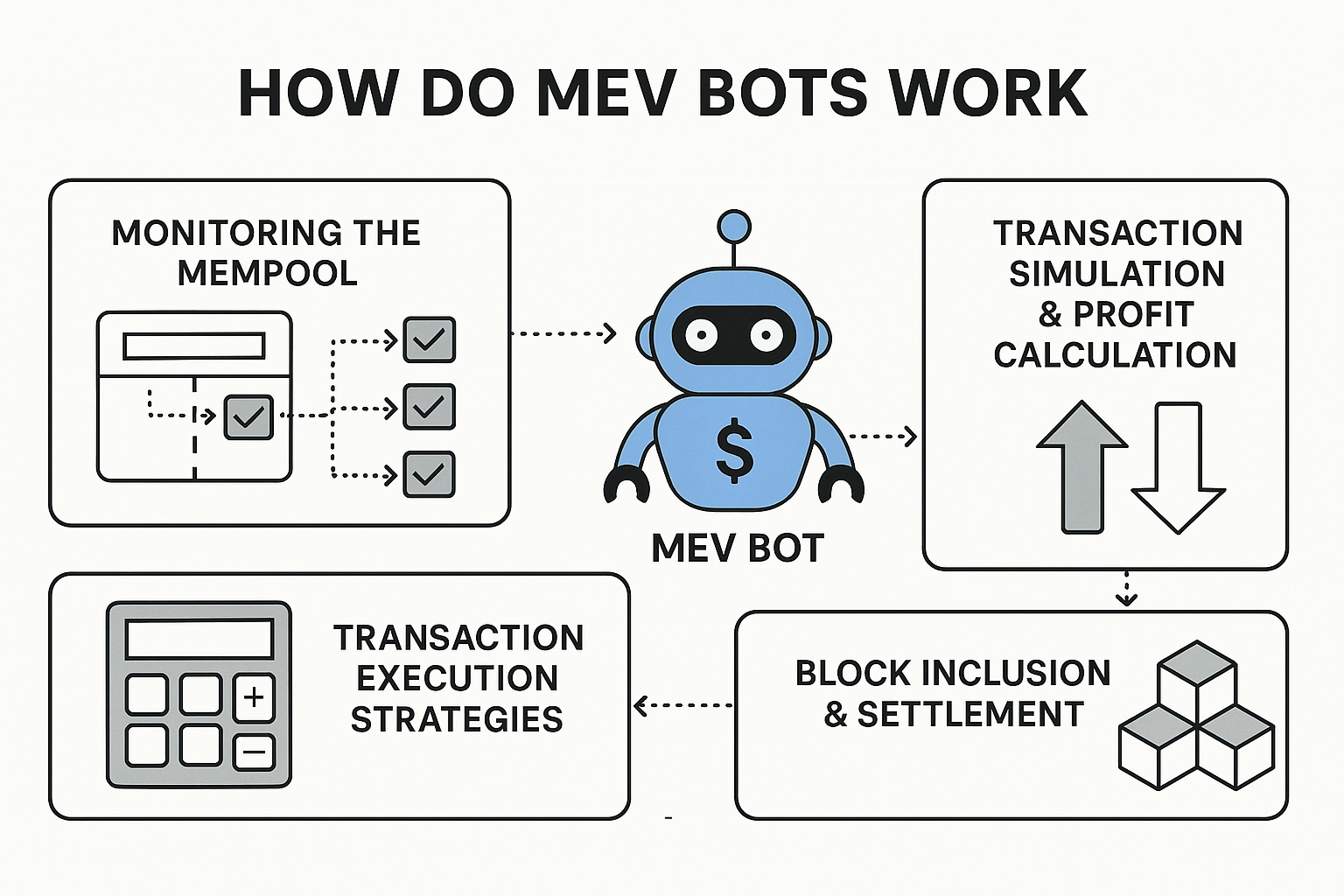
MEV bots follow a clear lifecycle to capture profit opportunities in blockchain systems. Their process can be broken down into four main stages:
Monitoring the Mempool
- The mempool is like a waiting room for transactions before they’re added to a block.
- MEV bots constantly scan this space to detect large trades that may shift token prices, liquidations in lending protocols, and arbitrage opportunities across decentralized exchanges (DEXs).
- By spotting these early, bots can act before the transactions are confirmed.
Transaction Simulation & Profit Calculation
- Before committing real money, MEV bots simulate transactions.
- They estimate the potential profit from the opportunity, the gas fees required to secure priority, and risks such as execution failure or slippage.
- This step ensures the bot only acts when the reward outweighs the cost.
Transaction Execution Strategies
Once profitable opportunities are identified, bots decide how to position their transactions:
- Frontrunning: Placing a transaction just before another to benefit from price movement.
- Backrunning: Executing right after a large trade to capture arbitrage.
- Sandwiching: Placing trades before and after a target transaction to profit from price changes.
These strategies rely on speed and precise timing.
Block Inclusion & Settlement
- To ensure their transactions are included, MEV bots often pay higher gas fees or use direct deals with validators/miners.
- Validators are incentivized to include these transactions because they earn more fees.
- Once included, the transaction is settled on-chain, locking in the bot’s profit.
Types of MEV Bots in Crypto
MEV bots come in many flavors, each designed to exploit specific inefficiencies or timing gaps in blockchain systems. While some strategies, like arbitrage, help balance markets, others, like sandwich attacks, can harm regular users by manipulating transaction order. Understanding these types helps traders, developers, and users better navigate the risks and dynamics of decentralized finance (DeFi).
Arbitrage Bots
Arbitrage bots are among the most common MEV bots. They exploit price differences between decentralized exchanges (DEXs) or liquidity pools by buying a token at a lower price on one platform and selling it at a higher price on another, often within the same block. These bots help align prices across platforms, contributing to market efficiency.
However, they also increase competition for block space, which can drive up gas fees and cause failed transactions for regular users. Their speed and precision make them powerful tools, but they require constant monitoring of price feeds and mempool activity to stay ahead of other bots.
Backrunning Bots
Backrunning bots execute transactions immediately after a large trade that moves the market. For example, if a whale swaps a large amount of ETH for USDC, pushing the ETH price up, a backrunning bot might buy ETH just after the swap and sell it at the new, higher price. These bots rely on real-time mempool monitoring and fast execution to capture the price momentum created by others.
While less aggressive than frontrunning, backrunning still leverages timing advantages and can subtly impact price discovery. It’s a strategy that rewards bots for reacting quickly to market-moving events.
Sandwich Bots
Sandwich bots perform a “before and after” attack around a user’s trade. When a bot sees a large swap in the mempool, it places a buy order just before the user’s transaction (to push the price up), then a sell order right after (to profit from the inflated price). This captures the slippage, the difference between expected and actual execution price, at the victim’s expense.
Users end up with worse trade outcomes, paying more or receiving less than expected. To defend against sandwich attacks, traders can use lower slippage settings, private RPC endpoints, or MEV-protected transaction routes like Flashbots or MEV-Blocker.
Liquidation Bots
Liquidation bots monitor lending protocols for loans that fall below healthy collateral ratios. When a borrower’s position becomes vulnerable, often during market volatility, these bots race to liquidate the loan and earn a bonus. This process helps maintain protocol solvency but can be brutal for borrowers who aren’t actively managing their positions.
Liquidation bots spike in activity during price crashes or rapid price swings, making it essential for borrowers to monitor health metrics and set alerts. Some bots even simulate future price movements to anticipate liquidations before they happen, adding another layer of competition and complexity.
JIT Liquidity Bots
Just-In-Time (JIT) liquidity bots temporarily add liquidity to a pool right before a large swap, earn trading fees from that swap, and then remove the liquidity immediately after. This tactic allows bots to profit without long-term exposure to impermanent loss. While clever, it can reduce fee share for long-term liquidity providers (LPs) and distort pool dynamics during large trades.
JIT bots often rely on mempool monitoring and precise timing to insert and withdraw liquidity within the same block. Their presence highlights the tension between passive LPs and active MEV strategies in DeFi ecosystems.
NFT MEV Bots
NFT MEV bots target high-demand mints or underpriced listings by scanning the mempool and executing faster than regular users. These bots can snipe rare NFTs before others, often using custom RPCs and optimized gas bidding. While they help surface valuable listings quickly, they also increase competition, cause failed transactions, and drive up mint costs.
For everyday users, this means more frustration and fewer chances to participate in hyped drops. Some platforms now use allowlists, randomized minting, or MEV-resistant infrastructure to reduce bot dominance and restore fairness in NFT launches.
Cross-Chain / Bridging MEV Bots
Cross-chain MEV bots exploit timing gaps and price differences across blockchains and bridges. For example, if ETH is cheaper on Arbitrum than on the Ethereum mainnet, a bot might bridge ETH from one chain to another and sell it for a profit. These strategies are complex and sensitive to bridge delays, inventory risks, and fluctuating fees.
Bots must track multiple mempools and price feeds across chains, making them harder to build and maintain. While powerful, cross-chain MEV is also riskier, especially during congestion or bridge outages, and is often reserved for advanced operators.
Oracle / Update-Timing Bots
Oracle MEV bots trade around known data refresh windows, such as Chainlink price updates or TWAP recalculations. When an oracle updates a token’s price, bots can execute trades that profit from the realignment between on-chain and off-chain values. This requires precise timing and a deep understanding of protocol mechanics. In edge cases, these strategies can resemble exploits, especially if they manipulate conditions just before an update.
Oracle MEV is highly technical and often overlaps with governance, protocol design, and security considerations. It’s a niche but impactful area of MEV activity.
Risks and Downsides of Using a MEV Bot
While MEV bots can unlock powerful profit opportunities, they also come with serious risks, especially for less experienced users. From technical vulnerabilities to ethical concerns, operating an MEV bot demands deep expertise, robust infrastructure, and a clear understanding of the trade-offs involved. Many users are drawn to the potential for high returns, but few are prepared for the financial, operational, and reputational risks that accompany them.
Smart Contract & Code Risks
MEV bots often rely on custom smart contracts and complex logic to execute trades automatically. If these contracts are poorly written, untested, or contain hidden backdoors, users can lose funds instantly.
Bugs in the code can lead to failed transactions, unintended behavior, or even permanent loss of assets. Worse, malicious actors sometimes release open-source MEV bots with subtle vulnerabilities that allow them to hijack or drain competing bots.
Without rigorous audits and secure deployment practices, users expose themselves to theft, exploitation, and cascading failures. This is especially dangerous in fast-moving environments where bots interact with volatile DeFi protocols.
Significant Financial and Capital Risks
Running a profitable MEV bot requires significant upfront capital and a high tolerance for loss. Bots often compete by bidding high gas fees to secure priority in block inclusion, so failed trades can still cost hundreds or thousands of dollars.
In highly competitive environments, multiple bots may target the same opportunity, leading to gas wars and diminishing returns. Many users underestimate how often transactions fail or get outbid, resulting in net losses despite promising setups.
Additionally, maintaining inventory across chains or pools adds complexity and risk. Without careful capital management and fallback strategies, MEV bot operations can quickly become unprofitable.
Technical and Operational Challenges
MEV bots demand high-performance infrastructure, including fast nodes, custom RPC endpoints, and real-time mempool access. They must be constantly updated to adapt to changing gas markets, protocol upgrades, and validator behaviors.
This requires deep technical knowledge, not just of smart contracts, but also of transaction ordering, block building, and network latency. Even small delays can cause missed opportunities or failed trades.
Many users underestimate the operational burden of keeping a bot competitive. Without automation, monitoring, and rapid debugging capabilities, even well-funded bots can fall behind or become obsolete.
Ethical & Regulatory Concerns
Some MEV strategies, like sandwich attacks or frontrunning, are viewed as exploitative or manipulative. They degrade user experience by causing slippage, failed trades, and unfair pricing. As MEV activity grows, regulators are taking notice. In 2025, agencies such as the DOJ and ESMA began classifying certain MEV tactics as market manipulation, with frameworks such as the EU’s MiCA aimed at tracking and penalizing suspicious behavior.
While not all MEV is malicious, the line between optimization and exploitation is thin. Users deploying bots must consider the ethical implications and prepare for evolving legal standards that may restrict or penalize certain tactics.
Is It Legal to Use a MEV Bot?
The legality of MEV bots is a gray area, heavily dependent on regional laws and interpretations of market manipulation.
- Regional Differences: In the U.S., prosecutors have argued that certain MEV tactics (such as frontrunning or “bait-and-switch” attacks) could fall under wire fraud or market manipulation laws. A recent case tested whether exploiting Ethereum’s transaction-ordering rules could constitute criminal activity. In the EU, frameworks like MiCA (Markets in Crypto-Assets Regulation) are beginning to address DeFi compliance, which may eventually include MEV practices. Other regions, such as the UK, focus more on institutional oversight, while ecosystems like Solana face fewer legal challenges.
- Ethical Debate: Some MEV strategies, like arbitrage, are seen as contributing to market efficiency. Others, such as sandwich attacks, are widely criticized as exploitative because they worsen trade outcomes for regular users. This raises questions about fairness in decentralized finance (DeFi), where transparency and equal access are supposed to be core principles.
- Industry Response: To counter harmful MEV, protocols and infrastructure providers are building MEV-resistant solutions. Examples include private transaction relays (such as Flashbots), MEV-protected RPCs, and fair ordering mechanisms that reduce bots’ ability to manipulate transaction placement.
Using an MEV bot is not automatically illegal, but certain strategies may cross into manipulative or fraudulent territory depending on local laws. Even if technically allowed, ethical concerns and evolving regulations mean that MEV bot operators should proceed with caution.
How to Stay Safe From MEV Bot Scams
Many “MEV bot” offers you will see online are scams. They often promise guaranteed profits, easy plug-and-play setups, or absurdly high APYs. In reality, most of these schemes are designed to steal your funds, trick you into sharing sensitive information, or drain your wallet through hidden approvals. Staying safe means treating MEV bot offers with extreme caution and following a disciplined checklist.
- Never share your seed phrase: Legitimate tools will never ask for it. If someone does, it’s a scam.
- Verify domains and sources: Always double-check URLs. Scammers often use lookalike domains to trick users.
- Avoid “guaranteed APY” promises: No real MEV bot can guarantee profits. High returns with no risk are a red flag.
- Don’t install unknown apps or extensions: Malicious software can hijack your wallet or monitor your activity. Stick to trusted platforms.
- Review token approvals regularly: Use tools like Etherscan or Revoke.cash to check what contracts have permission to spend your tokens.
- Test with small deposits first: If you are experimenting, start with minimal amounts to limit potential losses.
- Use reputable MEV-protected swap tools: Platforms like Flashbots, MEV-Blocker, or private RPC endpoints help protect against predatory MEV strategies.
If something sounds too good to be true in crypto, it usually is. MEV bot scams thrive on hype and greed. Protect yourself by staying skeptical, verifying sources, and using trusted infrastructure.
Are MEV Bots Worth Using as a Trader?
MEV bots can be profitable, but they are not a one-size-fits-all solution. Their usefulness depends on who you are as a trader and how much technical, financial, and operational capacity you have.
Who They are Useful For
- Advanced traders, developers, or institutions with strong infrastructure, deep blockchain knowledge, and significant capital.
- Those who can afford to run high-performance nodes, monitor mempools in real time, and compete in gas wars.
- Teams that can audit smart contracts and adapt strategies quickly as DeFi evolves.
Why They are Not Beginner-Friendly
- MEV bots require constant maintenance and technical expertise.
- The competition is fierce, as most profitable opportunities are captured by highly optimized bots.
- Failed transactions, gas wars, and code risks often mean losses for inexperienced users.
- Ethical and regulatory concerns add another layer of uncertainty.
Trade-Offs
- Potential Gains: Arbitrage, liquidation bonuses, and fee capture can be lucrative.
- Complexity: Running a bot is closer to managing a trading firm than clicking a button.
- Risk: Bugs, scams, failed trades, and regulatory scrutiny can wipe out profits.
- Cost: Infrastructure, gas fees, and capital requirements are high.
MEV bots are worth considering only for advanced traders or teams with the right resources. For most individuals, the risks, costs, and complexity outweigh the potential rewards. Beginners are better off using MEV-protected tools and focusing on safer DeFi strategies before exploring MEV bot development.
Want to Learn More About Crypto Trading in a Fun and Engaging Way?
Crypto trading doesn’t have to feel overwhelming or overly technical. At Dypto Crypto, learning is designed to be fun, engaging, and accessible for traders of all levels, whether you are just starting out or already deep into DeFi strategies.
- Interactive Learning: Explore trading concepts through clear guides, visual frameworks, and easy-to-follow checklists.
- Community-Driven: Connect with other traders, share insights, and grow together in a supportive environment.
- Practical Tools: Gain access to actionable strategies, MEV-protected swap routes, and risk management frameworks that help you trade smarter.
- Tailored for All Levels: Beginners get simplified breakdowns, while advanced traders can dive into deeper technical analysis and cutting-edge tactics.
Ready to level up your trading journey? Sign up with Dypto Crypto today and discover how learning about crypto can be both educational and enjoyable.
Frequently Asked Questions
Is it ethical to use a MEV bot?
It’s ethically debated. Some MEV strategies, like arbitrage, improve market efficiency, while others, such as sandwich attacks, are exploitative and harm regular users. Legality depends on local laws, but fairness concerns in DeFi mean MEV bots are controversial and increasingly scrutinized by communities and regulators.
Can I use an MEV bot if I’m not a developer?
Yes, but it is challenging. Non-developers can technically use prebuilt MEV bots, yet most require coding knowledge, infrastructure setup, and risk management skills. Without technical expertise, you are vulnerable to scams, losses, or failed trades. MEV bots aren’t beginner-friendly and demand an advanced understanding to be effective.
How can I protect myself from MEV attacks?
You can protect yourself from MEV attacks by using MEV-protected swap tools, private RPC endpoints, and setting lower slippage limits. Always review token approvals, avoid public mempool exposure when possible, and consider trusted relays like Flashbots to minimize the risk of predatory transaction ordering.
Can MEV bots be blocked or prevented?
Yes, MEV bots can be mitigated but not fully blocked. Protocols use MEV-resistant tools such as private RPCs, fair transaction ordering, and Flashbots to mitigate the harms caused by MEV. While these defenses limit sandwiching or frontrunning, complete prevention is difficult, as MEV exploits the blockchain’s transparent transaction design.
Disclaimer
This article is for educational and information purposes, and should not be considered financial advice. For more information visit our disclaimer page
About the Author