
Did you know that in early 2024, the digital asset market was valued at over $50 billion, and a new innovation, fractional NFTs, was introduced, reshaping participation by individuals and businesses in ownership and investment? Traditionally, owning high-value digital art, rare collectibles, or prime metaverse real estate meant securing 100% of an NFT, something most people could not afford due to high costs and limited liquidity. Fractional NFTs change this equation by distributing ownership of an expensive NFT into smaller, tradable units, allowing many people to own a share without buying the entire asset.
Fractional NFTs secured this by locking an original NFT in a smart contract and issuing multiple fungible ERC-20 tokens that represent a proportional share of the underlying asset. This innovation democratizes access to premium digital assets, making them financially accessible to a wider range of participants and introducing greater liquidity and tradability into previously static markets.
What Are Fractional NFTs?
Fractional NFTs are digital tokens that represent shared ownership of a single NFT. Compared to a traditional NFT, a fractional NFT breaks the asset into multiple smaller parts, each represented by fungible ERC-20 tokens on Ethereum. Each of these tokens represents a proportional share of the original NFT, allowing several people to own a piece of a high-value digital asset without having to purchase the entire NFT upfront.
Traditional NFTs follow ERC-721 standards, which makes them unique and non-divisible, meaning you can’t split a single NFT on a chain. Fractionalization works around this by locking the original NFT in a smart contract and issuing a predetermined number of fungible tokens that represent fractional ownership. Holders of these ERC-20 tokens don’t control the entire NFT, but have a stake in its underlying value and can trade their share on compatible marketplaces.
The main purpose of fractional NFTs is to expand accessibility and participation in the NFT market. By lowering the capital required to own this expensive digital asset, fractionalization democratizes ownership and enables a broader base of investors and enthusiasts to engage with valuable NFTs. This shared ownership model also helps improve market liquidity and price discovery by creating more tradable units tied to a single underlying token.
Fractional NFTs vs Traditional NFTs
Traditional and fractional NFTs represent two different ownership models, each designed for unique use cases. A traditional NFT is entirely owned by a single wallet, giving the owner complete control over the asset. A fractional NFT, on the other hand, splits ownership of a single NFT into smaller fungible tokens, allowing multiple participants to collectively own and interact with the same underlying asset. The differences between these models directly influence NFT usage, trading, and market value.
The table below highlights the differences between traditional NFTs and fractional NFTs.
| Feature | Traditional NFT | Fractional NFT |
| Ownership | A single owner holds 100% of the NFT and all decision-making power | Ownership is divided among multiple token holders |
| Liquidity | Often illiquid; selling requires finding a buyer for the entire NFT | Higher liquidity through small, tradable fractional tokens |
| Accessibility | High entry cost for premium NFTs | Lower entry barrier through affordable fractions |
| Governance | Controlled entirely by the NFT owner | Shared governance via voting or predefined smart contract rules |
The trade-off comes down to full control versus shared utility. Traditional NFTs are better suited for collectors, creators, or brands that value exclusivity and unilateral decision-making. Fractional NFTs are more valuable when the goal is broader participation, improved liquidity, community ownership, or investment access to high-value assets that would otherwise be out of reach for most buyers.
Why Do Fractional NFTs Exist?
Fractional NFTs aim to solve structural limitations in the early NFT market that stopped broader participation and efficient trading. Traditional NFTs are designed as indivisible, unique tokens, meaning they can only be owned or transferred as complete units. When rare digital assets like blue-chip art or collectible NFTs command high prices, this exclusivity creates unique challenges: restricted ownership to wealthy buyers or deep-pocketed collectors, narrow market participation, and expensive-to-find buyers. One-off NFTs can be slow and unpredictable. These factors contribute to high entry barriers, constrained liquidity, and limited accessibility in the NFT markets.
Fractional NFTs address these problems by dividing a single high-value NFT into small, tradable shares represented as fungible tokens. This enables co-ownership of the original asset, reducing the upfront cost needed to participate and opening the market to a broader group of investors. Because these fractional tokens can be freely bought and sold on secondary markets, fractionalization also boosts liquidity and enhances price discovery.
Fractional NFTs exist to democratize access to high-value digital assets, overcome the illiquidity inherent in unique token markets, and enable wider participation and market dynamism. They represent a pivotal innovation in digital ownership, shifting NFTs from niche, high-cost collectibles to inclusive, liquid, and tradable digital investment vehicles while preserving cryptographics ownership guarantees.
How Do Fractional NFTs Work?
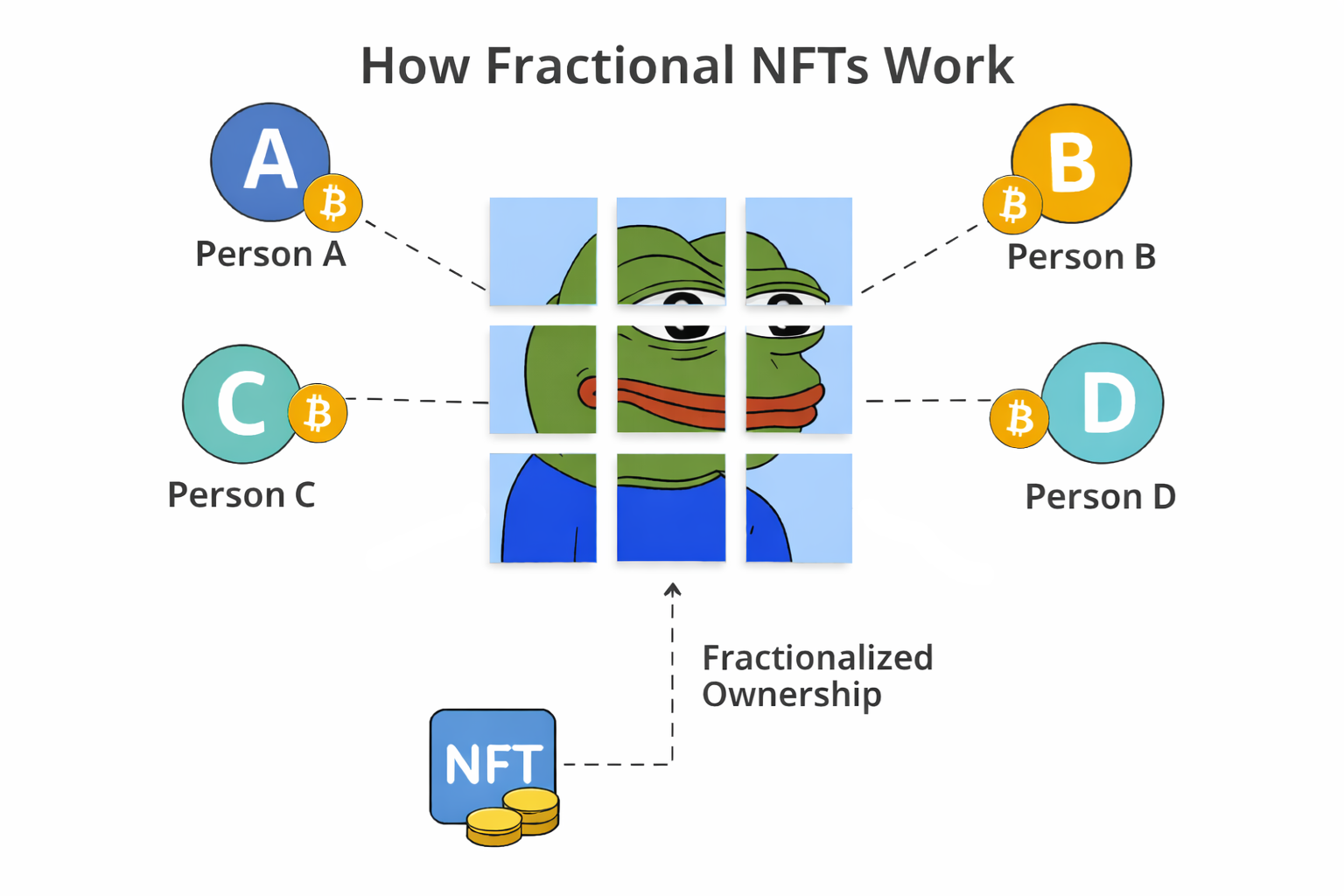
Fractional NFTs convert a single, indivisible NFT into smaller, fungible ownership units that can be held or traded by multiple users. The process starts when the original NFT is locked inside a smart contract, removing it from the direct control of a single owner. Once locked, the smart contract mints a fixed supply of fungible tokens, with each token representing a proportional claim on the underlying NFT.
These fractional tokens can then be sold, traded on secondary markets, or used for governance, depending on how the contract is configured. Instead of transferring the NFT itself, ownership and value move through the trading of fractions. Decisions like selling the NFT, changing parameters, or accepting a buyout offer are handled collectively through token-holder voting. This structure enables decentralized co-ownership while keeping custody and rules enforced on-chain.
The NFT Fractionalization Process
The fractionalization process follows the given structured flow:
- NFT Deposit: The NFT owner deposits the asset into a fractionalization protocol, which locks it into a smart contract.
- NFT Locking: The contract escrows the NFT, preventing it from being moved or altered unless predefined conditions are met.
- Token Minting: A fixed number of fungible tokens is created, each representing a fraction of the NFT’s ownership.
- Token Distribution: These tokens are distributed through sales, listings, or airdrops to investors or community members.
- Secondary Trading: Fractional tokens can be freely traded on supported marketplaces or DEXs.
Smart Contracts Behind Fractionalized NFTs
Smart contracts are the foundation that makes fractional NFTs trustless and transparent. They define and enforce all ownership rules automatically, without depending on intermediaries. This includes controlling the total token supply, recording who owns which fractions, and enabling permissionless transfers between wallets.
Moreover, smart contracts manage governance and buyout logic. They can require token-holder votes to approve major actions like selling the underlying NFT and enforcing a buyout mechanism where a single buyer acquires all fractions by paying a predefined price. Because these rules are encoded on-chain, all participants can verify how the fractional NFT operates, ensuring predictable behavior, transparency, and security across its entire lifecycle.
How NFTs are Fractionalized: The Process
Fractionalizing an NFT is a structured, tool-driven process designed to be accessible to non-technical users. In simple terms, the NFT owner deposits their asset into a fractionalized platform, which locks the NFT in a smart contract and issues fungible tokens that represent shared ownership. These tokens can later be distributed or traded, while the original NFT remains securely held on-chain.
Most modern fractionalization tools abstract away the complexity of the blockchain. Users interact through guided dashboards where they select the NFT, define ownership parameters, and publish the fractions for sale or distribution. This entire process is enforced by smart contracts, ensuring transparency and eliminating the requirement for intermediaries.
Choosing a Fractionalization Platform or Protocol
The first step is choosing a platform that supports the type of NFT you want to fractionalize. For this, you can go for Fractional.art, NFTX, and Unic.ly each offer a slightly different approach to liquidity, governance, and asset support.
When evaluating a platform, make sure to check the following factors:
- Asset Compatibility: whether the protocol supports single NFTs, collections, or vault-based models
- Security: use of audited smart contracts and established on-chain infrastructure
- Fees: minting, trading, and protocol fees that affect net returns
- Liquidity Options: access to DEXs, pools, or built-in marketplaces
Locking NFT in a Smart Contract
After choosing the platform, the NFT must be deposited into a smart contract. This contract acts as an on-chain vault that holds the NFT and prevents it from being transferred or altered outside the defined rules.
This step guarantees custody and trust. No single party can unilaterally move or sell the NFT. All future actions depend on the smart contract conditions agreed upon at the time of fractionalization.
Defining Token Supply and Pricing
After locking the NFT, the creator defines how ownership is divided. This includes setting the total supply of fractional tokens, which determines how small or large each ownership share will be.
Creators may also set an initial valuable or reserve price based on the NFT’s perceived market value. While pricing can be later be shaped by open-market trading, this initial configuration helps establish expectations around ownership and liquidity.
Distribution and Listing
Fractional tokens can be distributed in different ways depending on the goal:
- Sold through public or private sales
- Airdropped to early supporters or community members
- Listed directly on DEXs for open trading
Broad distribution helps bootstrap liquidity and community engagement, especially when fractions are shared with users who are incentivized to promote or govern the asset.
Enabling Governance and Buyout Rules
The last step includes configuring governance and buyout mechanisms. Smart contracts allow creators to define how decisions are made. Token holders may vote on proposals, approve buyout offers, or trigger predefined exit conditions if the buyer seeks 100% ownership.
Clear governance and buyout rules are important for transparency, fairness, and collaboration. They ensure that all participants understand their rights, reduce disputes, and align incentives among fractional owners over the lifecycle of the NFT.
Benefits of Fractional NFTs
Fractional NFTs deliver value across the NFT ecosystem by lowering entry barriers, improving liquidity, and expanding utility beyond simple ownership. For investors, they provide exposure to high-value NFTs without committing a large amount of capital. For creators and brands, they unlock flexible monetization and community-led growth models. For communities, fractional ownership turns passive holders into active stakeholders with shared incentives.
By converting illiquid, single-owner NFTs into tradable fractional tokens, this model aligns closely with broader Web3 goals while preserving transparency through smart contracts.
Democratized Access to High-Value NFTs
Fractional NFTs allow users to co-own expensive digital assets by purchasing fractional shares rather than complete NFTs. This reduces the financial barrier to entry and enables wider participation in assets that were previously limited to high-net-worth buyers. As a result, ownership of premium NFTs becomes more inclusive and globally accessible.
Better Price Discovery
Fractional trading introduces continuous market pricing rather than relying on infrequent, high-stake NFT sales. When many participants buy and sell fractions on open markets, prices adjust more dynamically in response to real demand. This broader participation helps establish more accurate and transparent valuations compared to single-buyer negotiations typical of traditional NFTs.
Improved Liquidity
Whole NFTs are often illiquid, requiring long wait times to find buyers at acceptable prices. Fractional tokens behave more like standard fungible assets and can be traded more frequently on secondary markets or DEXs. This makes it easier for holders to enter or exit positions and convert NFT exposure into cash when required.
Portfolio Diversification Opportunities
Fractionalization allows investors to spread capital across multiple NFTs, collections, or sectors using smaller allocations. This reduces dependency on the performance of a single NFT and helps manage risk, especially in volatile or speculative markets.
Community Engagement and Collaboration
Shared ownership naturally encourages collective participation. Fractional NFT holders may vote on governance decisions, coordinate marketing efforts, or collaborate on when and how to sell the underlying asset. This transforms NFTs from static collectibles into community-driven assets with aligned incentives.
New Monetization Models for Creators
Creators and project founders can monetize NFTs more flexibly by selling fractions rather than the entire asset. Beyond initial sales, ongoing trading activity of fractional tokens can support recurring revenue through platform fees or royalties, enabling longer-term value capture without repeated NFT launches.
DeFi Integration
As fractional NFTs are fungible tokens, they can be integrated directly into DeFi protocols. These tokens may be used for lending, borrowing, staking, or as collateral, extending NFT utility into broader financial use cases and enabling composability across the Web3 stack.
Use Cases of Fractional NFTs
Multiple industries are adopting fractional NFTs to expand access to high-value assets, improve liquidity, and unlock new forms of utility. By dividing ownership into smaller, tradable units, they allow individuals, communities, and organizations to participate in markets previously limited to high-net-worth buyers. These use cases span digital assets and tokenized representations of real-world value.
Fractionalization works best where assets are valuable, scarce, and difficult to transact in bulk. This makes it relevant for digital art, metaverse assets, intellectual property, and real-world assets that benefit from shared ownership and programmable rights.
Digital Art & Collectibles
High-value digital art and blue-chip collectibles are the most established use cases for fractional NFTs. Iconic collections like CryptoPunks or Bored Ape Yacht Club trade at prices that are inaccessible to most users. Fractionalization allows these NFTs to be divided into fungible tokens, enabling broader communities to invest in, trade, and gain exposure to culturally significant assets.
This model improves liquidity and price discovery by enabling fractional trading on open markets. Instead of relying on a single buyer for a full NFT sale, valuation is shaped by multiple participants, leading to more continuous market activity.
Gaming & Metaverse Assets
In gaming and metaverse ecosystems, NFTs represent land, characters, or rare in-game items with high upfront costs. Platforms like Decentraland feature virtual land parcels that can be prohibitively expensive for individual users. Fractional NFTs enable shared ownership among players, guilds, or DAOs.
This approach allows groups to collectively purchase and manage assets, share usage rights, and distribute potential revenues. In play-to-earn and metaverse economies, fractionalization enables collaborative ownership models that align with community incentives.
Music, IP, and Royalties
Fractional NFTs are explored for music rights, intellectual property, and future royalty streams. Creators can tokenize ownership or revenue participation linked to songs, albums, or digital IP, then fractionalize those tokens among fans or investors.
This model enables supporters to own a stake in creative output and participate in upside through royalties or licensing income. For creators, it provides an alternative funding mechanism while retaining programmable control over rights and distribution terms.
Real-World Asset Tokenization
Beyond traditional digital assets, fractional NFTs represent real-world assets such as real estate, collectibles, and luxury goods. In these cases, a physical asset is tokenized as an NFT, which is then fractionalized to allow shared digital ownership.
This structure lowers capital requirements, improves transferability, and enables global participation without traditional intermediaries. While regulatory and custody considerations remain important, real-world asset fractionalization highlights how NFTs combine physical value and on-chain ownership models.
Risks and Challenges of NFT Fractional Ownership
Despite the improved accessibility and liquidity that fractional NFTs provide, they also bring technical, legal, and market-related risks that buyers and platforms must consider. Unlike traditional NFTs owned by a single owner, fractional ownership depends on smart contracts, shared governance, and secondary markets, which add layers of complexity. These factors can expose participants to vulnerabilities that are not always obvious to non-technical users.
From a financial perspective, fractional NFTs behave more like tradable crypto assets than collectibles, making them sensitive to market sentiment, liquidity conditions, and speculation. From a structural standpoint, decision-making is distributed among many token holders, which can lead to coordination challenges or conflicts during buyouts or resale events.
Smart Contract Risks
Fractional NFTs depend on smart contracts to lock the original NFT, mint fractional tokens, enforce ownership rules, and manage buyouts or governance. If these contracts contain logic flaws, bugs, or security vulnerabilities, the consequences can be severe like unauthorized transfers and fund losses to permanent lockups of the NFT. Since smart contracts are immutable once deployed, so fixing issues after launch can be difficult or impossible without transferring assets to a new contract.
Regulatory & Legal Uncertainty
In some jurisdictions, fractional NFTs may be taken as investment contracts or securities, particularly when fractions are marketed with profit expectations or revenue-sharing features. This creates uncertainty about compliance requirements such as registration, disclosures, and investor protections. Platforms and investors may face future legal or regulatory challenges if authorities apply securities laws retroactively or introduce stricter frameworks for tokenized ownership models.
Governance and Buyout Conflicts
Fractional ownership requires collective decision-making, which becomes contentious. Disagreements among token holders about selling the NFT, accepting a buyout offer, or managing governance proposals may stall progress or reduce asset value. These issues are amplified when voting power is unevenly distributed, allowing large holders to dominate decisions while smaller participants have limited influence.
Market Volatility
The value of fractional tokens can fluctuate significantly due to NFT market hype cycles, limited trading liquidity, or broader crypto market movements. Even if the underlying NFT is high quality, fractions may experience sharp price swings if interest declines or if there are a few active buyers and sellers. This volatility makes fractional NFTs less predictable as long-term stores of value and more exposed to short-term market sentiment.
How Businesses Leverage Fractional NFTs for Different Purposes
Fractional NFTs are adopted by brands, creators, and startups as strategic business mechanisms that unlock new models for revenue sharing, fundraising, and engagement. At the core, fractional NFTs tokenize part-ownership of a unique asset and make it tradable on secondary markets, expanding participation beyond those who can afford to purchase 100% NFT and create new economic touchpoints across Web3 ecosystems.
Fractional NFTs Serving Businesses
- Fundraising and Capital Formation: Projects can fractionalize a high-value asset (such as a rare NFT, digital property, or licensed IP) and sell fractionalized shares to supporters and investors. This not only raises capital but also distributes economic stakes more broadly.
- Community Engagement and Loyalty: Brands can use fractional NFT ownership to strengthen community alignment by giving supporters a stake in an asset’s future. Fractional co-ownership encourages holders to participate in shared decisions, which drives deeper engagement and long-term loyalty.
- Revenue Sharing and Monetization: Creators and IP owners can share royalties or ongoing income streams by tokenizing recurring revenue as fractional NFTs. This allows backers to benefit directly from future earnings, turning passive supporters into aligned stakeholders.
Real-world examples already illustrate these models. In the music industry, platforms like Royal.io have enabled artists to sell portions of their streaming royalties to fans, effectively sharing future revenue and creating new monetization channels beyond traditional distribution deals. Equity and IP tokenization startups are also experimenting with fractionalizing patents, trademarks, and other intellectual property rights, enabling multiple entities to invest in or co-own these assets with clear on-chain records and automated revenue distribution.
Final Thoughts
Fractional NFTs highlight a significant evolution in how digital ownership and investment work in Web3. By dividing high-value NFTs into smaller, tradable units, fractionalization reduces entry barriers and expands access to valuable digital and tokenized assets for a broader audience. This approach not only increases liquidity and price discovery but also fosters community participation through shared ownership and governance mechanisms. At the same time, fractional NFTs depend on smart contracts and underlying protocols, which means their benefits and risks are rooted in decentralized technology and market dynamics.
Despite the digital innovation, there are some considerations to keep in mind. Technical vulnerabilities, regulatory uncertainty, and market volatility remain meaningful risks that can impact participant outcomes and long-term viability. Shared ownership models also introduce governance complexities, especially when collective decisions are made. These challenges underscore the need for due diligence, robust platform security, and clear legal frameworks as fractional ownership continues to expand.
Fractional NFTs hold the potential to democratize access to premium digital assets, opening new roads for investors, creators, and communities to participate in the digital economy. As the market matures and infrastructure improves, understanding both opportunities and limitations of fractional ownership becomes the key to navigating the future of NFTs.
Follow Dypto Crypto for timely and reliable coverage of ongoing insights, expert analysis, and latest updates on crypto trends.
Frequently Asked Questions
Can anyone buy a fractional NFT?
Yes. Anyone can buy a fractional NFT as long as they have a compatible cryptocurrency wallet, some crypto, and access to the platform from which they can purchase fractions.
Can fractional NFTs be easily sold or traded?
Yes. Fractional NFTs are more liquid than whole NFTs, but liquidity depends on market demand and listings.
Are fractional NFTs safe and secure?
Safety depends on the security of the underlying smart contract vault holding the original NFT. It’s important to use well-established, audited platforms. The blockchain transaction itself is secure, but smart contract risk is the main concern.
Do I actually own the NFT if I buy a fraction?
You own a proportional share governed by smart contract rules, not exclusive control.
What happens if someone wants to buy the full NFT?
Buyout mechanisms allow a buyer to acquire full ownership of the NFT, provided governance conditions are met, and token holders are compensated.
Disclaimer
This article is for educational and information purposes, and should not be considered financial advice. For more information visit our disclaimer page
About the Author