

Crypto grid trading bots have become very popular among traders, as they help generate profits by leveraging market volatility without constantly monitoring the market graph. The bots assist in buying and selling at set price intervals, thus making small profits as the prices fluctuate in a certain range.
The purpose of a grid bot is not to enter or leave a trade at optimum points in time. Instead, grid bots rely on a principle called “grids,” in which they buy at a low price and sell at a higher one. They perform best in a range-bound market, where prices frequently oscillate, potentially profiting from volatility as long as prices remain within the defined range.
This guide provides information on how crypto grid bots operate, important parameters that influence their performance, how to use them, best crypto trading platforms with a grid bot option, and some mistakes to avoid when using a grid bot.
What Is a Crypto Grid Trading Bot?
A crypto grid trading bot is basically an automated trading tool that can execute multiple buy and sell orders at predetermined price levels. You set the upper and lower price limits, and the bot automatically creates a grid of multiple price levels, buying when the price drops to a specific level and selling when it reaches a specific level.
The idea is quite simple. As the price fluctuates within your range, the bot keeps buying at lower grid levels and selling at higher ones, making small profits on each transaction. Grid bots are most effective in a ranging market, where prices fluctuate in a predictable manner without strong trends.
After that, the bot runs automatically 24/7 without constant supervision. It executes trades solely based on price action and your preset parameters.
Types of Grid Bots in Crypto Trading
Grid trading bots come in several variations for different market conditions. Spot grid bots trade actual cryptocurrencies without leverage, making them suitable for beginners. Futures grid bots operate with leverage to amplify returns but increase the risk substantially.
Infinity grid bots are designed for bullish or upward-biased markets, though they still underperform simple holding during strong parabolic trends. The reverse grid bots start with stablecoins and place buy orders at progressively lower levels, profiting as prices decline in bear markets.
How Crypto Grid Trading Bots Work – The Basics
Understanding the mechanics of grid trading helps you configure bots effectively and set realistic performance expectations.
Setting the Trading Range
Defining your operating range means setting upper and lower price boundaries for your bot to place all orders. Select a range that is highly effective. You can do that by analyzing the recent price action. Let’s say Bitcoin oscillated between $58,000 and $72,000 over the past month. You should set your range around $60,000 to $70,000 to capture the most movement with a safety buffer.
If the range is too narrow, then the price may quickly move outside the boundaries, which can stop the bot. And if the range is too wide, then the capital is spread thin across many levels. This reduces your profit per trade. Remember, market volatility affects your range selection; more volatile assets need wider ranges, while the stable assets use tighter ranges.
Grid Levels and Order Placement
Once you’ve set the range, the bot divides it into multiple grid levels based on your chosen number of grids. Each level represents a price point where the bot places orders. Spacing can be arithmetic (equal price intervals) or geometric (percentage-based intervals).
At each grid level, the bot places alternating buy and sell orders. When the price reaches the buying level, the bot buys. As the price advances to the next level, it generates a sell signal, thereby locking in the profit. More grids mean tighter spacing and more frequent trades. Fewer grids mean wider spacing with larger profits per trade but less frequent execution.
Bot Behavior When Price Moves
When prices move within your grid, the bots will follow a predictable pattern. Imagine there is a grid ranging from $60,000 to $70,000 for Bitcoin, with levels every $1,000. Let’s say that the current price is $65,000. The bot will then have buy orders at $64,000, $63,000, and $60,000. It will also have sell orders at $66,000, $67,000, and $70,000.
With the price falling to $64,000, the bot will place a buy. When the price rises to $66,000, it sells the position, realizing a profit after subtracting the fees. This pattern continues by buying during the fall and selling during the rise, making profits from volatility as long as the price stays within your range.
Important Crypto Grid Bot Settings That Affect the Results
Configuration settings greatly impact your grid bot’s performance and risk profile.
Number of Grids
The number of grids determines how finely you divide your trading range. More grids create tighter spacing. With 50 grids in a $10,000 range, each level is only $200 apart. This helps generate more frequent trades but smaller profits per trade, as well as higher fees.
On the other hand, fewer grids create wider spacing. If you have 10 grids in the same range, then each level is $1,000 apart. The trades will happen less frequently, but they will capture larger profits with lower fees. Most traders have found that 15-30 grids work well for major cryptocurrencies. They like to balance trade frequency with meaningful profits.
Grid Spacing: Arithmetic or Geometric
Arithmetic spacing divides the range into equal dollar amounts. Geometric spacing uses percentage-based intervals. For most cryptocurrencies, geometric spacing performs better because crypto markets move in percentage terms. For instance, if Bitcoin has moved from $50,000 to $55,000, then there is a 10% gain. But if Bitcoin moves from $100,000 to $105,000, that’s only 5%.
Capital Allocation and Position Sizing
The bot distributes your capital across all grid levels. With 20 levels and $10,000, each might receive $500 for buying. Avoid allocating so much that you can’t handle multiple consecutive buys if prices trend downward. The smaller positions across more grids provide better diversification.
Stop-Loss and Take-Profit Controls
The stop-loss settings automatically close all positions if the price falls below your threshold. This provides protection against crashes. Take-profit controls lock in gains when your position reaches a target profit level. Conservative setups use tighter controls, prioritizing capital preservation. Aggressive setups use wider controls, accepting more risk for larger returns.
Market‑Specific Settings
In sideways markets, use moderate grid numbers with tight ranges. For bullish markets, use wider ranges with upper boundaries well above current prices. Bearish markets favor reverse grids or tighter ranges. Volatile markets need wider ranges and more grid,s while calm markets can use tighter ranges.
How to Set Up a Crypto Grid Trading Bot
Setting up your first grid bot requires a systematic approach to avoid common pitfalls.
Choose the Right Trading Pair
Not all pairs suit grid trading equally well. The ideal pair combines high liquidity with sideways price action. Major pairs like BTC/USDT and ETH/USDT offer deep liquidity, meaning orders fill quickly at expected prices without slippage.
Look for pairs showing range-bound behavior in recent charts. If a coin traded between $0.80 and $1.20 for the past month, that’s strong grid bot material. Trading volume matters too – pairs with consistent daily volume above $100 million for major coins or $10 million for altcoins provide enough activity for smooth operation.
Define Grid Settings Based on Market Type
For ranging markets, set boundaries based on recent support and resistance levels. Use 15-25 grids with geometric spacing for crypto pairs. In trending markets, widen your range in the trend direction and reduce the grid count to 10-15 so you don’t sell your entire position too quickly.
Capital allocation should match your risk tolerance. Conservative traders might allocate 20-30% of their portfolio to a single grid bot. Start with geometric spacing for most crypto pairs unless trading stablecoin pairs.
Start Small and Test First
Before committing significant capital, test with a small amount. Many platforms offer paper trading, where you can test configurations with virtual funds. When ready for real trading, start with a fraction of your intended capital. If planning a $10,000 grid, start with $1,000-$2,000 and run it for at least a week.
Monitor trade frequency and profit per trade. If making dozens of daily trades but each captures only $2-5 before fees, adjust spacing or reduce the grid size. Pay attention to how close prices come to your boundaries and adjust accordingly.
Top Crypto Grid Trading Bots and Platforms (Best Picks)
Several platforms offer grid trading functionality with different features and fees.
Binance Spot Grid / Futures Grid
Binance offers both spot and futures grid bots integrated into the world’s largest crypto exchange. The interface provides preset strategies for beginners and custom settings for experienced traders with backtesting capabilities. Binance charges standard trading fees (0.1% spot, variable for futures) with no additional subscription costs. You can only trade pairs available on Binance, but the massive pair selection and liquidity rarely pose problems.
KuCoin Grid Bots (Spot and Futures)
KuCoin offers comprehensive grid options for both spot and futures with AI-powered parameter suggestions. The platform supports hundreds of trading pairs with the ability to copy successful strategies from other traders and detailed performance analytics. KuCoin uses a tiered fee structure starting at 0.1%, with grids free beyond trading fees.
3Commas Grid Bot
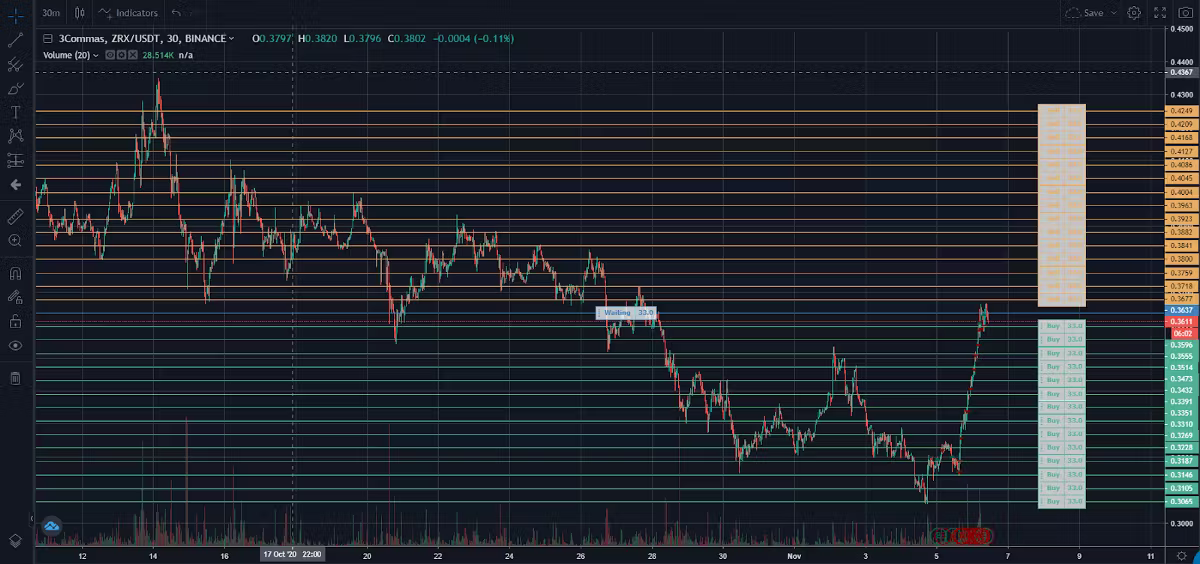
3Commas offers powerful grid bot functionality via API integrations with over 20 exchanges, emphasizing portfolio management and multi-exchange trading. Features include smart trading, portfolio tracking, and the ability to copy strategies from successful traders. Subscription pricing starts at $29 per month for basic features, with higher tiers unlocking more advanced capabilities. You also pay trading fees at connected exchanges. The polished interface and excellent mobile apps make monitoring easy.
OKX Spot and Futures Grid
OKX provides native grid bots for both markets with a clean interface and AI-recommended parameters. Multiple grid types and detailed performance tracking suit various strategies. Trading fees start at 0.08% for makers, 0.1% for takers, with no subscription costs beyond standard fees. The mobile app is particularly well-designed for on-the-go monitoring.
Free vs Paid Bots: Is Paying Extra Worth It?
The free exchange-native grid bots from platforms such as Binance, Pionex, and OKX do offer great functionality. They are also quite simple to set up, and they have no subscriptions either. You only have to pay trading fees, and that’s it. If you are a complete beginner or someone looking for straightforward grid strategies, these free options will be sufficient.
Now, let’s look at paid platforms like Cryptohopper, 3Commas, and Bitsgap. They provide traders with multi-exchange connectivity. Moreover, they offer advanced features such as trailing stops and indicator-based triggers, and, of course, better analytics. The paid bots are worth it if you have enough trading volume.
For portfolios under $10,000, subscription fees significantly affect profits. For larger portfolios over $50,000 or traders running multiple complex strategies, paid platforms can justify costs through better execution and time saved.
Risks and Limitations of Grid Trading Bots
Grid trading isn’t guaranteed to yield a profit, and understanding its limitations is crucial for managing capital effectively.
The most significant risk comes from strong trending markets. Grid bots profit from range-bound volatility but struggle when prices break out sharply. If Bitcoin rallies from $60,000 to $85,000 without pullbacks, a grid with a $70,000 upper limit sells everything early and misses most gains.
In sharp downtrends, spot grid bots keep buying as prices fall, accumulating positions that drop in value. Without proper stop-losses, you can experience significant unrealized losses waiting for recovery.
Overtrading in volatile conditions racks up fees that exceed profits. If grid spacing is too tight and markets whipsaw rapidly, you might execute dozens of daily trades each paying 0.1% fees (0.2% round trip), significantly impacting profitability.
Capital lockup is another consideration. Money allocated to grid bots is used to execute the strategy rather than being available for other opportunities. Exchange and execution risks matter too, as orders might not fill at expected prices during extreme volatility.
Common Mistakes to Avoid When Using Grid Bots
Many traders sabotage grid bot performance through avoidable errors.
Setting unrealistic price ranges is extremely common. Too-wide ranges spread capital thin across massive areas, making individual trades barely matter. Too-narrow ranges mean prices quickly escape boundaries, stopping the bot. Balance capturing realistic movements with meaningful position sizes.
Using too many grids for available capital creates similar problems. With 100 grids and only $5,000, each level gets $50. After fees, individual profits are negligible. Fewer grids with meaningful capital perform better.
Ignoring market conditions is perhaps the biggest mistake. Deploying standard grids during strong bull runs can lead to selling positions too early. The same configuration produces different results in ranging versus trending markets.
Neglecting fee calculations can turn seemingly profitable grids into losers. Always calculate whether the expected profit per level exceeds round-trip fees. Setting and forgetting without monitoring is risky, as market conditions change constantly. Overallocating entire portfolios to grid strategies creates concentration risk. Many traders limit grid strategies to 20–40% of their portfolio to reduce concentration risk.
The Bottom Line
Crypto grid trading bots provide a useful tool for making money from market volatility by automatically buying and selling at set price levels. They are most useful in markets where prices are range-bound and move in predictable cycles, making steady small profits from repeated transactions.
The strategy is ideal for traders who want to automate their strategy and eliminate emotional decision-making. Instead of focusing on the perfect entry and exit points, grid bots help you harvest profits from price actions within your chosen range.
To be successful, one needs to properly configure, set realistic expectations, and manage risks effectively. Begin with a small capital investment on user-friendly platforms such as Binance or Pionex. Experiment with different configurations to identify settings that suit your risk level and market conditions.
Grid bots are not ideal for all market situations. They perform poorly in trending markets and need capital investment. But for traders who are ready to understand how they work and keep track of their performance, grid bots can be a steady source of income for most market situations. Approach grid trading as a strategy, manage risk effectively with stop-losses, and continue learning from Dypto Crypto.
Frequently Asked Questions
Are grid trading bots actually profitable in crypto?
Grid trading bots can be profitable in the right market conditions, particularly ranging markets. Profitability depends on proper configuration, reasonable fees, and appropriate market selection. Many traders achieve consistent 5-15% monthly returns in suitable conditions, though performance varies based on volatility and settings.
Can I run grid bots on decentralized exchanges (DEXs)?
Most grid bots operate on centralized exchanges due to fast execution requirements. Some DeFi protocols are developing grid trading functionality for DEXs, but options remain limited. Higher transaction fees and slower execution on many DEXs make grid trading less practical currently.
Is it better to use arithmetic or geometric grid spacing?
Geometric grid spacing typically works better for cryptocurrencies because it accounts for percentage-based price movements. Crypto assets move in percentage terms, making geometric spacing more effective across different price levels. Arithmetic spacing can work for stable coin pairs.
What market conditions are best for grid trading bots?
Grid bots perform best in sideways or range-bound markets where prices oscillate within a predictable range without strong trends. Moderate volatility within the range generates frequent trading opportunities. Calm markets with 10-20% price ranges work well. Strong trending markets are least suitable.
What’s the best crypto grid trading bot for beginners?
Pionex offers the best combination of low fees (0.05%), user-friendly interface, and free built-in bots for beginners. Binance is another excellent choice due to familiar interface, massive liquidity, and integrated grid features. Both platforms let you start small and offer preset configurations.
How much money do I need to start grid bot trading?
You can start with $100-200, though $500-1,000 provides more meaningful results. Smaller amounts limit grid levels you can fund adequately. For optimal performance, consider $2,000-5,000 as a comfortable starting point that allows proper spacing and position sizing without overexposing your portfolio.
Disclaimer
This article is for educational and information purposes, and should not be considered financial advice. For more information visit our disclaimer page
About the Author