
You spent 300 hours grinding in a game, earned rare legendary gear, and built up your character. Then the servers shut down. Everything vanishes. Your time, your effort, and your digital assets are all gone.
This is the reality of traditional gaming. You don’t own anything. The game developer controls everything, and when they pull the plug or change the rules, you are left with nothing. Web3 gaming promised to address this with Play-to-Earn (P2E), allowing players to earn crypto while playing. It sounded revolutionary until the model collapsed under its own weight, turning games into joyless grind fests where fun took a backseat to profit extraction.
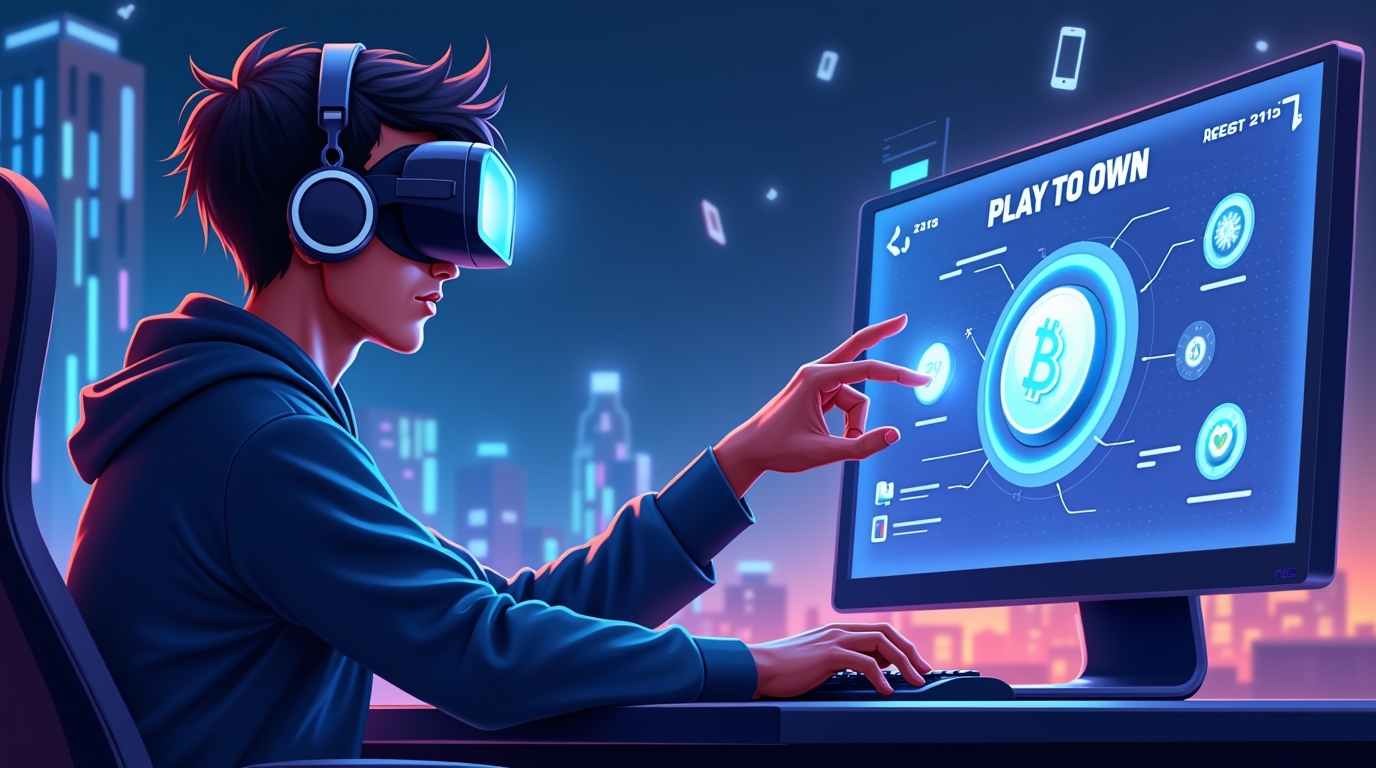
Now, a new model is gaining traction: Play to Own (P2O). Instead of paying you to grind, it gives you actual ownership of your in-game assets. That legendary sword? It’s yours. That virtual land? You own it. That rare character skin? It’s in your wallet, not the developer’s database.
Play to Own changes the fundamental relationship between players and games. It’s not about how much you can earn today; it’s about building digital assets that hold long-term value. This guide explains how P2O differs from P2E, why it matters, and whether this model can deliver on Web3 gaming’s original promise.
Understanding the Play to Own Gaming Model
Play to Own gives players genuine ownership of in-game assets through blockchain and NFTs. Every item you acquire, weapons, characters, land, cosmetics, exists as a digital token in your wallet that you control completely.
When you earn or purchase an item in a P2O game, it’s minted as an NFT on a blockchain. This represents verifiable ownership. Unlike traditional games where items exist only in the developer’s database, your P2O assets exist independently. You can trade, sell, or transfer them. The developer cannot delete or remove them.
Core Elements:
- Ownership: Assets are yours permanently, stored in your wallet
- Utility: Items have actual gameplay functions, not just collectibles
- Long-Term Value: Assets can appreciate based on rarity and demand
- Interoperability: Some assets work across multiple games
The key difference? Items have real economic value outside the game. That legendary sword isn’t just powerful. But it’s a tradable asset with market-determined pricing.
Play to Own vs. Play to Earn: Key Differences
P2O and P2E both use blockchain and NFTs, but the philosophies and outcomes differ dramatically.
| Aspect | Play to Earn (P2E) | Play to Own (P2O) |
| Primary Goal | Income Generation | Asset ownership & investment |
| Player Approach | Game as a job | Game as entertainment with investment upside |
| Analogy | Gig work- trade time for payment | Collecting art-accumulate assets that compound |
| Focus | Short-term cash flow | Long-term value building |
| Relationship | Transactional | Investment oriented |
Play-to-Earn treats gaming as a source of income. Complete tasks, earn tokens, cash out. The game is a job disguised as entertainment. Success depends on grinding hours before the economy collapses.
Play to Own treats gaming as both an investment and an entertainment. Play for fun, build valuable assets over time, and own assets that may appreciate. The game is actually a game, with ownership as a feature.
This motivation shift changes everything.
Ownership vs. Income as the Core Value
Play to Earn prioritizes income. Players log in to grind daily tasks, complete quests, and extract tokens they can sell for real money. The focus is on short-term cash flow. This creates a transactional relationship that players optimize for efficiency rather than enjoyment.
Play to Own prioritizes ownership. Players acquire assets they genuinely want to keep and use. The focus is on building a collection of valuable items that enhance gameplay and retain long-term value. This creates an investment relationship that players optimize for quality assets, not quick flips.
The difference affects every design decision. P2E games must constantly print new tokens to reward players, creating inflationary pressure. P2O games can focus on creating high-quality, limited-supply assets that maintain or increase in value.
When income is the goal, gameplay becomes secondary. When ownership is the goal, gameplay becomes essential because assets are only valuable if people actually want to play the game.
Economic Sustainability
This is where the models diverge most dramatically.
Play-to-Earn Economics: P2E games typically distribute tokens as rewards for completing tasks. These tokens have value only if new players continue to join and buy them. This creates a pyramid-like structure in which early players profit from new-player inflows. When growth stalls, token prices collapse, rewards become worthless, and the player base evaporates.
Axie Infinity demonstrated this perfectly. At its peak in 2021, players earned $1,000+ monthly. By mid-2022, daily earnings fell to pennies as the token’s value plummeted from $165 to around $10. The economy could no longer sustain itself once new-player growth slowed.
Play-to-Earn Economics: P2E games base their value on asset scarcity and utility rather than continuous token emissions. A rare sword or plot of land has value because it’s limited in supply and useful in gameplay. Value comes from genuine demand, not from the need for new players to pump token prices.
When designed properly, P2O economies function like real estate or collectibles markets. Prices fluctuate based on supply, demand, and utility, not on whether enough new users joined this month to fund veteran players’ earnings.
The sustainability difference is massive. P2E needs constant growth to survive. P2O needs good gameplay and meaningful assets.
Gameplay Depth and User Experience
Play-to-Earn optimizes for efficiency, not fun. Players figure out the most profitable activities and repeat them endlessly. The result? Shallow gameplay focused on farming, clicking, and grinding. P2E games often feel like work because they literally are work, but just with game graphics.
Play to Own can prioritize actual game design. Since the business model doesn’t depend on paying players to grind, developers can focus on creating compelling gameplay, interesting progression systems, and rich worlds. Assets have value because the game is good and people want to play it, not because players need to extract income.
Games like Illuvium and Big Time are building AAA-quality experiences around ownership rather than earnings. They are designed as real games first, with ownership mechanics integrated naturally rather than bolted on as the entire point.
The user experience gap is enormous. P2E feels like a job. P2O feels like a hobby with investment upside.
Player Identity and Long-Term Investment
In P2E games, your character is disposable. You are optimizing for token extraction, so if another game offers better rewards, you jump ship immediately. There is no reason to build attachment or identity around temporary farming tools.
In P2O games, your assets represent your gaming identity. That character you’ve leveled up, that land you’ve developed, that rare mount you earned, they’re part of your digital identity. You are more likely to stick around, contribute to the community, and care about the game’s long-term success because your investment is tied to it.
This creates compounding network effects. Players invest time and money. That investment creates emotional attachment. Attachment drives loyalty and advocacy. Loyalty builds community. Community creates value. And the cycle reinforces itself.
P2O aligns player incentives with game health in ways P2E never could.
Asset Utility and Interoperability
Play-to-Earn assets often become worthless once their earning potential expires. That Axie you bought for $300? When breeding rewards declined, it became nearly valueless as a digital pet.
Play-to-Earn assets maintain utility independent of token rewards. Your character, land, or items remain useful as long as the game exists and people play it. The value comes from what the asset does, not from what it pays out.
Some P2O games are experimenting with interoperability, using assets across multiple games. Your character skin from one game might work in another game built on the same blockchain standard. This is still an early stage, but it represents a fundamental shift in how digital assets work.
Instead of assets locked in one game’s economy, they become portable digital property. This increases utility and potential value beyond the success of any single game.
Benefits of Play to Own for Players
| Benefit | Description |
| True Ownership | Assets exist in your wallet, not the game company’s database |
| Real Economic Value | Items have genuine market value based on supply and demand. Rare assets can appreciate over time |
| Trade Freedom | Sell, trade, or gift assets anytime through decentralized marketplaces. No developer permission needed |
| Transparency | Blockchain shows exactly how many items exist, who owns what, and all transaction history. No hidden drop rates |
| Long-Term Utility | Well designed assets maintain usefulness over years, not months. Early investments provide value indefinitely |
| Player Governance | Many P2O games use DAO structures where asset holders vote on development decisions |
Benefits for Developers & Publishers
Better Retention: Players who own assets stick around longer. They have invested real money, creating switching costs that reduce churn.
Fair Monetization: Sell limited-supply assets at market rates instead of exploitative pay-to-win mechanics. Early buyers benefit from price appreciation.
Secondary Market Revenue: Smart contracts include royalty fees on secondary sales. Every NFT trade generates ongoing revenue with no additional development required.
Community Co-Creation: Asset owners become stakeholders who contribute ideas, create content, and evangelize the game because their holdings’ value depends on success.
Organic Marketing: Engaged players generate word-of-mouth marketing, recruit friends, and build hype because it benefits their asset values.
Risk Distribution: Sell assets to fund ongoing development and share success with early supporters, rather than funding everything upfront.
How P2O Encourages Organic Community Growth
Ownership creates fundamentally different social dynamics than transactional gameplay.
Shared Incentives: Asset owners are incentivized to help the game succeed because the value of their holdings depends on it. This transforms players into stakeholders who promote and defend the game.
User-Generated Content: Players who own land or spaces create experiences and host events. In The Sandbox and Decentraland, landowners become content creators, attracting other players.
Natural Advocacy: Asset owners naturally talk about their investments, share accomplishments, and recruit friends. It’s genuine enthusiasm from people with skin in the game.
Long-Term Relationships: P2O communities develop over years. Players form bonds, create clans, and build businesses together. That is impossible in transactional P2E environments.
Player Governance: Many P2O games use voting systems in which asset holders decide on changes and features, increasing investment and reducing developer-player conflicts.
Risks and Misconceptions of Play to Own Gaming
| Risk/Misconception | Details |
| Asset Volatility | NFT values swing wildly based on market sentiment. That $5,000 land might be worth $500 next year. P2O purchases are speculative |
| Over-Monetization | Some games require expensive NFTs to start, creating accessibility barriers. Entry cost can exclude casual players |
| Technical Barriers | Managing wallets, gas fees, decentralized marketplaces intimidate non-crypto gamers. One private key mistake = lose everything |
| Security Risks | You are responsible for security. Phishing and malware can drain wallets. Blockchain transactions are irreversible. |
| Speculation Over Gameplay | P2O can transfer into NFT trading rather than gaming. Floor prices become more important than game mechanics. |
| “Ownership” Misconception | You own the NFT, not the game code, servers, or assets. If the game shuts down, NFT might be worthless. |
| Regulatory Uncertainty | Government figuring out NFT and blockchain game regulations. Future laws could impact tradability or taxation. |
Conclusion
Play to Own offers a fundamentally better model than Play to Earn. Instead of treating games as income machines, P2O creates genuine digital economies where players own valuable assets and communities form around shared investment in success.
P2E incentivizes players to compete against one another to extend the game’s longevity by extracting value before the economy collapses. P2O aligns players with success. You want it to thrive because it increases your assets’ value.
Neither model is perfect. P2O faces challenges around accessibility, speculation, and technical complexity. But it addresses the fundamental sustainability problems that killed first-generation P2E games.
The future likely involves hybrid models. But if forced to choose, P2O’s emphasis on ownership and long-term value provides a more promising foundation than P2E’s unsustainable token-farming economics.
Want to stay ahead of Web3 gaming trends and navigate the crypto space with confidence? Join Dypto Crypto for in-depth guides on cryptocurrency, blockchain gaming, NFTs, and emerging digital economies.
Sign up for the Dypto Crypto newsletter to get expert analysis and practical insights delivered to your inbox.
Frequently Asked Questions
Are Play to Own games a scam?
Not inherently, but the space is prone to scams. Legitimate P2O games offer genuine ownership, transparent economics, and real gameplay. However, some projects use P2O marketing while running pump-and-dump schemes or abandoning development after initial NFT sales. Research the team, roadmap, community, and actual gameplay before investing. If a game promises guaranteed returns or focuses entirely on asset appreciation rather than gameplay, it’s a red flag.
Can you still make money in Play to Own games?
Yes, but it’s not guaranteed like P2E promised (and failed to deliver). Money comes from asset appreciation, trading, or renting out your items rather than grinding for token rewards. If you acquire rare or useful assets early and the game succeeds, their value may increase significantly. However, you can also lose money if the game fails or if you overpay during hype cycles. Treat P2O investments like collectibles or real estate, possible profit, but also real risk.
Do I need NFTs to play Play to Own games?
Usually, yes. At least to access full ownership benefits. Some P2O games offer free-to-play modes with limited functionality or rental systems where you can borrow assets. But to truly own assets and participate in the ownership economy, you need to purchase or earn NFTs. The good news is prices vary widely. Some games have affordable starter assets while others require significant investment. Always start small and verify you enjoy the gameplay before committing serious money.
How do I get started with Play to Own games?
First, set up a crypto wallet like MetaMask or Phantom. Research games in genres you enjoy, check reviews, community sentiment, and gameplay videos. Start with free-to-play modes or inexpensive starter assets. Never invest more than you can afford to lose. Learn the game mechanics before buying expensive NFTs. Join the game’s Discord or community to ask questions and learn from experienced players. Most importantly, prioritize games that look fun, if gameplay sucks, no amount of ownership will keep you engaged.
Disclaimer
This article is for educational and information purposes, and should not be considered financial advice. For more information visit our disclaimer page
About the Author