

Imagine a blockchain that doesn’t just record transactions, but proves the passage of time itself. That is the innovation behind Proof of History (PoH), a cryptographic clock that allows networks to order events before consensus, unlocking unprecedented speed and scalability. Unlike traditional models that struggle with latency and coordination, PoH ensures every transaction has a verifiable timestamp, reducing overhead and enabling thousands of transactions per second.
In this article, we will break down what PoH is, how it works, and why it matters. We will explore its role in solving critical challenges like transaction ordering, network latency, and scalability, and show how it powers modern ecosystems such as Solana. Finally, we will look at real-world use cases, limitations, and what the future holds for PoH in a multi-chain world. Whether you are a crypto beginner or a DeFi enthusiast, this blog will help you understand how chronology, consensus, and scalability converge to shape the next generation of blockchain technology.
How Does Proof of History Work?
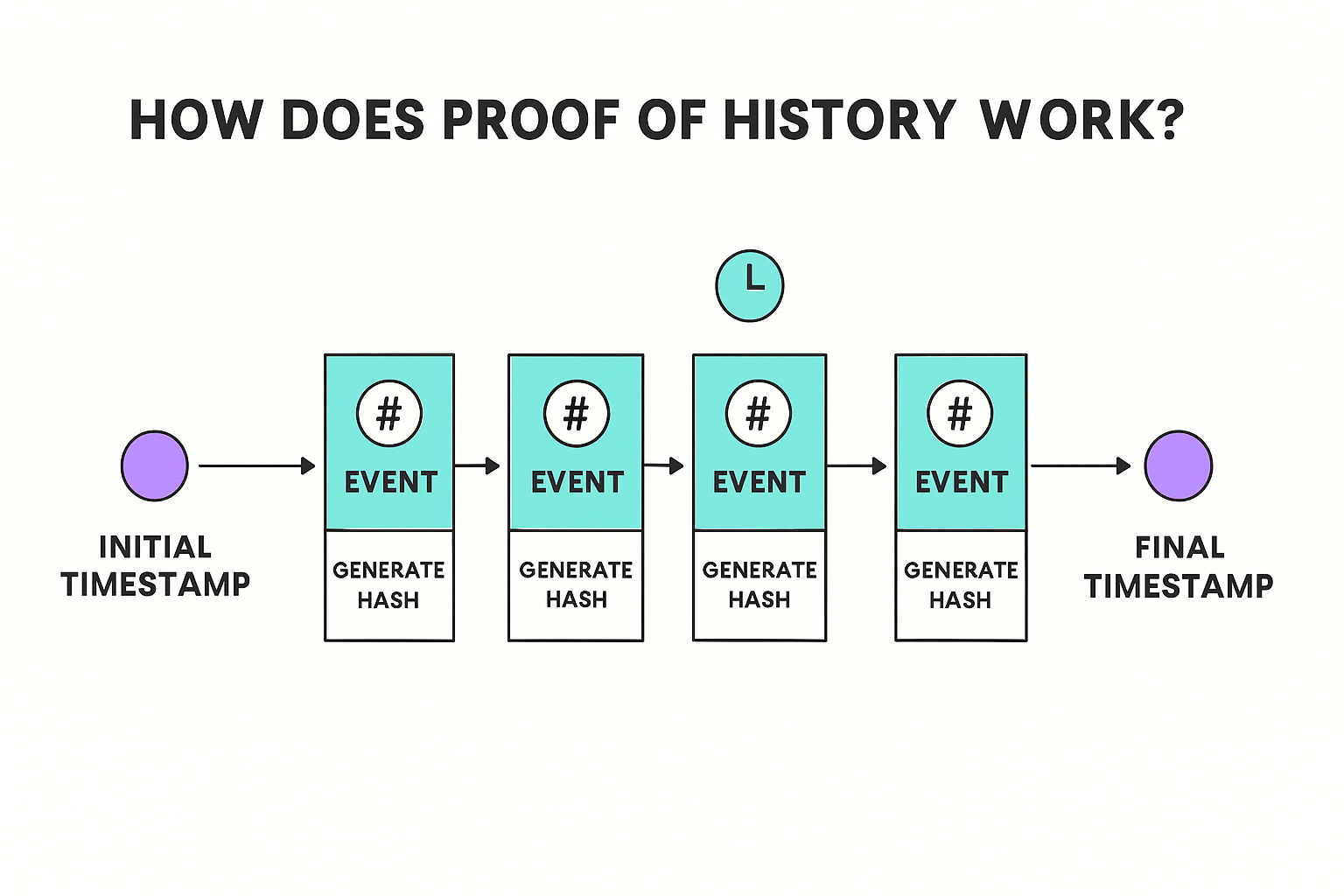
Proof of History (PoH) is Solana’s innovation that serves as a cryptographic clock, enabling the blockchain to order events before consensus, thereby drastically improving speed and scalability. Here is a detailed breakdown of how it works.
PoH is not a consensus mechanism by itself but a timekeeping technique that complements Solana’s Proof of Stake (PoS). It creates a verifiable sequence of timestamps using cryptographic hashes, ensuring that every transaction or event has a provable timestamp. Here’s how PoH works step by step;
- Initial Timestamp: The system begins with a starting point (an initial seed).
- Verifiable Delay Function (VDF): A cryptographic function repeatedly hashes its previous output. Each hash is unique and can only be computed sequentially (no shortcuts).
- Event Recording: When a transaction occurs, it is inserted into this sequence at a specific hash. This creates a tamper-proof timestamp that proves when the event occurred relative to other events.
- Validator Efficiency: Validators don’t need to spend time agreeing on the order of events. They verify the hash sequence, which is much faster.
- Consensus Layer (PoS): Once events are ordered by PoH, Solana’s Proof-of-Stake (PoS) validators confirm blocks. This combination allows Solana to process over 65,000 transactions per second (tps).
Proof of History matters because it fundamentally transforms how blockchains handle time and transaction ordering. By embedding timestamps directly into the ledger using cryptographic hashes, PoH eliminates the need for validators to coordinate on the sequence of events during consensus. This drastically reduces latency and enables Solana to achieve high throughput, processing tens of thousands of transactions per second.
This mechanism also enhances scalability, allowing the network to grow without compromising speed or security. Most importantly, PoH provides a transparent and verifiable way to prove when each transaction occurred, making the blockchain more efficient, trustworthy, and future-ready.
The Role of Proof of History in Modern Blockchain Architecture
Here is a clear breakdown of how Proof of History (PoH) reshapes modern blockchain architecture, especially for high-performance ecosystems like DeFi and dApps:
- Transaction Ordering Without Bottlenecks: Traditional blockchains rely on consensus to determine transaction order, which can slow throughput. PoH pre-orders transactions using cryptographic timestamps, eliminating the need for validators to debate sequence.
- Reduced Network Latency: By embedding time directly into the ledger, PoH allows validators to process transactions faster. This minimizes delays and enables near-instant finality, crucial for real-time applications.
- Scalability Without Sacrificing Security: PoH enables thousands of transactions per second by decoupling time from consensus. This allows Solana and similar chains to scale horizontally while maintaining decentralization and integrity.
Proof of History (PoH) is relevant to the following modern blockchain use cases.
- DeFi Protocols: Speed and precision are critical for decentralized exchanges, lending platforms, and liquid staking. PoH ensures accurate transaction sequencing, preventing front-running and race conditions.
- dApp Ecosystems Games, social apps, and marketplaces demand low-latency interactions. PoH supports seamless UX by enabling fast reads/writes without waiting for consensus delays.
- Validator Efficiency & Cost Reduction: Validators spend less time and compute power on ordering, reducing operational costs and improving energy efficiency, which is a key to sustainable growth.
- Cross-Chain and Layer 2 Compatibility: PoH’s deterministic ordering makes it easier to sync with other chains or rollups, supporting interoperability and modular architecture.
PoH vs PoS vs PoW: Understanding the Difference
| Feature | Proof of History (PoH) | Proof of Stake (PoS) | Proof of Work (PoW) |
| Core Idea | Cryptographic clock that timestamps events before consensus | Validators stake tokens to secure and validate transactions | Miners solve complex puzzles to validate blocks |
| Performance | Extremely high throughput (65k+ TPS on Solana) | Moderate to high (hundreds to thousands TPS depending on chain) | Low (Bitcoin ~7 TPS, Ethereum pre-merge ~30 TPS) |
| Energy Use | Very low (hashing is sequential but lightweight) | Low to moderate (depends on validator hardware, but far less than PoW) | Very high (massive energy consumption due to mining) |
| Decentralization | Relies on the validator set; risk of centralization if a few validators dominate | Generally decentralized, but staking concentration can occur. | Strong in theory, but mining pools create centralization risks |
| Scalability | Highly scalable due to pre-ordered transactions | Scalable, but limited by validator coordination | Poor scalability due to slow block times and high energy costs |
| Adoption | Emerging (primarily the Solana ecosystem) | Growing rapidly (Ethereum, Cardano, Polkadot, etc.) | Widely adopted historically (Bitcoin, early Ethereum) |
- Performance: PoH is designed for speed and efficiency, making it ideal for high-performance chains like Solana. PoS offers a balance of speed and security, whereas PoW significantly lags in throughput due to its reliance on computational puzzles.
- Energy Use: PoW is notorious for its massive energy consumption, raising environmental concerns. PoS and PoH are far more energy-efficient and align with modern sustainability goals.
- Decentralization: PoW was initially praised for decentralization, but mining pools have concentrated power. PoS decentralization depends on token distribution, as large holders can dominate the network. PoH, while efficient, faces similar risks if validator participation is limited.
- Scalability: PoH excels, enabling thousands of transactions per second through pre-ordering events. PoS scales better than PoW but still requires validator coordination. PoW struggles with scalability due to slow block times and high costs.
- Adoption: PoW remains the most battle-tested (Bitcoin), PoS is now the dominant model for new chains (Ethereum post-merge, Cardano), and PoH is innovative but niche, currently tied to Solana’s ecosystem.
PoW = Security & decentralization, but slow and energy-heavy. PoS = Balanced, efficient, widely adopted. PoH = Ultra-fast, scalable, but still emerging. This makes PoH particularly relevant for DeFi and dApps that demand low latency, while PoS is becoming the mainstream choice for sustainable blockchain growth.
How PoH Enables Eventual Consistency
Eventual consistency means that in a distributed network, all nodes will eventually agree on the same state, even if they temporarily hold different views. In large-scale systems (such as blockchains), nodes are geographically dispersed and cannot synchronize instantly. Eventual consistency ensures reliability without requiring constant, heavy communication. Achieving consensus on the event order is costly, as nodes must exchange messages to agree on the sequence.
PoH generates a continuous chain of timestamps using a verifiable delay function (VDF). Each hash output depends on the previous one, creating a provable timeline. Transactions are inserted into this hash chain at specific points, thereby establishing their order before consensus.
Validators don’t need to constantly message each other to agree on ordering. They simply verify the timestamp chain, which is computationally cheap. Even if nodes temporarily see different subsets of transactions, the PoH timeline ensures they will converge on the same global order once synchronization occurs.
Eventual consistency matters because it produces;
- Reduced Overhead: Less chatter between nodes means lower bandwidth usage and faster block production.
- High Throughput: By solving ordering upfront, Solana achieves tens of thousands of transactions per second.
- Reliable State Convergence: Nodes can independently verify the timeline, ensuring eventual consistency without sacrificing decentralization.
PoH serves as a shared clock for the blockchain, enabling nodes to agree on the order of events with minimal communication. This makes eventual consistency not just possible, but highly efficient, unlocking the scalability needed for modern DeFi and dApp ecosystems.
Solana: The First Chain to Use Proof of History
Solana is the first blockchain to implement Proof of History (PoH), combining it with Proof of Stake (PoS) to achieve extremely high throughput and low latency. As of December 2025, Solana processes thousands of transactions per second with block times under one second, making it one of the fastest public blockchains.
Solana is a Layer 1 blockchain launched in 2020, designed to support decentralized applications (dApps), decentralized finance (DeFi), NFTs, and other Web3 use cases. It stands out for its speed, scalability, and low fees, positioning itself as a high-performance alternative to Ethereum and other smart contract platforms. Solana matters because it enables real-time, low-cost transactions, which are essential for DeFi protocols, gaming, and large-scale consumer applications.
Here’s how Solana implements Proof of History (PoH);
- Proof of History (PoH): A cryptographic clock that timestamps events before consensus, ensuring all validators agree on the order of transactions without constant communication.
- Hybrid with Proof-of-Stake (PoS): Validators stake SOL tokens to secure the network, while PoH provides an event timeline. Together, they deliver speed and security.
- Verifiable Delay Function (VDF): PoH relies on sequential hashing, which cannot be parallelized, creating a tamper-proof record of time.
- High Throughput: By pre-ordering transactions, Solana achieves tens of thousands of TPS in theory, with real-world throughput consistently in the thousands.
Below are Solana’s statistics as of December 2025.
- Real-time TPS: ~1,200 transactions per second (with peaks above 5,000 TPS)
- Theoretical Max TPS: ~65,000
- Block Time: ~0.4 seconds
- Finality: ~12–13 seconds
- Average Transaction Fee: Less than $0.01
Proof of History matters because it transforms how blockchains handle speed, scalability, and trust. By embedding timestamps directly into the ledger via a cryptographic hash chain, PoH eliminates the need for validators to constantly coordinate on transaction ordering.
This reduces network latency, lowers communication overhead, and enables extremely high throughput, enabling the processing of thousands of transactions per second. At the same time, the mechanism ensures transparency and verifiability, as anyone can review the sequence of events to confirm the order.
In practice, this makes PoH especially valuable for modern DeFi protocols and dApp ecosystems, where low fees, fast settlement, and reliable sequencing are critical for user experience and security.
Real-World Use Cases of Proof of History
Below are some of the real-world use cases of Proof of History (PoH) beyond Solana.
- High-Frequency Trading dApps: In decentralized exchanges (DEXs), speed and fairness are critical. PoH’s timestamping ensures trades are executed precisely, reducing the risk of front-running and slippage. For example, a DeFi protocol could use PoH to guarantee that arbitrage opportunities are executed in the exact order they were submitted, creating a level playing field for traders.
- Gaming & NFT Ecosystems: Games and NFT marketplaces require fast, verifiable event ordering, whether it is recording in-game actions or minting digital assets. For example, an NFT auction platform could use PoH to prove the exact sequence of bids, ensuring transparency and trust in competitive bidding environments.
- IoT Data Timestamping: Billions of IoT devices generate data streams that must be trusted and correctly ordered. PoH can provide lightweight, cryptographic timestamps for sensor data. For example, a smart city project could use PoH to timestamp traffic sensor data, ensuring accurate sequencing for analytics and automated decision-making.
- Enterprise Audit Trails: Businesses need tamper-proof logs for compliance, audits, and security. PoH can serve as a verifiable timeline of events across distributed systems. For example, a supply chain platform could use PoH to timestamp each step of product movement, creating an immutable audit trail for regulators and partners.
PoH isn’t just about blockchain speed; it is about trust in time itself. By embedding cryptographic timestamps into event sequences, PoH makes distributed systems more reliable, transparent, and scalable. Imagine how PoH could apply to your niche:
- Could your project benefit from verifiable ordering of events?
- Would low-latency timestamping improve user trust or system efficiency?
- Could PoH help you build audit-ready logs or real-time applications?
Proof of History is more than Solana’s secret weapon. It is a versatile tool that can empower DeFi, gaming, IoT, and enterprise systems to achieve eventual consistency, fairness, and transparency at scale.
Limitations and Challenges
Here is a clear breakdown of the limitations and challenges of Proof of History (PoH), along with practical guidance for teams or users considering PoH-based platforms:
- Centralization Risk: PoH relies on a validator set to maintain the timestamp chain. If only a small number of validators dominate, the system risks centralization. This concentration can undermine the decentralization ethos of blockchain, especially if large stakeholders control most of the network’s stake.
- Validator Hardware Requirements: Running a PoH validator requires high-performance hardware (powerful CPUs, large memory, and high-speed networking). This raises the barrier to entry compared to lighter consensus models, potentially excluding smaller participants and reinforcing centralization.
- Lack of Multi-Chain Adoption: PoH is currently unique to Solana and hasn’t been widely adopted across other chains. This limits interoperability and makes PoH-based platforms more niche, with fewer cross-chain integrations compared to PoS or PoW ecosystems.
To address these issues and more, below is a list of tips you can apply to Solana and any other Proof-of-History (PoH)- based platform.
- Diversify Validator Participation: If you are building on PoH, encourage broad validator participation through incentives, community outreach, and staking pools to reduce centralization risks.
- Plan for Hardware Requirements: Budget for robust infrastructure if running validators. For smaller teams, consider delegating stake to trusted validators rather than operating your own node.
- Design for Interoperability: Since PoH is not yet multi-chain, integrate bridges, oracles, and cross-chain protocols to connect with broader ecosystems. This ensures your project isn’t siloed.
- Focus on Use Cases That Need Speed: PoH shines in high-throughput, low-latency applications (DeFi, gaming, real-time marketplaces). Align your project with these strengths to maximize value.
- Monitor Ecosystem Growth: Track Solana’s roadmap and potential adoption of PoH-like mechanisms elsewhere. Early movers in this space can gain a competitive edge.
PoH delivers unmatched speed and scalability, but it comes with trade-offs in validator accessibility and ecosystem adoption. By planning for hardware demands, encouraging decentralization, and designing for interoperability, projects can harness PoH’s strengths while mitigating its risks.
What’s Next for Proof of History in a Multi-Chain Future?
Here is a forward-looking perspective on Proof of History (PoH) and how it could evolve in a multi-chain future:
- Adoption by Other Chains: While PoH is currently unique to Solana, other Layer 1 blockchains may experiment with similar timestamp-based mechanisms. This could lead to broader adoption of “cryptographic clocks” to reduce consensus overhead and boost throughput.
- Integration with Layer‑2s: Layer‑2 scaling solutions (like rollups) could incorporate PoH to pre-order transactions before submitting them to Layer‑1. This would improve efficiency and reduce latency, especially for high-frequency DeFi applications.
- Role in Cross‑Chain Interoperability: PoH’s deterministic ordering could help synchronize events across multiple chains. Imagine bridges or interoperability protocols that use PoH timestamps to align transaction sequences across ecosystems, reducing disputes and improving trust.
- Impact on Web3 Infrastructure Scaling: As Web3 expands into gaming, social apps, and enterprise systems, PoH could serve as a backbone for real-time, verifiable event ordering. This would enable smoother user experiences and more reliable audit trails across diverse applications.
As a beginner or DeFi user, you can expect to see PoH-inspired designs beyond Solana, giving you more options. DeFi, NFT, and gaming platforms will leverage PoH to improve speed and fairness. Transactions will settle faster and experience lower latency across ecosystems. With multiple chains and interoperability layers, navigating wallets, bridges, and protocols will require more awareness and careful choices.
Proof of History is likely to evolve from a Solana-specific innovation into a broader multi-chain tool for scalability and interoperability. For everyday users, this means a future of faster apps and richer ecosystems, but also the need to stay informed and manage complexity as Web3 infrastructure grows.
Final Thoughts
Proof of History represents a bold step forward in blockchain architecture, showing how cryptographic timekeeping can unlock speed, scalability, and trust in distributed systems. From Solana’s pioneering implementation to potential future adoption across multi-chain ecosystems, PoH is reshaping what’s possible for DeFi, gaming, IoT, and enterprise applications. It solves one of the hardest problems in distributed networks, ordering events efficiently, while opening the door to new kinds of real-time, low-latency experiences.
For you as a crypto beginner, trader, or dApp enthusiast, this means a future of faster chains, richer apps, and more opportunities, but also more complexity to navigate. Staying informed and connected to communities that value transparency and education is key to thriving in this evolving landscape.
If you want to keep learning, exploring, and engaging with real insights, sign up with Dypto-Crypto right now. It is a community built for clarity, trust, and global perspectives, helping you grow smarter in the blockchain space. With our free weekly newsletter, you can stay one step ahead and emerge as an industry leader.
FAQs (Frequently Asked Questions)
Is Proof of History a consensus mechanism by itself?
No, Proof of History (PoH) is not a consensus mechanism by itself. It is a timekeeping technique that creates a verifiable sequence of timestamps, allowing nodes to agree on the order of events. PoH works alongside Proof of Stake (PoS) in Solana, where PoH handles ordering, and PoS provides consensus and security. Together, they enable high throughput and low latency.
Why isn’t every blockchain adopting PoH if it’s so fast?
Not every blockchain adopts Proof of History (PoH) because it comes with trade-offs. Running PoH validators requires powerful hardware, which raises entry barriers and risks centralization. Additionally, PoH is still relatively new and mostly tied to Solana, so other chains haven’t widely integrated it yet. Many ecosystems prefer more established models, such as PoS, for broader adoption and interoperability.
Does Proof of History reduce decentralization?
Proof of History doesn’t inherently reduce decentralization, but its hardware demands can make validator participation more challenging. Since running a PoH validator requires powerful infrastructure, smaller players may be excluded, concentrating control among larger operators. This creates a risk of centralization, though community-driven staking pools and broader validator incentives can help balance participation.
How is PoH different from using a normal timestamp?
Proof of History (PoH) differs from a normal timestamp because it doesn’t just record time; it cryptographically proves it. Normal timestamps can be altered or rely on external clocks, while PoH uses a verifiable delay function to generate a sequential chain of hashes. This makes the timeline tamper-proof and ensures all nodes agree on the exact order of events without needing constant communication.
Disclaimer
This article is for educational and information purposes, and should not be considered financial advice. For more information visit our disclaimer page
About the Author