


Have you ever asked that if Bitcoin can swing 10% in a day, then how is USDT always worth exactly $1?
The answer to that is pegging – it’s the concept that only seems complicated, but it’s actually quite straightforward once you figure it out. Pegging is a highly important concept if you are operating in the crypto space.
Crypto’s biggest issue has always been the fact that it is highly volatile. Suppose you want to buy a physical asset like a carpet with Bitcoin. You can’t really do that if Bitcoin may lose 20% of its value by tomorrow. No business would accept this scenario, and regular people cannot trust it as a store of value. The solution to this problem is pegging.
Pegging resolves the issue by linking the crypto assets to stable external references—normally the US dollar, and sometimes gold or other currencies.
The Basics: What Is Pegging in Crypto?
Basically, pegging in crypto refers to linking a digital asset’s value to another more stable asset. The goal is to keep the pegged crypto’s price as close as possible to whatever it is tied to.
Usually, the stablecoins are pegged to fiat currencies. For instance, 1 USDT should always be equal to $1 USD. So, when you hold USDT, you’re owning a cryptocurrency that moves with the dollar rather than simply bouncing around like Bitcoin or Ethereum.
This concept of pegging is actually borrowed from traditional finance. Countries have often pegged currencies to each other for hundreds of years. Under the Gold Standard, the currencies were actually pegged to gold. And after World War 2 ended, the Bretton Woods agreement had most Western currencies pegged to the US dollar, which itself was pegged to gold. In fact, the Hong Kong dollar is still pegged to the USD today.
Why does crypto require pegging? The simple answer is volatility. Bitcoin’s price has always fluctuated at ten times the rate of the US dollar. Even though this is great for traders, it is terrible for actually using crypto as money. You cannot run any business if the “cash” might lose a significant percentage of its value overnight.
So, pegged cryptocurrencies help provide stability by maintaining a fixed exchange rate – usually 1:1 – with their reference asset. If USDT is pegged 1:1 to USD, then theoretically, that means 1 USDT should always allow you to purchase $1 worth of goods.
The peg target can be:
- Fiat currencies (USD, EUR, GBP – most common)
- Commodities (gold, silver, oil)
- Other cryptocurrencies (less common, usually over-collateralized)
- Baskets of assets (combination of multiple references)
However, there is a big catch. The coin that was supposed to maintain a peg does not always do so. In simple terms, the peg price is merely your target. And the market price is where it actually trades. The challenge is to keep the peg price and the market price as close as possible. This is achieved using a variety of mechanisms, which we will cover in the next section.
How Does Crypto Pegging Work – Mechanisms & Models
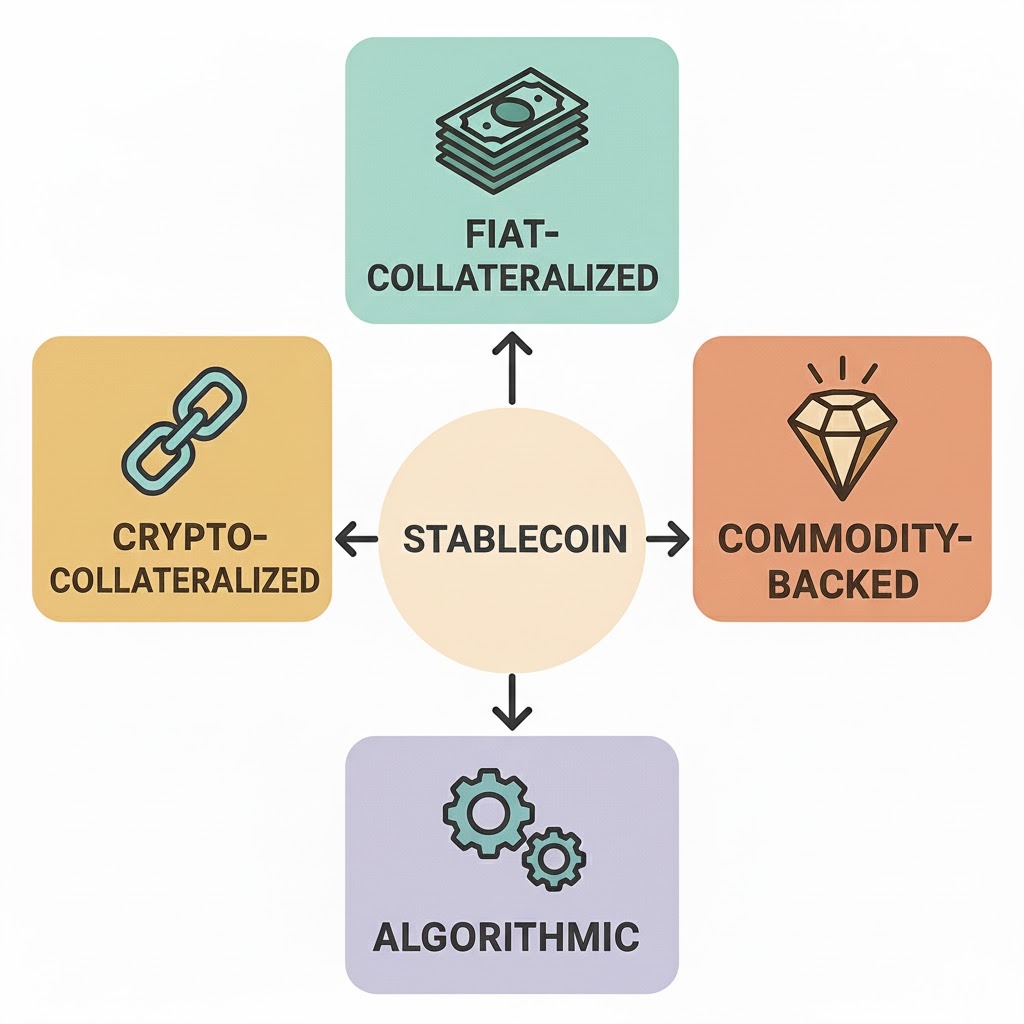
Maintaining a peg requires highly specific mechanisms that can adjust the supply and demand to keep the prices stable. Here’s how the different models work.
Maintaining a peg isn’t magic. It requires specific mechanisms that adjust supply, demand, or both to keep prices stable. Let’s break down how different models actually work.
Fiat-Collateralized Pegs
The most straightforward approach is to back crypto with actual fiat currency that is held in reserve.
Here is how it works. For every stablecoin issued, there is supposed to be $1 (or whatever fiat currency it is pegged to) sitting in the bank account. So, if 100 million USDC tokens exist, the Circle (the company behind USDC) should have $100 million in reserves.
Whenever you want to create new stablecoins, you have to deposit fiat with the issuer. Then the issuer mints the tokens for you. To redeem them, you have to send tokens back and receive fiat. This ability to exchange 1:1 between the token and fiat is what helps to maintain the peg.
The reason this works is simply arbitrage. If USDC trades at $0.98, arbitrageurs buy it cheaply, redeem it for $1, and pocket the difference. This buying pressure pushes the price back up. If it trades at $1.02, people mint new USDC for $1 and sell it for $1.02, increasing supply and pushing the price back down.
Examples:
- USDT (Tether) – The biggest stablecoin by far, though its reserves have been questioned repeatedly
- USDC (USD Coin) – Issued by Circle, considered more transparent with regular audits
- BUSD (Binance USD) – Binance’s fiat-backed stablecoin (though being phased out)
The transparency issue:
This model only works if the issuer actually holds the reserves they claim. Even Tether has famously admitted their tokens were not 100% backed by actual dollars – some of the reserves were in commercial paper, or corporate debt, or other assets. That revelation definitely shook confidence. But USDT has maintained its peg well.
The regular audits and transparent reserve reporting are highly important. Circle actually publishes a monthly attestation showing exactly what backs USDC. The more transparent the reserves, the more people have trust in the peg.
Crypto-Collateralized Pegs
Instead of fiat, you can actually back stablecoins with other cryptocurrencies as well. That’s what crypto-collateralized models do.
The challenge here is that the crypto is volatile, meaning that the value fluctuates a lot. You can’t simply back $1 worth of stablecoin with just $1 worth of cryptocurrency. It is too risky.
But over-collateralization helps resolve the issue. Basically, the system asks you to lock up more crypto than the value of the stablecoins you’ve created. A prime example of that is DAI. It’s a decentralized stablecoin created by the MakerDAO protocol (a decentralized protocol)
Note: DAI is a stablecoin, and it’s a type of cryptocurrency that is designed to stay equal to $1 USD. It is backed by other cryptocurrencies like Ethereum (ETH) rather than cash.
This is how it works:
- You deposit $150 worth of ETH into a smart contract.
- You can mint up to $100 worth of DAI (maintaining a 150% collateralization ratio).
- The DAI is pegged to $1 USD.
- To get your ETH back, you repay the $100 DAI plus a small stability fee.
You must be wondering why we need to over-collateralize. The answer is simple. If ETH drops in value, your collateral must cover the DAI that you minted. If your collateral ends up falling below the minimum threshold, your position gets liquidated. The protocol automatically sells your ETH to buy back and burn DAI. This helps maintain the system’s stability.
We can see that the peg here always holds because DAI is always redeemable. After all, you can burn it to unlock collateral. If DAI trades below $1, people can buy it cheap to repay their loans, reducing the supply. On the other hand, if it trades above $1, people actually mint more DAI to sell – increasing the supply.
People prefer using this model as it’s decentralized. No company is holding your fiat, and no bank accounts are to be frozen. It’s simply smart contracts and code, making it ideal for the crypto-native crowd.
Commodity-Backed Pegs
Instead of pegging to fiat, you can also peg your tokens to physical commodities such as gold.
The best example is PAXG (Pax Gold). On their official website, it’s written that,
“Each Pax Gold (PAXG) token is backed by one fine troy ounce of gold, stored in LBMA vaults in London. If you own PAXG, you own the underlying physical gold, held in custody by Paxos Trust Company.”
Moreover, the gold is actually allocated. That means that specific gold bars back specific tokens.
Here’s how it works: Whenever you buy PAXG, either the gold is bought and vaulted or the existing vaulted gold is allocated to back your tokens. You can always redeem PAXG for physical gold. However, there are minimums and fees to pay. The token price also tracks the gold price.
The appeal of commodity-backed pegs to investors:
- You can get access to gold without needing to physically store it yourself.
- There is an easy transfer compared to shipping the actual gold bars.
- There is divisibility here, as you can own a fraction of an ounce
- 24/7 tradability is available here that gold markets do not offer.
There are other commodity-backed examples as well, such as the oil-pegged tokens (for example, the controversial Venezuela’s Petro) and silver-backed tokens,
The main requirement here is that of legitimate custody. Someone actually needs to hold the physical commodity, and the users need to trust or verify that the backing exists. In this case, regular audits and transparent custody arrangements are important.
Algorithmic Pegs
This is the most interesting model, although it has been known to be quite risky as well. Algorithmic stablecoins also maintain pegs, but they do so without collateral. They just use a lot of math and incentives.
The concept here is simple. Based on the price, the smart contracts automatically adjust the token supply. So, if the stablecoin trades above $1, the protocol mints new tokens to increase the supply and push the price down. On the other hand, if the trades are below $1, the protocol incentivizes burning tokens to reduce the supply and push the price up.
The most popular example of algorithmic pegs is the TerraUSD (UST). It had a good run until it collapsed in May 2022, losing billions in value. TerraUSD was linked to another coin, LUNA. They used a system where users could swap between the two coins to keep UST near $1. But people lost trust in LUNA, which resulted in LUNA’s price crashing. The system tried to solve it by creating more LUNA, but it just ended up spiralling out of control. This crash demonstrated that the stablecoins can fail without any real collateral. Once the confidence is gone, the peg just can’t be saved. So, some algorithmic pegs like FRAX use partial collateral to avoid a crash like this.
Hybrid Models
Projects can combine multiple approaches, which try to get the best of both worlds. A great example of that is FRAX; it started as a fractional-algorithmic stablecoin. Part of each FRAX is actually backed by collateral (USDC), and part of it is algorithmic. Based on the market conditions, the ratio is adjusted. In stable times, you don’t need that much collateral. But during stressful periods, the protocol increases collateralization.
There are many benefits to using hybrid models. They are more capital-efficient than using full collateralization and more resilient than using pure algorithmic approaches. Moreover, they have the flexibility to adapt to different market conditions.
The only drawback is its complexity, as hybrid systems have more moving parts. That means there are more potential failure points for regular users.
Top Pegged Cryptocurrencies & Stable Assets
Here are the major pegged cryptocurrencies and stable assets that are used in the crypto markets.
USDT (Tether)
USDT is known as the king of stablecoins by market cap and trading volume. It’s pegged to USD in a 1:1 ratio, meaning it is fiat-collateralized. Despite having some controversy over its transparency, it has maintained its peg remarkably well. It is widely traded across many blockchains and is the most liquid stablecoin out there.
USDC (USD Coin)
USDC is Circle’s stablecoin, and it is considered more transparent than Tether due to regular attestations. It is entirely backed by cash and short-duration US treasuries. It is the second-largest stablecoin, and it is most commonly used in DeFi. It briefly depegged during the Silicon Valley Bank crisis, but it recovered quickly.
DAI
DAI is the leading decentralized stablecoin, which is backed by crypto collateral. It is pegged to USD, but it is maintained through smart contracts rather than a centralized company. It’s popular in DeFi for those who want to avoid centralized stablecoin risk.
PAXG (Pax Gold)
Each PAXG token represents one troy ounce of gold that is held in vaults. It offers crypto-native ways to hold the gold exposure. It can be redeemed for actual physical gold. Moreover, it tracks gold prices rather than maintaining a fixed $1 peg.
BUSD (Binance USD)
It was a huge fiat-backed stablecoin issued by Paxos in partnership with the Binance platform. It is being phased out because of regulatory pressure from the SEC.
FRAX
It’s a fractional-algorithmic stablecoin that is highly collateralized. It represents an attempt at a more sustainable algorithmic model after Terra’s collapse.
The Difference Between Pegged and Backed Crypto
It seems that “pegged” and “backed” mean the same thing, but there’s a nuanced difference between the two. Pegged refers to the price target. That means that if a coin is pegged to $1, it will always aim to trade at $1. The peg describes the price relationship.
Meanwhile, “backed” refers to what supports the peg, meaning the collateral or the reserves. A coin is said to be backed by USD if there are actual dollars held to support its value.
You can be pegged without being backed, and you can also be backed without being pegged. For instance, algorithmic stablecoins such as the now-defunct TerraUSD were pegged to $1 but not actually backed by anything. They just had supply and demand algorithms. Wrapped Bitcoin (WBTC) was backed by actual Bitcoin but not pegged to a fixed price; it merely tracked Bitcoin’s volatile price movements.
Though most stablecoins have been pegged and backed, for example, USDC is pegged to $1 and also backed by real dollars in reserves. Moreover, DAI is pegged to $1 and backed by crypto collateral, which is locked in smart contracts.
What are the Benefits of Crypto Pegging?
There are many benefits when it comes to crypto pegging. Here are a few of the main ones:
- Price Stability for Real Use Cases
Stablecoins can function as money. You can actually pay someone in USDC and know that its value will remain the same tomorrow. Businesses can therefore easily accept stablecoins without any exchange rate risk. This ends up making crypto really practical for trading and payments.
- Bridge Between Crypto and Fiat
Stablecoins act as a bridge between crypto and fiat. They let users move the funds, do trading or hold value in stable assets without the need to convert to traditional currency. This helps save time and money. Moreover, it keeps the users within the crypto ecosystem.
- DeFi Building Block
In DeFi (Decentralized Finance), stablecoins are very important. They actually enable lending, borrowing as well as yield farming with predictable returns and reduced risks. This provides a stable foundation that is required for decentralized markets to work.
- Cross-border transactions
Stablecoins help make it much easier, faster, cheaper and more accessible to send money globally. The fees are also much less compared to traditional banking systems.
- Hedge against volatility
Sometimes markers crash and when that happens in the crypto space, you can utilize stablecoins to preserve your capital without having to exit crypto entirely. You can hold your assets there until the market conditions improve.
- Simplified Accounting
Stable value helps make accounting easier for businesses using crypto. The revenue gained and expenses incurred in USDC are much easier to track than Bitcoin where the value is constantly changing. Moreover, tax reporting also becomes straightforward.
- Access to USD Without Banks
Stablecoins help provide access to dollar-denominated assets without needing US bank accounts. This is ideal for countries where there are currency restrictions or unstable local currencies. Notable countries that have benefitted from this are Nigeria, Turkey and Argentina.
What Can Go Wrong with Crypto Pegs?
Pegged cryptocurrencies are not risk-free. There are some major things you need to look out for!
Insufficient or Fraudulent Reserves
The biggest risk with collateralized stablecoins is insufficient or fraudulent reserves. What if the reserves don’t actually exist? Or what if they are not what they claimed to be?
Tether actually faced this accusation multiple times. So much so that they actually admitted at one point that the USDT was not fully backed by dollars but rather by various assets such as corporate debt and commercial paper. Since 2025, they have made changes to be more transparent but the trust was definitely shaken. The reserves need to match issued tokens, otherwise the peg can break.
Lack of Transparency
The problem is that many stablecoin issuers do not regularly provide the detailed audits that are needed. When there is a lack of transparency, users cannot actually verify that the backing actually exists. Instead of being a verifiable system that users can trust, it becomes a trust game.
Liquidity Crises
Even if you have proper backing, there are liquidity problems that can lead to temporary depegs. This happens when everyone tries to redeem at once and there isn’t enough liquidity to handle the rush. This happened with the USDC during the Silicon Valley Bank Crisis. Circle has $3.3 billion stuck in the Silicon Valley Bank, leading to a brief depeg even though USDC was backed.
Note: A depeg occurs when a stablecoin loses its fixed value (its peg).
Algorithm Failures
The algorithmic stablecoins are quite fragile because their pegging mechanism depends on continued market confidence and arbitrage. The algorithms can daily majorly when there is extreme market stress.
Real-World Depeg Events
Here are some major real-world depeg events that made quite an impact.
- TerraUSD (UST) – May 2022
UST was an algorithmic stablecoin pegged to $1 and it was backed by LUNA. It ended up collapsing after a huge sell-off triggered a “death spiral”. As the UST was redeemed for LUNA, the supply actually exploded and it led to LUNA’s price crashing and destroying confidence. Within just days, UST fell to $0.10, wiping out about $45 billion.
The lesson here is that pure algorithmic pegs without real collateral are extremely fragile.
- USDC – March 2023
USDC briefly dropped to the rate of $0.88 when $3.3 billion of its reserves were stuck in the failed Silicon Valley Bank. Once the deposits were guaranteed, it actually quickly recovered.
The lesson here is that even fully backed stablecoins face banking risks and that the diversification of reserves is crucial.
- Tether (USDT) – Multiple Brief Depegs
USDT has actually experienced short-lived dips below $1 because of market stress or fears over reserves. But it always regained its peg fast through liquidity and arbitrage.
The lesson here is that market dominance and arbitrage can maintain stability even if there are transparency concerns.
Regulatory Impact on Crypto Pegging
Stablecoins are actually getting a lot of attention from regulators globally. So, the rules they set will definitely play a huge role in how these digital currencies maintain their value in the future.
United States
In the U.S., the regulators view the stablecoins as something which can impact the entire financial system. So, they are keeping a very close eye on them.
Recently, the SEC has made things a bit clearer by saying that certain “covered stablecoins” are not actually considered securities under federal law. This helped lower some of the confusion and fear around the enforcement. But still the SEC continues to take action against crypto projects that commit frauds or break rules.
At the same time, banking regulators have also limited how much banks can get involved with stablecoins in order to control risks.
Moreover, Congress is also working on laws regulating stablecoins. One huge step was the GENIUS Act passed in 2025. It requires stablecoin issues to have proper licenses, maintain the reserves, conduct regular audits and to operate more like traditional banks do.
A notable example of how serious things have gotten is Paxos, Paxos had to stop issuing BUSD because of the regulatory pressure.
European Union – MiCA
Europe actually has its own approach under MiCA (Markets in Crypto-Assets Regulation). Under the MiCA law, the companies that issue stablecoins have to be officially authorized and keep a strong reserve backing. They also have to get regularly audited and must remain transparent about all of their operations.
Moreover, MiCA also puts limits on how big a stablecoin can grow. This prevents risks to the financial system. The entire goal is to make the market safer and encourage innovation.
Global Approach
Different countries are taking different and unique approaches:
- UK: Bringing stablecoins into the existing payment regulations
- Singapore: The country requires stablecoin reserves to be held domestically
- China: Have completely banned stablecoins along with other crypto
- Developing nations: Many see stablecoins as useful but are still developing frameworks
Impact on pegging
Regulation can strengthen the pegging mechanisms by emphasizing on transparency, proper reserves, as well as professional management.
The downside is that the stricter rules may reduce the decentralization and leave out the algorithmic or fully decentralized stablecoins that don’t fit neatly into these regulations.
The biggest worry is that if regulations become too strict, stablecoin projects might move their operations offshore or go underground, which makes the system less stable than having well-regulated, transparent stablecoins in the mainstream.
Pegging in DeFi: How It’s Used Across Protocols
Stablecoins are known as the lifeblood of DeFi because of its versatile benefits. Here are all the ways that pegged assets enable decentralized finance.
Lending and Borrowing (Aave, Compound)
DeFi lending protocols allow you to deposit stablecoins in order to earn interest or to borrow against crypto collateral. The stable value is important because lenders need to know that their $1000 USDC will be worth exactly $1000 when they withdraw it. The borrower needs predictable debt amounts.
For instance, Aave offers the interest rates on USDC deposits (currently around 2-4% APY), and the platform lets you borrow the USDC against ETH or any other collateral. The only reason this works is because the USDC maintains its $1 peg.
Liquidity Pools (Curve, Uniswap)
Liquidity pools such as Curve Finance are made for trading stablecoins like USDT, DAI and USDC with low fees and price changes. The platform works best since all these coins are supposed to maintain their value of $1.
The price barely moves when you are trading one stablecoin for another – this is known as low slippage. The people who are depositing their stablecoins into Curve’s pools are called liquidity providers, and they earn a small trading fee from swaps. As the coins stay around $1, they deal with very little impermanent loss. That means they don’t lose value compared to just holding their stablecoins.
Yield Farming and Staking
Many of the DeFi yield strategies depend on stablecoins. You may deposit USDC in a vault, which automatically allocates it to different protocols to maximize the returns. Your yield is actually measured in stable dollars rather than the volatile crypto.
Decentralized Stablecoin Creation
There are protocols such as MakerDAO that let you easily mint stablecoins by locking the crypto as collateral. This helps create a decentralized dollar alternative without the need for centralized users.
Cross-Chain Bridges
Stablecoins allow you to move value between blockchains. You can bridge USDC, knowing that the value stays stable instead of bridging to ETH (where the price may lose its value).
DAO Treasuries
The Decentralized Autonomous Organizations (DAO) usually hold huge portions of their treasuries in stablecoins to make sure that they can cover operational expenses without any volatility risk.
Risk consideration for DeFi users:
Whenever you use stablecoins in DeFi, you’re basically adding pegging risk on top of protocol risk. And if you are farming yield on Aave with USDC, then you are being exposed to boat Aave’s smart contract risk as well as USDC’s potential depeg risk. You should always consider both layers of risk when you start trading using stablecoins.
Summing Things Up
Basically, in crypto, pegging means keeping a coin’s value stable by linking it to something else, usually the US dollar, but sometimes gold or other currencies. Different types of pegs work in different ways. Fiat-backed stablecoins are reliable but centralized. Crypto-backed ones are more decentralized but need extra collateral. Algorithmic pegs are efficient but can be fragile, and hybrid models try to balance these factors.
Stablecoins rely on their peg to work well. They power DeFi, make trading easier, and help with payments. But they are not risk-free. Weak reserves, poor transparency, regulation, or broken algorithms can cause the coin to lose its peg, which is called a depeg. Terra’s collapse showed this clearly.
It is important to know what backs a stablecoin and how its peg works, because not all stablecoins are the same. When pegging is done right, it can make crypto more stable and predictable, even in volatile markets.
Want to deepen your understanding of crypto beyond just stablecoins? Dypto Crypto offers engaging courses on DeFi, Web3 fundamentals, and blockchain technology that go beyond surface-level explanations. Understanding the full crypto ecosystem, not just one piece, makes you a smarter investor and user. Check out Dypto Crypto’s resources and start learning the fun way.
H2: FAQs (Frequently Asked Questions)
Q: How do stablecoins maintain their peg?
They use different methods. Fiat-backed coins hold reserves for 1:1 redemption, crypto-backed ones use over-collateralization, and algorithmic coins adjust supply based on price. Arbitrage and market forces help keep the peg stable.
Q: What causes a stablecoin to depeg (lose its peg)?
Depegs occur when reserves are lacking, confidence drops, liquidity dries up, or smart contracts fail. External shocks like bank failures or algorithm breakdowns can also trigger sell-offs and price drops.
Q: Are algorithmic pegs stable and safe?
Not really. TerraUSD’s collapse proved they’re fragile since they depend entirely on confidence, not real collateral. When trust fails, they spiral down instead of recovering.
Q: If I use a stablecoin in yield farming, what extra risk does its peg bring?
You face both protocol and depeg risk. If a stablecoin loses its peg while staked, your value drops even if the protocol itself is safe. Always check the coin’s peg reliability before farming.
Disclaimer
This article is for educational and information purposes, and should not be considered financial advice. For more information visit our disclaimer page
About the Author