
TLDR
- Billions of dollars worth of BTC have moved from onchain to ETFs.
- Self-custodied Bitcoin is at its lowest point in 15 years.
- The main reason? Tax advantages.
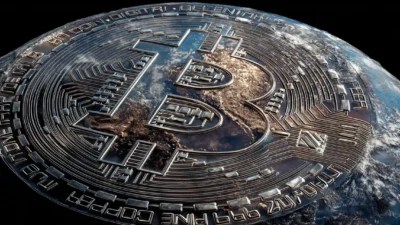
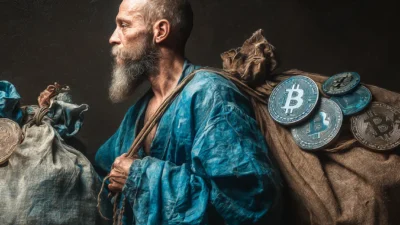
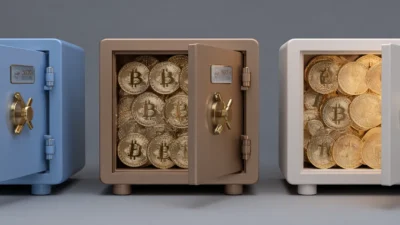
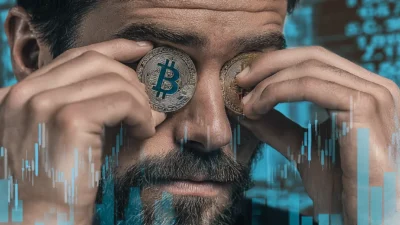
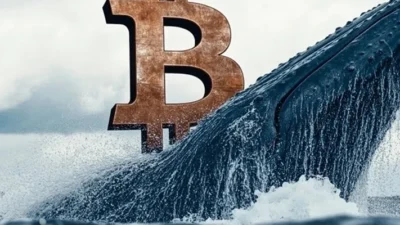
“Not your keys, not your coins.” For years, this has been the rallying cry for serious crypto holders. The idea is simple: if you don’t personally control the private keys to your crypto wallet, you don’t truly own your assets. But now, some of the biggest players in the game — the legendary OG Bitcoin whales — are starting to sing a different tune.
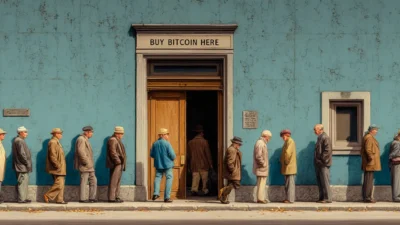
These early adopters, who stacked massive amounts of Bitcoin when it was practically worthless, are now moving their fortunes from self-custody into shiny new spot Bitcoin ETFs. Why would the most hardcore believers give up their keys? Good question. Let’s get after it.
A Quick Overview of ETFs
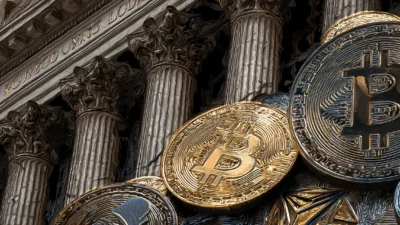
Before we get into the whale drama, let’s quickly cover the basics. An ETF, or Exchange-Traded Fund, is an investment fund that trades on a stock exchange, just like a regular stock. A spot Bitcoin ETF holds actual Bitcoin as its underlying asset. When you buy a share of a Bitcoin ETF, you’re buying a piece of the Bitcoin held by the fund.
The big difference? You don’t have to worry about storing the Bitcoin yourself. A major financial institution, like BlackRock, handles all the security and custody. This makes it super easy for people to get exposure to Bitcoin through their regular brokerage accounts without the headache of wallets and private keys.
The Great Migration: Why Whales Are Moving
So, why are these long-time HODLers suddenly moving billions into ETFs? It turns out there are some pretty compelling reasons, and they mostly come down to convenience, taxes, and playing nice with the traditional financial system (TradFi).
The Convenience Factor
Let’s be real: self-custody can be a pain. It involves hardware wallets, seed phrases, and the constant, nagging fear that you’ll forget your password or have your device stolen. For whales managing millions or even billions of dollars in Bitcoin, that’s a whole lot of stress.
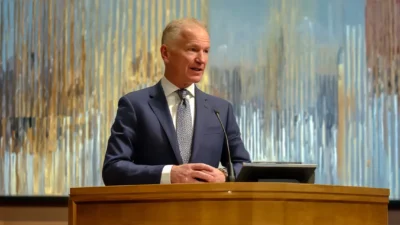
Robbie Mitchnick, who heads up digital assets at BlackRock, told Bloomberg that many whales are jumping at the “convenience of being able to hold their exposure within their existing financial adviser or private-bank relationship.”
BlackRock alone has already seen over $3 billion in these conversions into its iShares Bitcoin ETF (IBIT). By moving to an ETF, Bitcoin whales can see their Bitcoin alongside their stocks, bonds, and other investments, making it much easier to manage their entire portfolio.
Taxes, Taxes, Taxes
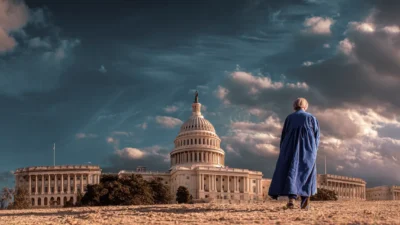
Only two things are certain in this world. And only one has to do with money. Taxes. The one thing you can’t escape, even in the wild world of crypto. According to Martin Hiesboeck from Uphold, the main driver for this shift is simple: taxes. A recent rule change from the U.S. Securities and Exchange Commission (SEC) has made a huge difference.
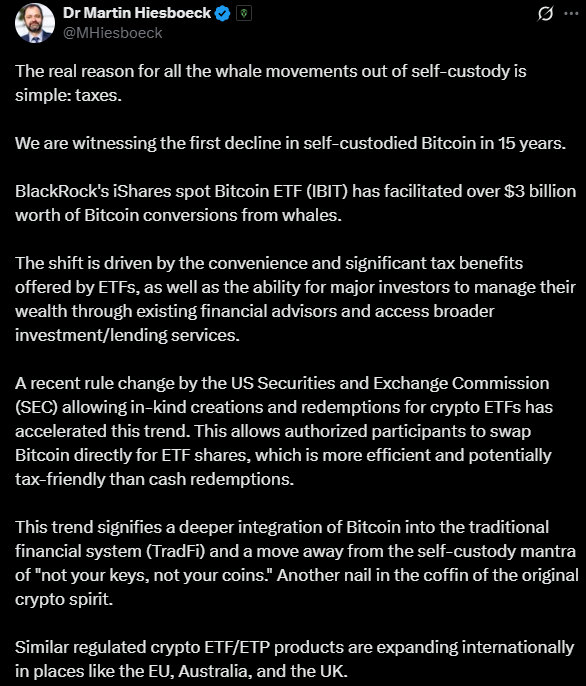
In July 2025, the SEC approved “in-kind” creations and redemptions for crypto ETFs. This is a bit technical, but stick with us. Previously, if you wanted to move your Bitcoin into an ETF, you’d have to sell your Bitcoin for cash, then use that cash to buy ETF shares. This selling part is a “taxable event,” meaning you’d likely have to pay capital gains tax.
With in-kind redemptions, authorized participants can now directly swap Bitcoin for ETF shares. This process is far more efficient and can be more tax-friendly, saving these large investors a ton of money. It’s a game-changer that makes ETFs much more attractive.
Integrating with Traditional Finance
Moving their holdings into the regulated world of ETFs allows these Bitcoin whales to bridge the gap between crypto and traditional finance. The integration lets them use their Bitcoin wealth to access other financial services, like getting loans using their ETF shares as collateral.
It’s about making their massive crypto fortunes work for them in the broader financial system, something that’s much harder to do with self-custodied coins.
A real-world example: You can go into a bank and take a loan against your assets, even stocks. You can’t really do that yet with BTC. But putting that wealth into IBIT changes the whole story.
Your wealth goes from being something that’s purely digital to something that is basically free money. How? Incredibly wealthy people can borrow at interest rates lower than the current inflation rate, meaning the interest on borrowed funds will be lower than the rate at which inflation can erode them.
You borrow against your IBIT at 1% interest. The inflation rate is 3%. Free money.
The End of an Era?
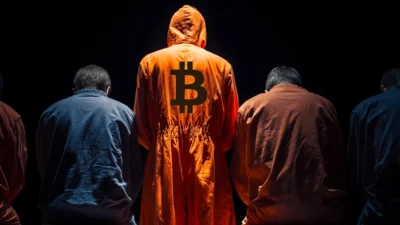
The trend marks the first significant decline in self-custodied Bitcoin in over a decade and a half, according to Hiesboeck. For the die-hard crypto purists, this feels like a betrayal of the original ethos of Bitcoin — a decentralized currency free from banks and governments. As Hiesboeck put it, it’s “another nail in the coffin of the original crypto spirit.”
But for others, this is just the natural evolution of an asset class going mainstream. The approval of spot Bitcoin ETFs was a monumental step in legitimizing Bitcoin as a credible investment. The fact that the earliest and biggest believers are now embracing these products shows that Bitcoin is growing up.
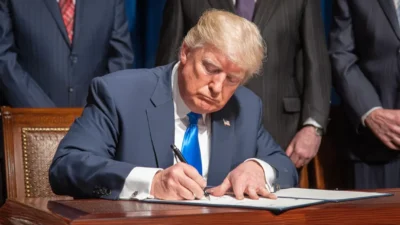
SEC Chairman Paul S. Atkins even said the changes will help build a “rational regulatory framework for crypto,” which ultimately leads to a “deeper and more dynamic market” that benefits everyone.
What This Means for Users
So, should you ditch your hardware wallet and run to the nearest ETF? Not necessarily.
- For Newcomers: If you’re new to crypto, ETFs offer a simple and relatively safe way to get started. You don’t have to worry about the steep learning curve of self-custody.
- For Experienced Holders: If you’re comfortable with self-custody and value the “not your keys, not your coins” philosophy, there’s no reason to change. Direct ownership still offers the highest level of control and censorship resistance.
Now have more choices than ever. The crypto landscape is expanding, offering different options for different types of investors with varying levels of risk tolerance and technical know-how.
The Bigger Picture (Splash, Maybe) for These Bitcoin Whales
The movement of Bitcoin whales into ETFs is a sign that Bitcoin has firmly arrived on the world’s financial stage. While the spirit of decentralization remains a core part of the crypto community, the practical benefits of integrating with traditional finance are becoming too big for even the largest holders to ignore.
The shift doesn’t mean self-custody is dead. For many, it will always be the purest way to hold crypto. But the rise of regulated, convenient products like ETFs is opening the door for a new wave of adoption and making Bitcoin a more accessible asset for everyone. It’s not a good thing. It’s not a bad thing. It’s just an option.
Disclaimer
This article is for educational and information purposes, and should not be considered financial advice. For more information visit our disclaimer page
About the Author