

TLDR
- Back in December, we wrote an article about a possible ETH supply squeeze. The data at the time showed that it was a possibility in the near future.
- The signs continue to accumulate. Staking is at all-time highs, with nearly 30% of the supply locked up.
- Institutional interest continues to increase.
- This week, Etherscan recorded a record for new ETH addresses.
Market analysts have spent months speculating on the possibility of an Ethereum “supply squeeze”, a scenario in which the supply drops sharply while demand remains steady or increases. According to the latest on-chain data and market reports, that theoretical scenario appears to be transitioning into a tangible reality.
We’re not saying it’s happening. But if it is…we called it.
Some recent metrics indicate that ETH available on exchanges has hit a decade-low, while staking participation has reached all-time highs. When combined with a surge in new wallet creation and institutional adoption, the ecosystem is displaying the classic indicators of a tightening supply. Let’s get after it.
Exchange Reserves Hit Historic Lows
The primary driver of the current supply squeeze discussion is the rapid depletion of ETH held on centralized exchanges. Data from back in December showed that the percentage of Ethereum’s circulating supply on exchanges like Coinbase and Binance has dropped to just 8.7%.
It has since risen, but not by much. Those exchanges hold about 16.5 million tokens now, while ETH has a total supply of 120.69 million, according to CoinMarketCap. The TLDR? Since July 2025, the amount of ETH on exchanges has plummeted.
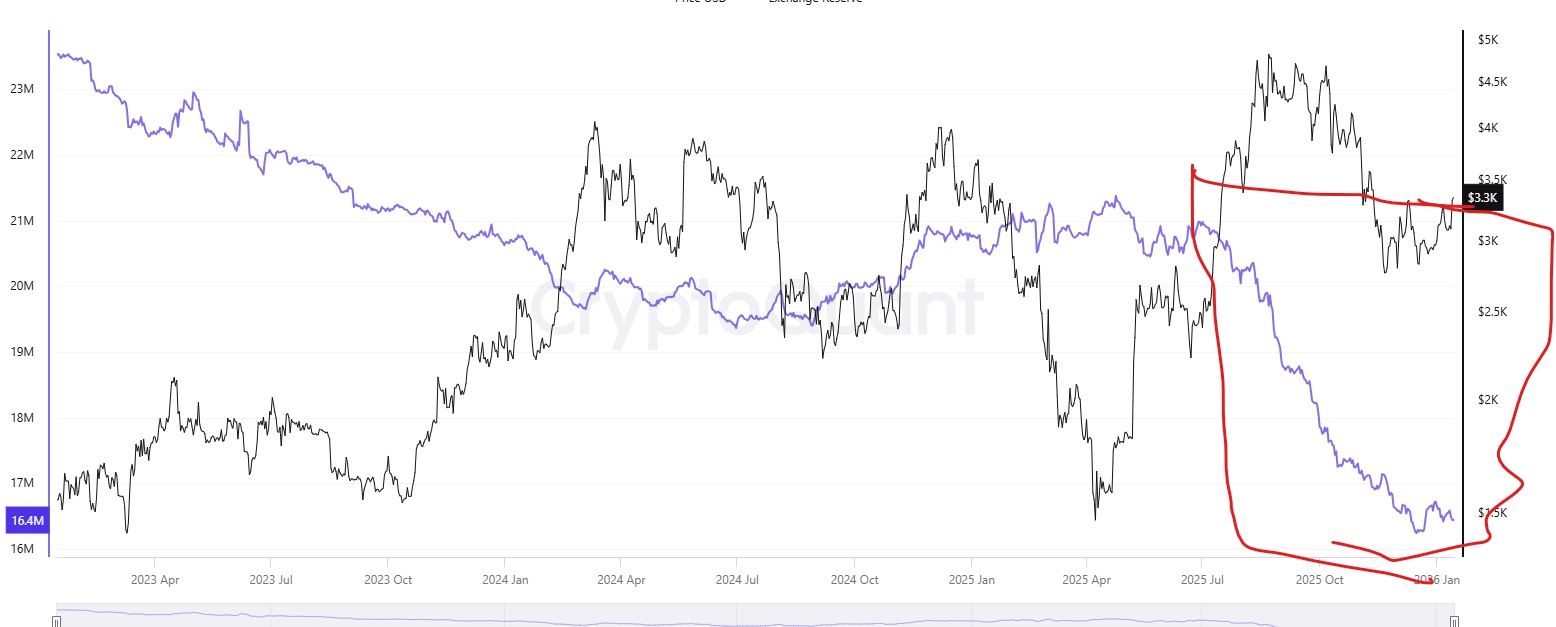
PS…we know we suck at drawing circles. We’re not artists. We’re crypto nerds.
In financial markets, exchange reserves are often viewed as “liquid supply” — assets that can be sold immediately. When investors move assets off exchanges and into private “cold” wallets, it usually shows a long-term holding strategy, often referred to as hodling.
The migration suggests that current holders have little intention of selling in the short term. With fewer tokens available for immediate purchase, any spike in demand could have an outsized impact on price action, a foundational concept in supply and demand economics.
The New Staking Frenzy
If Ethereum is leaving exchanges, where is it going? The data points to staking contracts.
Staking involves locking up ETH to help secure the network in exchange for rewards. Once ETH is staked, it is removed from the immediate circulating supply, effectively becoming illiquid.
Reports confirm that staked Ether has reached a new all-time high of roughly 36 million ETH. This accounts for nearly 30% of the cryptocurrency’s circulating supply.
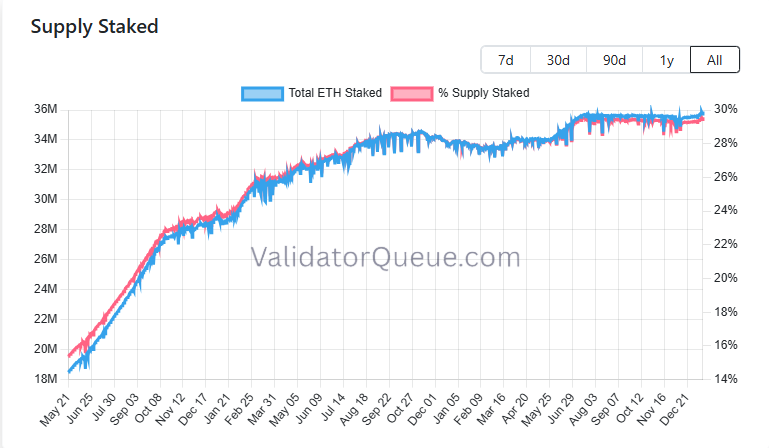
To put this in perspective, the prior peak for staked ETH was roughly 29.5% in July 2025. The trend shows no signs of slowing down.
Lido Finance remains the dominant player in this sector, accounting for approximately 24% of all staked ETH. However, the composition of stakers is shifting. While early staking was driven by crypto-native users, recent growth is increasingly fueled by institutional capital.
Institutional Giants Double Down
The current narrative that “smart money” is entering the Ethereum ecosystem is supported by significant institutional movements. Large asset managers are viewing staking not just as a network function, but as a core component of their investment strategy.
BitMine, a major institutional player, now holds 4.17 million ETH. This represents more than 3.45% of Ethereum’s total circulating supply. Notably, over 1.25 million of those tokens are currently staked — a figure that nearly doubled in just one week.
Furthermore, traditional finance (TradFi) adoption is accelerating. Grayscale has begun distributing staking rewards to investors in its Ethereum ETFs, marking a pivotal shift in how institutional products engage with on-chain yield.
Similarly, Morgan Stanley recently filed to launch a spot Ethereum ETF that includes a staking component. These moves signal that large-scale asset managers are removing liquidity from the market to capture yield, further tightening the available supply.
Network Activity and The Fusaka Effect
A supply squeeze requires two variables: falling supply and rising (or steady) demand. While the supply side is contracting via staking and cold storage, the demand side is being driven by record-breaking network activity.
Following the Fusaka upgrade in December 2025, Ethereum has seen a resurgence in user metrics. The upgrade was designed to make the network cheaper and easier to use by improving how data is handled. The results have been immediate.
Over the last week, the network has averaged 327,000 new wallets created per day. Sunday set a single-day record with almost 600,000. Additionally, the number of active addresses on Ethereum has surged to over 847,000.
The activity is largely attributed to the dramatic reduction in transaction costs. Just a year ago, average transaction fees could spike to $11, and in previous years, extreme congestion pushed gas fees over $200.
Today, following the Pectra and Fusaka upgrades, average transaction fees have stabilized around $0.15. The affordability has reopened the network to retail users and smaller transactions, fueling a new wave of adoption.
A Textbook Supply Squeeze?
Maybe. A supply squeeze is a market condition in which the available supply of an asset dries up, making it difficult for buyers to purchase without driving prices up.
The current Ethereum landscape presents a convergence of these factors:
- Supply Shock: 40+% drop in exchange reserves since July; lowest levels since 2015.
- Liquidity Lock: 30% of supply locked in staking contracts, with institutions accelerating this trend.
- Demand Surge: Record-breaking new wallet creation and active addresses, driven by negligible transaction fees.
While we remain cautious regarding price predictions, the underlying mechanics of the Ethereum network have fundamentally shifted. The abundance of liquid ETH that characterized previous market cycles has been replaced by a scarcity model driven by staking and long-term holding.
If demand continues to track with the post-Fusaka user growth, the supply squeeze thesis moves from speculation to statistical probability.
The Road to 100,000 TPS
The pressure on supply may continue as the network prepares for further technological leaps. Ethereum co-founder Vitalik Buterin recently commented on the network’s long-term roadmap, emphasizing a goal of developers eventually walking away from a fully self-sustaining system.
The next major milestone is the “Glamsterdam” fork. The upgrade aims to introduce “perfect parallel processing”, which would purportedly allow for larger block sizes and increased transaction bandwidth without raising the requirements for running a node. The ultimate goal is to increase Ethereum’s throughput to 10,000 transactions per second (TPS).
As the network scales to accommodate more users while simultaneously locking up more assets for security, the dynamic between scarcity and utility will likely define Ethereum’s market performance in the coming months. It’s an exciting time to be an ETH holder.
Disclaimer
This article is for educational and information purposes, and should not be considered financial advice. For more information visit our disclaimer page
About the Author