
TLDR
- Coinbase Ventures knows what it wants to see in 2026.
- They want to spend funds on specific areas of DeFi, RWAs, robotics, and AI.
Coinbase Ventures has released a “what should we build next?” list. But realistically, it’s more of a “what should we buy next?” list. If you’re looking for the next big thing in crypto, this is a treasure map.
Every year sees massive changes to the crypto landscape. Stablecoins are changing how we think about payments, and prediction markets are finally going mainstream.
With all the regulatory clarity 2025 brought, Coinbase Ventures is strutting around with deeper liquidity and better tech. And they’re looking to make some big bets. Let’s get after it.
RWA Perpetuals
Real-world assets (RWAs) on the blockchain have been a hot topic, but Coinbase Ventures thinks the real action is in “RWA perpetuals.” What does that even mean?
Think of perpetuals (or “perps”) as futures contracts without an expiration date. They let you bet on the future price of an asset without actually owning it. In plain terms, you can create a market for almost anything — from oil prices and private company stock to economic data.
According to Kinji Steimetz from the Ventures team, this “perpification of everything” will allow traders to hedge their bets or get exposure to assets that are normally hard to trade. It’s about bringing more of the traditional finance world onto the blockchain in a faster, more flexible way.
Specialized Exchanges and Trading Terminals
Remember when DeFi was a mess of different apps and confusing interfaces? Honestly, it’s still a mess. But now it’s a different kind of mess. But history has a way of repeating itself, doesn’t it? We’re seeing a similar problem with newer crypto products like prediction markets.
Better Marketplaces for Trading
Building a good crypto exchange is tough. You need to protect the liquidity providers (market makers) from predatory traders, among other things.
Coinbase Ventures is interested in new designs that build these protections right into the system. One example is “Prop-AMMs” on Solana, which create a safer environment for liquidity providers. The idea is to build smarter, more sustainable exchanges from the ground up.
One-Stop Shop for Prediction Markets
Prediction markets have blown up, with over $600 million in liquidity spread across different platforms. It’s a pain for users who have to jump between sites with different tools and isolated funds.
The solution? Aggregators. Jonathan King envisions trading terminals that pull everything together. The idea isn’t new for crypto. Aggregators, like 1inch, have been around for close to a decade. But for prediction markets? That’s a new level of innovation as well as complexity.
But if a team can pull it off, it could change the game forever. Imagine a single dashboard where you can see all the odds, use advanced trading tools, and find arbitrage opportunities across different prediction markets. Think of it as the ultimate interface for betting on future events.
Next Gen DeFi
DeFi isn’t done evolving. The next wave will be all about making it more efficient and accessible.
Making Perps More Useful
Perpetual futures are already a massive market, with monthly trading volumes hitting $1.4 trillion and surpassing those of regular DEXs.
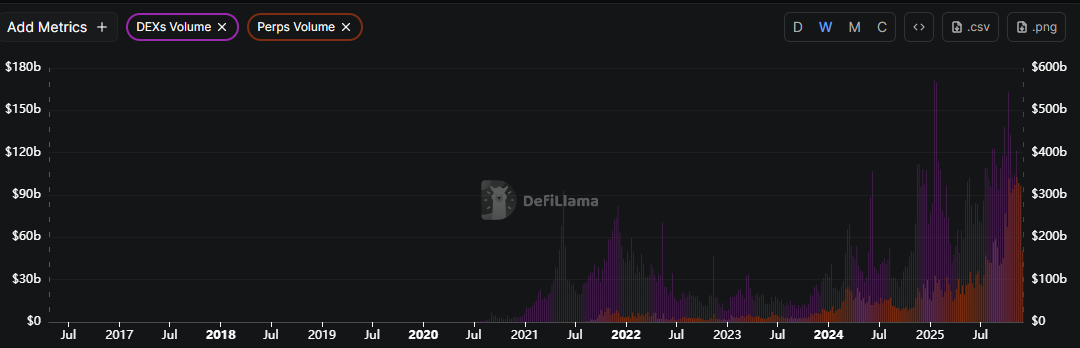
The next step is to make them even more useful. Projects like Hyperliquid are letting users earn interest on their trading collateral. Users can hedge, earn, and leverage their assets simultaneously without sacrificing liquidity. It’s about making your money work harder for you.
Lending Without Collateral
Most DeFi lending requires you to put up collateral (like ETH, BTC, or stables). But what if you could get a loan based on your reputation? This is the idea behind unsecured lending. It’s a huge market — the US alone has $1.2 trillion in unsecured credit (ie, credit cards).
The challenge is figuring out how to manage risk. The team that cracks this will essentially build a better, more efficient banking system on the blockchain.
Keeping Business Private
Blockchains are transparent, which is great for verification but bad for privacy. Most people don’t want their entire financial history public. The same goes for professional traders who don’t want to leak their strategies.
There’s a big push for privacy-preserving tools. Private digital assets like Zcash and DeFi apps with private orderbooks are starting to pick up steam. Using advanced cryptography allows blockchains to maintain their security while protecting users’ privacy.
AI and Robotics Meet Crypto
AI is everywhere, and its intersection with crypto is creating some wild new possibilities.
Training Robots with Crypto Incentives
Coinbase Ventures thinks robots are the next frontier, but they need a ton of data to learn how to interact with the physical world. This is where crypto comes in.
Decentralized physical infrastructure networks (DePIN) use crypto tokens to incentivize people to contribute resources, like data. A similar model could be used to collect the high-quality physical interaction data needed to train advanced robots and humanoid systems.
Proving You’re Human
As AI gets better at creating content, it’s becoming harder to tell what’s made by a human and what’s not. This is a big problem.
A “proof of humanity” solution is needed to verify human identity online. Coinbase Ventures portfolio company, Worldcoin, is already working on this with its iris-scanning Orb. The goal is to create a system that distinguishes people from bots, which will be crucial as AI becomes more integrated into our lives.
AI for Building on the Blockchain
Smart contract development is complex, but AI is about to make it a lot easier. AI agents could soon handle everything from writing smart contract code to performing security audits (what could possibly go wrong there? Kidding. A lot. A lot could go wrong).
Moral of the Story? Build It and Coinbase Ventures Will Probably Buy It
Coinbase Ventures has laid out a compelling vision for where crypto is headed. These are areas where real companies and groundbreaking protocols are expected to emerge.
The team’s message is clear: they are ready to back the ambitious builders who are tackling these challenges. While this list provides a roadmap, the most exciting innovations often come from unexpected places. We’ve seen a lot of cool things in 2025. But it’s looking like 2026 may be even more interesting.
Disclaimer
This article is for educational and information purposes, and should not be considered financial advice. For more information visit our disclaimer page
About the Author