TLDR
- Media outlets rely on drama and clickbait titles to get reads.
- Right now, large DAT acquisitions are not part of the narrative.
- However, the drama surrounding the market, and notably, digital asset treasury companies, is overblown. Here’s what’s really happening.
Headlines are screaming about liquidation risks, market meltdowns, and corporate whales dumping their bags. It’s enough to make even the most diamond-handed investor a little sweaty. But is all this drama legit, or is it just another classic case of FUD (Fear, Uncertainty, and Doubt) in a down market?
Everyone’s looking for a villain when prices are in the red, and big-money players like DATs are an easy target. The story goes something like this: crypto prices fall, forcing these companies to sell off their massive holdings to cover their debts, which then pushes prices down even further in a “death spiral.” It’s a scary thought, for sure.
The narrative that these giants are about to fold and crash the market seems a bit overblown. In reality, many of these companies are sticking to their long-term conviction. Let’s cut through the noise and get after it.
What’s a DAT, Anyway?
A Digital Asset Treasury (DAT) is a company that holds a significant amount of cryptocurrency on its balance sheet. Think of them as the corporate HODLers of the crypto world. We talk about them frequently in a regular segment called This Week in Corporate Crypto Treasury News. However, the last couple of weeks have been eerily quiet, at least, on the news front.
The two big names you’ll hear tossed around are Strategy Inc. (for Bitcoin) and BitMine Immersion Technologies (for Ethereum). These companies raise money from investors and use it to buy up huge stacks of crypto, betting on its long-term value. Their stock prices are often tied to the performance of the crypto they hold.
The model is great when the market is pumping. But when things go south, investors get nervous. Because that’s what investors do. They didn’t invest to get poor, right? They worry that if the value of the crypto drops too much, these companies won’t be able to pay their debts and will be forced to sell, triggering a market-wide catastrophe.
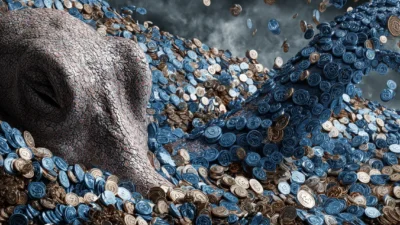
The Ele-FUD in the Room
The recent market slump has put DATs under a microscope. Pundits and armchair analysts are pointing to falling crypto prices and warning that a massive liquidation event is just around the corner.
Strategy, the largest corporate holder of Bitcoin, has been a primary target of this concern. The company has taken on debt to fund its Bitcoin purchases, and it has annual dividend payments nearing $800 million. Critics argue that if Bitcoin’s price keeps falling, Strategy will have no choice but to sell its BTC to cover these obligations.
The fear isn’t entirely baseless. Strategy’s own CEO, Phong Le, admitted in an interview that selling Bitcoin would be a “last resort” if the company’s stock value fell below its net asset value and other funding options dried up. But notice the key words: last resort.
Note: The interview is over an hour long, and this wasn’t even mentioned until 45 minutes into the interview:
The $60 Billion Bitcoin Bet | Strategy CEO Phong Le
This is where the FUD machine kicks into high gear. People hear “sell Bitcoin” and immediately picture a doomsday scenario where Strategy dumps its entire stash, tanking the market for everyone.
The Reality: Sticking to the Game Plan
While the headlines are focused on worst-case scenarios, the actions of these companies tell a different story. Instead of panicking, many DATs are holding firm and even using the downturn as a buying opportunity.
Strategy’s Stand
Strategy has been proactive in addressing investor fears. They recently launched a “BTC Credit” dashboard to provide more transparency about their financial health. According to their data, they have enough assets to cover their debt obligations for decades, even if Bitcoin’s price stays flat.
They claim that even if BTC dropped to their average purchase price of around $74,000, their assets would still be nearly six times their convertible debt. At a price of $25,000 BTC, they’d still be covered twice over.
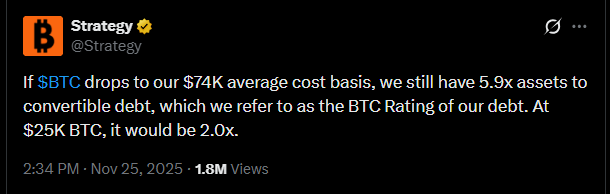
CEO Phong Le emphasized that their main strategy is to raise capital when their stock trades at a premium and use it to buy more Bitcoin. Selling is not part of the plan unless every other option is exhausted. They see the current market as a chance for their dividend payments to “season the market,” proving their stability even in bearish conditions.
BitMine’s Bullish Moves
On the Ethereum side of the fence, BitMine has been anything but shy about its convictions. As ETH prices took a dip, what did they do? They went shopping.
BitMine recently announced that its crypto and cash holdings have reached a staggering $11.2 billion, including 3.63 million ETH tokens. That’s a whopping 3% of the entire Ethereum supply. Their stated goal is to acquire 5% of the network.
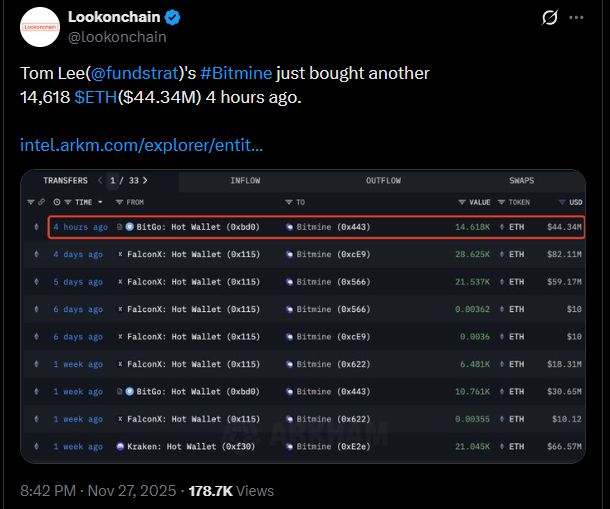
In just one week, the company acquired nearly 70,000 ETH. Shortly after, reports surfaced of another purchase of over 14,600 ETH worth around $44 million. This is not the behavior of a company that’s scared or on the verge of liquidation.
BitMine’s Chairman, Tom Lee, has been consistently bullish. He noted that while ETH prices were down, the risk/reward was becoming asymmetric, suggesting the potential upside far outweighs the remaining downside. He has also been a vocal proponent of Ethereum, predicting it will be favored by Wall Street and regulators as a “truly neutral chain.”
So, What’s the Real Story?
The narrative of impending doom is catchy, and it gets clicks. But when you look at the actions of these major DATs, you see a picture of conviction, not panic.
These companies have long-term strategies built around the fundamental value they see in Bitcoin and Ethereum. They’re structured to weather market volatility. For them, a down market isn’t a catastrophe; it’s an opportunity to accumulate more assets at a discount.
Of course, risk is always part of the game in crypto. A black swan event could theoretically force liquidations. But at this point, liquidations are part of the game. No one cries when shorts get liquidated, do they? The market is pumping, and most people are seeing their portfolios skyrocket. But for every winner, there is a loser.
The current situation looks less like a ticking time bomb and more like a calculated, long-term play by some of the biggest players in the space. They’re not just hoping for a market recovery; they’re actively investing in it.
Don’t Let FUD Drive Your Decisions
For the average crypto user, the “DAT drama” is a powerful lesson in filtering out the noise. It’s easy to get swept up in fear when the headlines are bleak. But it’s crucial to look beyond the sensationalism and understand the bigger picture.
Instead of panicking about what the whales might do, pay attention to what they are doing. Right now, they’re showing a surprising amount of resolve. They’re holding their ground and, in some cases, buying the dip with conviction.
Does this mean you should blindly follow their lead? Absolutely not. Always do your own research and make decisions that align with your own financial goals and risk tolerance. But don’t let FUD be the primary driver of your strategy. The market is often a test of patience and nerve, and right now, the biggest players are showing they have plenty of both.
Disclaimer
This article is for educational and information purposes, and should not be considered financial advice. For more information visit our disclaimer page
About the Author