
TLDR
- If you’ve ever vacationed in the Caribbean, you know things are pretty expensive.
- That could be about to change in Bermuda, which announced it’s piloting a fully onchain economy.
- The initiative is backed by Coinbase and Circle.
When you think of Bermuda, you probably picture pink sand beaches, sitting in a pool with a cocktail with a little umbrella, or maybe that mysterious triangle where planes supposedly vanish into thin air. But while the rest of the world is busy turning it into a conspiracy theory about disappearing ships, this tiny island nation is busy. Busy doing what? Busy making traditional banking vanish.
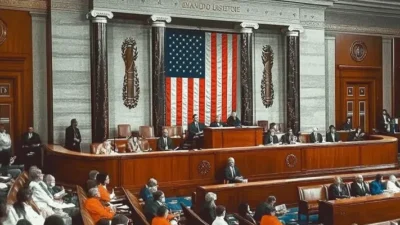
The Government of Bermuda dropped a bombshell at the World Economic Forum in Davos. They announced plans to transform the island into the world’s first fully onchain economy.
What does that mean, exactly? Why are heavy hitters like Coinbase and Circle involved? Semi-spoiler: We may be looking at the future of finance. Let’s get after it.
What Is an Onchain Economy?
Let’s strip away the jargon for a second.
In the traditional world (we call this offchain), when you buy a coffee with a credit card, that transaction bounces around between payment processors, your bank, the coffee shop’s bank, and card networks. Each stop takes a cut of the cash (fees) and slows things down. It’s like sending a letter through five different post offices before it reaches your neighbor.
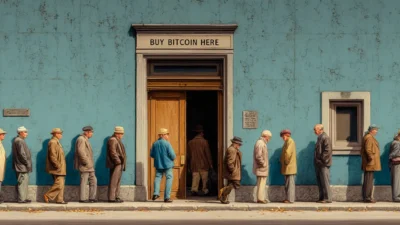
An onchain economy moves those transactions onto the blockchain.
Instead of using slow, expensive banking rails, the money moves digitally, peer-to-peer. It’s faster, cheaper, and transparent. For Bermuda, going onchain means using digital assets — specifically stablecoins like USDC — as everyday financial infrastructure.
Imagine paying your taxes, buying groceries, or getting your paycheck sent directly to a digital wallet, instantly and with barely any fees. That’s the vision.
The Dream Team: Bermuda, Circle, and Coinbase
Bermuda isn’t trying to hack this together in a garage. They’ve brought in the varsity team. The first string. The first line. The starting lineup. The Michael Jordans of the crypto space. The government has partnered with two of the biggest, most trusted names in the game:
- Circle: The creators of USDC (USD Coin). This is a stablecoin pegged to the US Dollar. One USDC always equals $1. It doesn’t go up and down like Bitcoin, making it perfect for buying stuff without worrying that your coffee will cost $50 tomorrow.
- Coinbase: One of the largest and most secure crypto exchanges in the world. They provide the infrastructure (the tech plumbing) to make all this work.
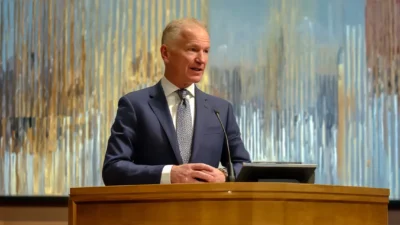
Circle CEO Jeremy Allaire and Coinbase CEO Brian Armstrong are working directly with Bermuda’s Premier, E. David Burt, to make this happen.
When you have the leaders of the crypto industry shaking hands with heads of state, it’s a sign that crypto is graduating from internet magic money to actual financial utility.
Why Bermuda?
You might be wondering, Why is a tropical island leading the charge?
The short answer? “Dem fees”.
The much longer answer? It comes down to simple economics. Bermuda is an island. Traditional banking on islands is notoriously expensive and restrictive.
Because they are classified alongside other Caribbean jurisdictions, payment processors and banks jack up the fees. That squeezes local businesses that are already dealing with thin merchant margins (business-speak for not making enough profit).
By switching to a digital finance model, Bermuda can:
- Slash Transaction Costs: Merchants can accept payments without losing a chunk to credit card fees.
- Speed Things Up: No waiting days for funds to clear.
- Empower Locals: It creates a system that efficiently circulates money locally.
As Premier Burt put it, “This initiative is about creating opportunity, lowering costs, and ensuring Bermudians benefit from the future of finance.”
Crypto With or Without a Safety Net?
The big question for anyone new to crypto. We’ve all heard the horror stories about scams and unregulated platforms that end up rugged or exploited.
Here is where Bermuda is different. They aren’t new to this.
Back in 2018 — which is practically ancient history in crypto years — Bermuda passed the Digital Asset Business Act. It’s a comprehensive set of laws designed to properly regulate crypto. They created a safe sandbox for companies to operate in. While everyone else was trying to shut crypto down, Bermuda was opening its doors.
Because they built these clear rules early on, they attracted legitimate companies (like Circle and Coinbase) rather than the shady ones. The government is rolling out nationwide digital finance education and technical onboarding. They want their citizens to be crypto-literate.
The approach — combining clear regulation with innovation and education — is exactly what the rest of the world has been struggling to do. So to answer the question, it’s going to be as safe as it can get.
Testing the Waters (and the Wallets)
This isn’t a theory on a whiteboard. It’s already happening.
At the 2025 Bermuda Digital Finance Forum, they ran a live test. They executed an airdrop (sending free crypto to wallets) of 100 USDC to every attendee. These people could then turn around and spend that digital cash at newly onboarded local merchants.
It worked.
Now, the plan is to expand. Government agencies will start piloting stablecoin payments. Financial institutions will begin exploring tokenization (turning real-world assets into digital tokens). And by the time the 2026 Forum rolls around in May, they plan to have a larger consumer stimulus and even deeper integration.
Why Is This News Relevant to Crypto Users?
Okay, so you don’t live in Bermuda. Why should you care?
Because this is a proof-of-concept.
Critics often say that Crypto has no real-world use cases. Bermuda is proving them wrong on a national scale. They are showing that blockchain technology can run a country’s economy more efficiently than the old banking system.
If Bermuda succeeds, other countries will be watching. It validates the tech you are learning about right now. It shows that stablecoins like USDC are safe, useful, and ready for the mainstream.
The Future Is Island-Shaped
Bermuda is betting big that the future of finance is onchain. They are cutting out the middlemen, lowering costs for their people, and proving that responsible innovation isn’t an oxymoron.
For those just starting their crypto journey, it’s a comforting sign. It means the industry is maturing. We are moving away from just speculation and memes, and moving toward a world where your digital wallet is as essential as your physical one.
So, while we might not all be able to jet off to Bermuda tomorrow, we can certainly take a page out of their book: don’t be afraid to embrace the upgrade.
Disclaimer
This article is for educational and information purposes, and should not be considered financial advice. For more information visit our disclaimer page
About the Author