
TLDR
- A new report from Coinbase shows that younger investors are investing and trading with crypto more heavily than older generations. Substantially more.
- Younger investors are also more interested in DeFi and the ecosystems and products that made it successful, such as lending and derivatives.
- The majority of people in the space believe that crypto and blockchain will play a major role in the future of finance.
Younger investors are rewriting the financial rulebook, ditching stocks for crypto, and finding advice on TikTok rather than Wall Street.
According to a new report from Coinbase, Gen Z and Millennials aren’t just dabbling in crypto — they are completely rethinking what it means to build wealth. While older generations (Gen X and Boomers) are clutching their pearls and their mutual funds, younger investors are looking at the traditional system, shrugging, and saying, “Yeah, we can do better.” Let’s get after it.
The “Hard Mode” Economy
“We know the way the traditional financial system works is broken.” – Brian Armstrong
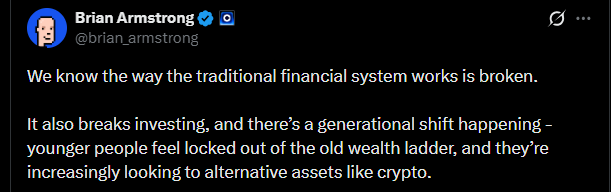
If you feel like the economic game is rigged against you, you aren’t imagining things. The data backs you up.
Nearly three-quarters (73%) of younger adults believe it is harder for their generation to build wealth through traditional means than for older generations. And who can blame them? House prices have skyrocketed, inflation is a constant headache, and the old advice of “work hard and save 10%” just doesn’t cut it anymore.
Younger investors don’t see how the current system can deliver economic freedom. So, they stopped waiting for permission and started looking for alternatives.
This isn’t a teenage rebellion. It’s a survival strategy.
While stock ownership is similar across age groups (about half of both young and old investors own stocks), their intentions differ. A whopping 86% of younger investors are actively hunting for rewards beyond boring old dividends. They want growth, and they want it now.
Ditching the Suit-and-Tie Advice
Remember when financial advice meant sitting in a stuffy office with a guy named Greg who wore a tie and used words like “fiscal responsibility”? Yeah, those days are gone.
The study found that younger investors are way more likely to take matters into their own hands. They are “self-directed,” which is a fancy way of saying they trust themselves more than they trust traditional institutions.
- 83% of younger investors feel they need to take control of their investment options.
- 69% feel more confident making their own decisions than relying on a financial advisor.
So, where are they getting their info? Spoiler: It’s not the Financial Times.
While older investors still lean heavily on financial planners (51%), younger investors are turning to the internet. YouTube (43%), Instagram (29%), TikTok (28%), and Reddit (22%) are the new boardrooms.
Is there some bad advice on crypto TikTok? Absolutely. (Please, do your own research before buying a coin just because a guy dancing in his kitchen told you to.)
But this shift proves that financial knowledge is being democratized. You don’t need a degree to learn about DeFi. You just need a WiFi connection and a healthy dose of skepticism.
Is Crypto Becoming a Safer Bet?
Here is where the divide gets really interesting. For older generations, crypto is often seen as “risky” or “scary.” For younger investors, it represents an opportunity.
Younger investors are twice as likely as older investors to already own crypto. But it goes deeper than that. They view crypto as a legitimate tool for financial leveling.
- Optimism: 4 in 5 younger adults believe cryptocurrency will play a much larger role in the future financial system.
- Opportunity: 4 in 5 agree that crypto gives their generation financial opportunities they wouldn’t otherwise have.
- Social Proof: 7 in 10 personally know someone who has made serious money trading crypto.
It’s not just about Bitcoin anymore, either. Younger investors are diversifying and have about 25% of their portfolios in “non-traditional assets” (think crypto, NFTs, and other digital assets), compared to just 8% for older investors.
Risk vs. Reward: The Need for Speed
Here is a stats bomb for you: Younger investors are nearly three times as likely to trade at least once a week as older investors.
Why the rush? Because they expect higher returns. About 28% of younger investors are expecting returns of 15% or more. To get those gains, they are willing to hustle. They are looking into derivatives, margin trading, and other high-octane strategies that would make a traditional banker faint.
It makes sense, right? If you believe the traditional slow-and-steady path is broken, you’re going to look for the express lane.
What the Report Means for New Users
So, what is the takeaway here? Are we all just gambling degenerates? Far from it.
The data shows that we are a generation of active participants. We aren’t passive. We aren’t waiting for a pension that might never come. We are learning, trading, and adapting.
However, with great power comes great responsibility (sorry, had to do it). Being a self-directed investor means the safety net is in your own hands.
- Don’t just follow the hype: Just because 67% of young investors are interested in “copy trading” (mimicking the trades of influencers or friends), doesn’t mean you should blindly follow a whale off a cliff.
- Education is key: Since we aren’t using traditional advisors, we have to be our own teachers. Read the whitepapers, understand the utility, and learn the basics of blockchain.
- Security first: Younger investors are tech-savvy, but scammers are too. Use platforms that prioritize security, and never share your seed phrase.
The Future is Digital
The older generation might be scratching their heads, but the trend is undeniable. The financial landscape is shifting beneath our feet, and it’s shifting toward digital, decentralized, and democratized assets.
You aren’t crazy for wanting to explore crypto. You aren’t “irresponsible” for looking beyond the stock market. You’re just ahead of the curve.
Ready to start your journey without the headache? We’ve got the guides, the security, and the community to help you navigate this new world.
Disclaimer
This article is for educational and information purposes, and should not be considered financial advice. For more information visit our disclaimer page
About the Author