
TLDR
- A new report from Memonto Research shows that nearly all token launches from 2025 are deep in the red.
- The higher the valuations, the more they dumped once the token went live.
- TGEs were supposed to stop this from happening, but there has been little to no impact.
If you bought into a token launch lastyear, there’s a 4-in-5 chance you’re sitting on a loss right now. According to data from Memento Research, a staggering 84.7% of token launches in 2025 are now trading below their initial valuation. The median token is down about 71% from its debut price. Translation? Most people who bought at launch got wrecked.
Or “rekt” — depending on the circles you run with.
But here’s the thing: this isn’t just bad luck or bear market vibes. The data reveals some clear patterns about why these tokens tanked. And even more importantly, what you should watch out for if you’re thinking about jumping into the next big launch. Let’s get after it.
2025 Was Brutal for Token Launches (and for the Investors…)
Of the 118 token launches tracked in 2025, only 18 remain in the green. That’s a measly 15.3% success rate.
The rest? They’re drowning. Over half — 51% to be exact — are down more than 70% from their launch price. Another 14% are down between 50-70%. When you add it up, 65% of all launches lost at least half their value.
Here’s where it gets even messier: while the average token might be down only 33%, that number masks how poorly the big, hyped launches performed. When you weigh the numbers by market size (i.e., accounting for how much money was actually in these tokens), the picture darkens to a 61.5% loss. Big launches with huge buzz? They crashed harder.
Token Generation Events (TGEs) were supposed to be the “fix” for pump n’ dumps, where early investors took profits and left retail users holding worthless bags. But these TGEs proved to be just another flop in the world of token launches. Buying at launch meant you were likely buying the peak. The longer you held, the more you probably lost.
Why Did So Many Tokens Tank?
It’s not just early investors being sketchy. There are several reasons tokens fail.
Sky-High Valuations at Launch
One of the clearest patterns in the data: the higher the starting valuation, the worse the outcome. Tokens that launched with a Fully Diluted Valuation (FDV) under $200 million had a 40% chance of staying green. Not great, but survivable.
Now look at tokens that launched with an FDV over $1 billion. Every single one — 100% of them — is now in the red, with a median loss of around 81%.
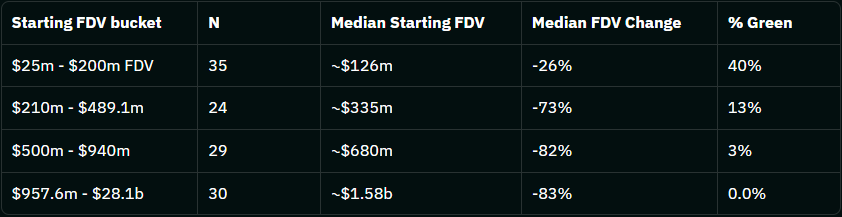
Let that sink in. If you bought a token that debuted with a billion-dollar valuation, you were almost guaranteed to lose money.
Why? Because these valuations were set way too high. Projects were pricing in years of growth and hype before they even proved their product worked. When the hype faded, and people realized the token wasn’t going to 10x overnight, users dumped as fast as they could. It’s crypto, so they didn’t have to wait until the market opened, either.
Not Enough Substance
2025 was dominated by two categories: Infrastructure (Infra) and AI. Together, they made up 60% of all token launches. And guess what? They were also some of the worst performers.
Infra tokens had a median loss of 72%, with only 9% staying green. AI tokens? Even worse. Down 82% on median, with just 13% in the green.
These sectors were crowded, overhyped, and over-funded. Everyone wanted to be the next big infrastructure play or ride the AI wave. But most projects didn’t have real traction, sustainable revenue, or a clear path to adoption. They had whitepapers and roadmaps, not results.
It all comes down to narrative. AI and infrastructure were two of the hottest narratives in 2025. The people who push those narratives are the early investors in these projects. They built hype. Took profits. Walked away. It’s that simple.
Meanwhile, quieter sectors like DeFi had a 32% success rate. Not flashy, but more tokens survived because they had actual use cases and weren’t drowning in hype.
Sell Pressure from Day One
How does it all happen? Early investors, team members, airdrops, and exchanges all create waves of sell orders. Add in retail traders trying to flip for quick profits, and you’ve got a recipe for immediate downward pressure.
Most tokens peak within 30 days of launch. Then it’s downhill from there. Compare that to IPOs (Initial Public Offerings) in traditional finance, which tend to post steady gains over longer periods. Stocks might not moon overnight, but they also don’t crash 70% in a few weeks.
Enh. They don’t usually crash 70% in a few weeks…
Equities Are Quietly Outperforming Tokens
While tokens were getting hammered, crypto companies going public were doing just fine.
According to a recent X post from DWF Ventures, the venture capital arm of crypto market maker DWF Labs, IPOs by crypto companies raised over $14.6 billion in 2025. That’s a 48x increase from 2024.
Companies like Coinbase, Circle, and Kraken attracted serious institutional capital, and their stock prices generally held up better than most token launches. Of course, Kraken hasn’t gone public yet, but it will likely do so sometime in 2026.
Why are crypto stocks outperforming…well…crypto? A few reasons:
- Institutional access: Pension funds, endowments, and other big players can buy stocks. Many of them can’t buy tokens due to regulatory restrictions. Going public opens the floodgates to a whole new pool of money.
- Better liquidity: Stocks have options, leverage, and index inclusion (like Coinbase joining the S&P 500). Tokens? Not so much.
- Steadier performance: Stocks tend to grow more slowly but more predictably. Tokens are volatile and often peak fast before crashing.
Both tokens and stocks can offer similar upside potential. But stocks come with way less risk. Tokens might give you a shot at a quick 10x, sure. But they also give you a high chance of losing 70% of your money.
What the Report Could Mean for New Crypto Investors
Full disclosure: we don’t know much about Memento Research or DWF. They offered absolutely zero proof in their research. No links. Nothing…
We were unable to verify any of what they were saying. However, a lot of it matched up with what we saw throughout the year, which is why we felt like the report was worth covering.

Dypto Crypto’s two pennies? Take these reports from DWF and Memento with a grain of salt.
That being said, there is some decent information new users can take from the “data”. Here’s what to keep in mind:
- Don’t Buy the Hype – Just because a project has a slick website, big-name backers, and a buzzy narrative doesn’t mean it’s a good investment. Ask yourself: Does this project have real users? Real revenue? A product people actually need?
- Wait for the Dust to Settle – Tokens tend to peak fast and then bleed. If you’re eyeing a new launch, consider waiting a few weeks (or months) to see how it performs. You might miss the initial pump, but you’ll also avoid buying the top.
- Diversify Beyond Tokens – Crypto isn’t just tokens. Companies like Coinbase and Kraken are publicly traded, and you can buy their stock through any brokerage. If you want exposure to crypto but with less volatility, equities might be the smarter play.
- Focus on Fundamentals – The projects that survive will be those with real use cases, actual revenue, and solid tokenomics.
The Bigger Picture
2025 was a wake-up call. The era of “buy every token at launch and hope it moons” is over. Valuations were too high, hype was too strong, and fundamentals were too weak.
But that doesn’t mean crypto is dead. Far from it. The industry is maturing. Institutions are piling in. Regulations are getting clearer. Companies are going public and raising billions.
We’re seeing a shift from speculation to sustainability. Projects that focus on real value can still thrive. The rest will fade into obscurity.
For 2026, expect more IPOs, more M&A (mergers and acquisitions) activity, and more consolidation. Exchanges like Kraken and Coinbase are becoming super apps, buying up smaller players and adding new features. Stablecoins and payments infrastructure are booming. Companies are doubling down on compliance and building defensible moats.
The future of crypto isn’t about chasing the next shiny token. It’s about investing in companies and projects that are building for the long haul.
Be Smart, Not Sorry
If there’s one lesson from 2025, it’s this: buying tokens at launch is a gamble, and the odds aren’t in your favor.
That doesn’t mean you should avoid crypto. It means you need to be smarter about how you invest. Do your research. Ask tough questions. Don’t buy the hype. Wait for proof, not promises.
And remember that you’re not late to the party. The industry is still growing, regulations are improving, and institutional money is flooding in. There will be plenty of opportunities ahead. So don’t blow your portfolio on the next overhyped token launch.
Disclaimer
This article is for educational and information purposes, and should not be considered financial advice. For more information visit our disclaimer page
About the Author