

In crypto markets, where volatility and manipulation are constant companions, traders often fall victim to false breakouts and liquidity traps. The Swing Failure Pattern (SFP) is a price action concept designed to expose these moves. By identifying when price briefly breaks a key high or low to trigger stop-losses or lure breakout traders, only to reverse sharply, SFPs reveal the hidden footprints of liquidity grabs.
For traders, this pattern is more than just a failed breakout; it is a signal of impending reversal and a way to avoid common traps that catch inexperienced participants. Whether you are navigating Bitcoin’s wild swings or altcoin volatility, mastering SFPs helps you anticipate market turning points, trade with confidence, and protect yourself against manipulation.
What Is a Swing Failure Pattern (SFP)?
A Swing Failure Pattern (SFP) is a price action setup that occurs when the market briefly breaks a key swing high or low, triggering liquidity (like stop-losses or breakout entries), but then fails to sustain the move and sharply reverses. This failed breakout often signals exhaustion of one side of the market and potential manipulation by larger players. Key characteristics of an SFP include;
- Liquidity Grab: Price pushes beyond a prior high/low to trigger stop-losses or lure breakout traders.
- Failure to Hold: The candle fails to close beyond that level, showing rejection.
- Sharp Reversal: Price reverses direction quickly, often with strong momentum.
- Market Manipulation Signal: Suggests that “smart money” used liquidity to fill positions before reversing.
Traders use SFP for;
- Spotting Reversals: Helps identify when a breakout attempt is false, signaling a potential trend change.
- Risk Management: Provides clear invalidation levels (the broken high/low).
- Versatility: Works across multiple timeframes and markets (crypto, forex, stocks).
- Transparency of Market Behavior: Reveals how liquidity hunts and failed breakouts expose manipulation.
| Setup Type | Price Action | Trader Insight |
| Bullish SFP | Price dips below a swing low, sweeps liquidity, then reverses upward | Signals failed breakdown → potential long entry |
| Bearish SFP | Price spikes above a swing high, triggers breakout buyers, then reverses downward | Signals failed breakout → potential short entry |
An SFP is a failed breakout pattern that exposes liquidity grabs and market manipulation, making it a powerful tool for spotting reversals and protecting against traps.
Types of Swing Failure Patterns
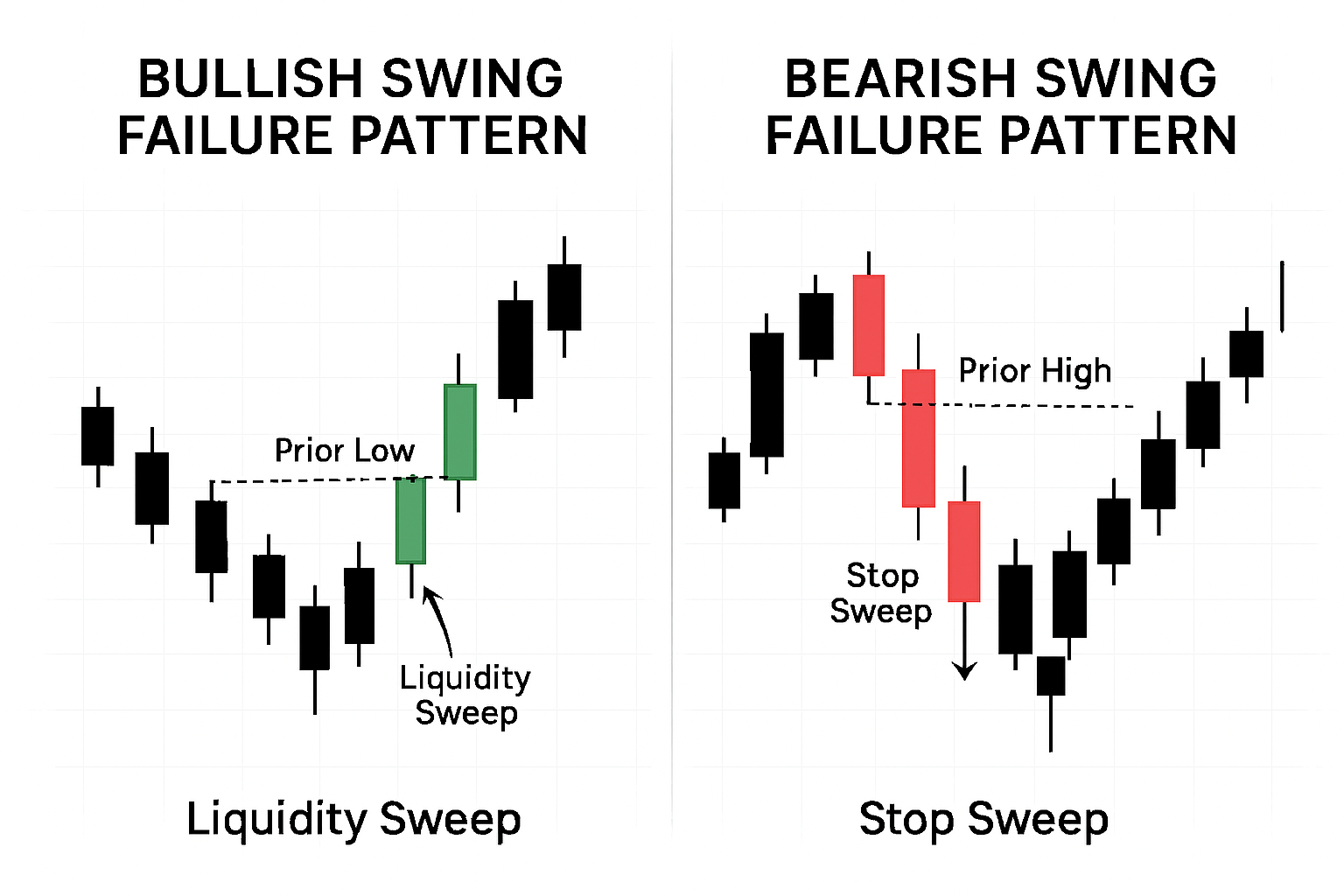
Swing Failure Patterns (SFPs) can be bullish or bearish, depending on whether the liquidity sweep happens below a prior low or above a prior high. Both setups highlight failed breakouts and potential reversals, but they mirror each other in direction.
Bullish Swing Failure Pattern
- Occurs when price breaks below a prior swing low, sweeping liquidity (stop-losses of longs or breakout shorts).
- The market then closes back above that low, rejecting further downside.
- This failed breakdown often signals a return of strength, making it suitable for long entries.
Bearish Swing Failure Pattern
- Occurs when price breaks above a prior swing high, sweeping stops, and enticing breakout buyers.
- The market then closes back below that high, rejecting the continuation of the upward move.
- This failed breakout creates shorting opportunities as momentum shifts downward.
How To Identify a Valid Swing Failure Pattern
Identifying a valid Swing Failure Pattern (SFP) requires more than just spotting a wick or a quick reversal. It demands a structured approach and multiple layers of confirmation. Many traders fall into the trap of assuming any failed breakout is an SFP, but without proper context and rejection signals, these setups can be misleading.
A true SFP reflects deliberate market behavior, often driven by liquidity hunts and manipulation, followed by a strong rejection that signals a potential reversal. To trade SFPs effectively, you need to combine technical precision with contextual awareness, ensuring that each setup aligns with broader market dynamics and key price levels.
Step 1: Mark the Correct Swing Levels
The first step in identifying a valid SFP is to mark the correct swing highs and lows on your chart. These levels represent areas where price previously reversed, and they often attract liquidity. Depending on your trading strategy and timeframe, you might use daily, 4-hour, or 1-hour charts to find these swing points.
Look for levels that have been tested multiple times or that elicit strong reactions, as these are the zones where stop-losses and breakout orders tend to accumulate. Avoid arbitrary or minor pivots; instead, focus on structurally significant highs and lows that reflect real market interest. Proper level selection sets the foundation for spotting meaningful sweeps.
Step 2: Confirm the Sweep
Once you have identified a key swing level, the next step is to confirm that the price has actually swept it. This means the market must break above a swing high or below a swing low in a way that triggers stop orders or entices breakout traders. The sweep should be clear and intentional, not just a small wick or indecisive candle.
Often, this move is fast and aggressive, designed to trap traders and fill orders for larger players. A valid sweep typically includes a candle with a long wick piercing the level, or a full-bodied candle that temporarily closes beyond it. This action signals that liquidity has been tapped, setting the stage for a potential reversal.
Step 3: Confirm Rejection
After the sweep, the most critical step is confirming rejection. This is where the market shows that the breakout attempt has failed and momentum is shifting in the opposite direction. Rejection can be confirmed by several price action signals: a candle that closes back inside the range, a bullish or bearish engulfing pattern, or a strong wick indicating rejection at the swept level.
In more advanced setups, traders may also look for order flow shifts, such as a delta flip or a volume spike against the sweep direction. These signs indicate that the market has absorbed the liquidity and is now reversing. Without a clear rejection, the sweep could simply be a continuation move.
Step 4: Context Filter (When SFP Matters Most)
Even with a clean sweep and rejection, context is what determines whether an SFP is worth trading. The most reliable SFPs occur at key technical zones such as support and resistance levels, supply and demand areas, or trendline touches. These zones add confluence and increase the probability of a successful reversal. Additionally, SFPs that align with indicators like RSI divergence, volume spikes, or Fibonacci retracement levels tend to be more powerful.
Context helps filter out low-quality setups and ensures you trade with the broader market narrative. By combining structure, confirmation, and context, you can identify high-probability SFPs and avoid common traps.
Tools to Help You Spot SFPs Faster
Spotting Swing Failure Patterns (SFPs) manually can be time-consuming, especially for beginners who are still learning to identify liquidity sweeps and rejection signals. Fortunately, several tools and platforms can automatically detect these setups, providing alerts or visual overlays that highlight potential SFPs. These tools are not a replacement for manual confirmation, but they can speed up the process and reduce the chance of missing opportunities. By combining automated detection with your own analysis, you can filter out false signals and focus on high-probability setups.
- TradingView Indicators: Many community-built indicators highlight liquidity sweeps and failed breakouts. Some scripts automatically mark swing highs and lows, then alert you when the price sweeps through these levels and rejects them. This is beginner-friendly because TradingView offers a simple interface, customizable alerts, and the ability to overlay these indicators directly on your charts.
- LuxAlgo: A premium toolkit that provides advanced market overlays, including liquidity zones, reversal signals, and SFP detection. It is particularly useful for traders who want structured, visually clear signals without having to code their own indicators. LuxAlgo can highlight potential SFPs in real time, but it’s best used as a supporting tool alongside your own confirmation methods.
- Bookmap: For traders who want to go deeper into order flow, Bookmap provides a heatmap view of liquidity and stop orders. It allows you to see where large liquidity clusters sit and how price interacts with them. This makes it easier to spot when a sweep is likely to occur and whether rejection is strong enough to qualify as an SFP. While more advanced than TradingView, it’s excellent for traders who want to understand the mechanics behind liquidity grabs.
Beginners should start with TradingView indicators because they are easy to use and widely available. As you gain experience, tools like LuxAlgo and Bookmap can add depth to your analysis. Remember, these tools are supportive aids. They highlight potential setups, but the final decision should always come from manual confirmation of structure, rejection, and context.
How To Trade the Swing Failure Pattern
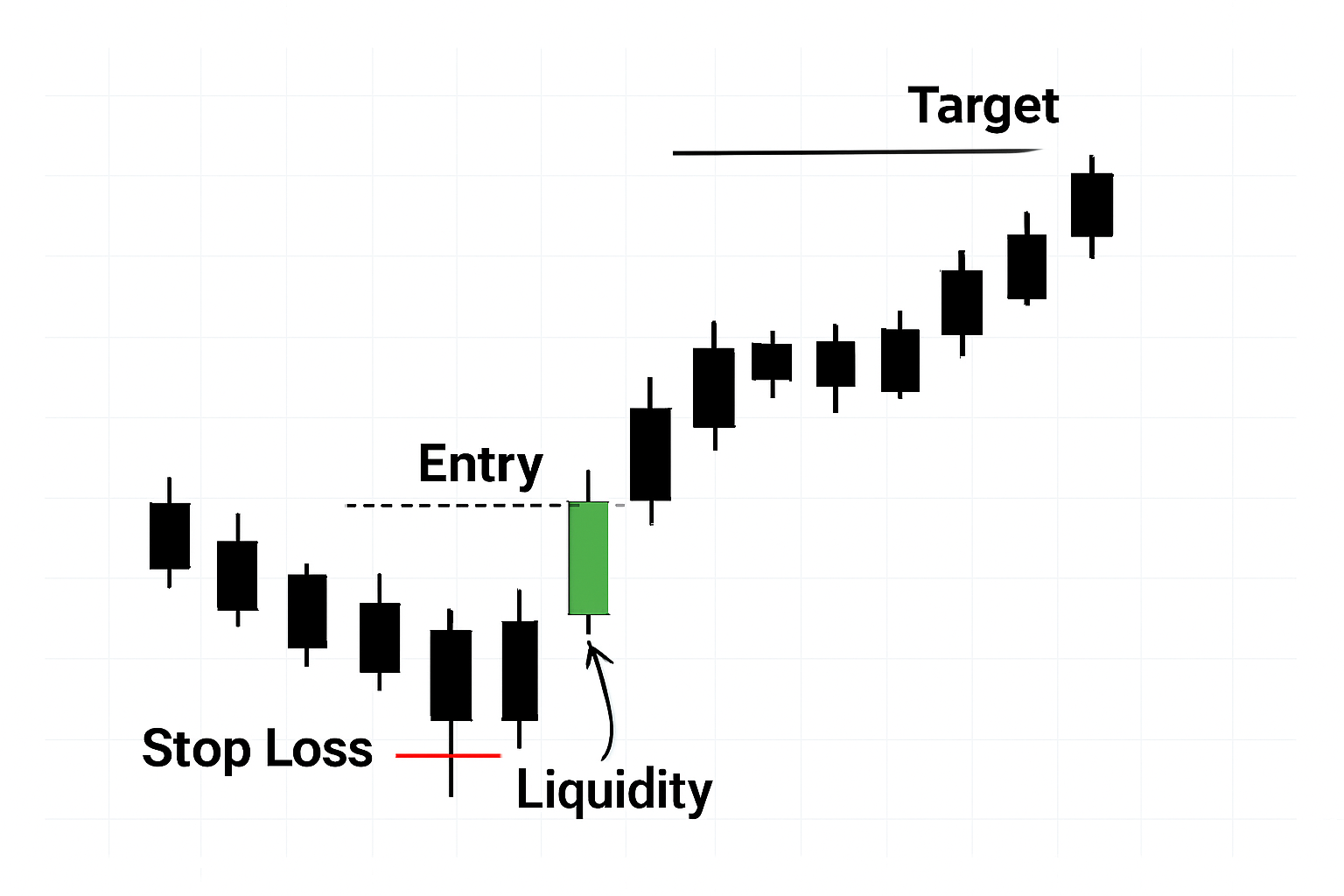
Swing Failure Patterns (SFPs) can be traded both as entries and exits, depending on the strength of the setup and the trader’s strategy. Because they highlight failed breakouts and liquidity grabs, SFPs often mark turning points in the market. The key is to wait for confirmation before acting, then structure your trade with disciplined risk management.
Entry Strategies
When trading an SFP, the most common approach is to wait for confirmation of rejection before entering. This means allowing the sweep candle to close back inside the prior range, showing that the breakout attempt has failed. Traders can then enter with a market order immediately after confirmation, ensuring they catch the reversal momentum.
Alternatively, more patient traders may prefer a limit order at the retest of the swing level, which allows them to enter at a better price if the market revisits the swept zone. Both methods are valid, but the choice depends on whether you prioritize certainty (market order) or precision (limit order).
The critical point is to avoid entering during the sweep itself, as this exposes you to the risk of continuation rather than reversal.
Stop Loss Placement
Proper stop loss placement is essential when trading SFPs, as the setup relies on failed breakouts. The most effective strategy is to place your stop just beyond the sweep wick, above the high in a bearish SFP or below the low in a bullish SFP. This ensures that if the market invalidates the pattern and continues in the breakout direction, your risk is minimized.
Placing stops too tight may result in premature exits due to normal volatility, while placing them too wide reduces your risk-to-reward ratio. By anchoring stops beyond the liquidity sweep, you align your invalidation point with the setup’s logic: if price breaks and holds beyond the sweep, the SFP is no longer valid.
Take Profit Targets
Take profit strategies for SFPs should balance realistic targets with strong risk-to-reward ratios. Common approaches include targeting key support or resistance levels aligned with the reversal direction, using Fibonacci retracements to project likely pullback zones, or applying fixed risk-to-reward ratios, such as 2R or 3R. For example, if you risk 1% of your account on the trade, aim to secure 2–3% in profit.
This ensures consistency and discipline across multiple trades. More advanced traders may also trail stops as the move develops, locking in profits while allowing for extended runs. The key is to define targets before entering, so emotions don’t interfere once the trade is live.
Common Mistakes Traders Make With SFPs
Even though Swing Failure Patterns (SFPs) are powerful reversal signals, many traders misapply them due to rushed analysis or a lack of structure. Recognizing these common mistakes can help you avoid costly errors and improve your edge.
- Misidentifying Swing Levels: One of the most frequent errors is marking insignificant highs or lows as swing points. For example, a trader might label a minor intraday wick as a swing low, only to see the price sweep it and continue trending. Valid swing levels should be structurally significant, ideally on higher timeframes like 1H, 4H, or daily, and show clear market reactions. If the level hasn’t attracted liquidity or reversed price in the past, it’s unlikely to produce a meaningful SFP.
- Entering Too Early: Another common mistake is jumping into a trade during the sweep itself, before confirmation. Traders often get excited when a price breaks a key level and assume the reversal is imminent. But without a candle close back inside the range or a clear rejection signal, the move could be a genuine breakout. For instance, entering short as price spikes above a swing high, without waiting for a bearish engulfing candle, can lead to getting trapped in a continuation rally.
- Ignoring Market Context: SFPs don’t exist in a vacuum. They’re most effective when they occur at key zones, such as support/resistance or supply/demand, or when they are in confluence with indicators like RSI divergence or volume spikes. A trader who spots an SFP in the middle of a strong trend, without any contextual support, might enter a reversal trade that quickly fails. For example, a bullish SFP during a steep downtrend may look promising, but without support or volume confirmation, it’s likely to be a short-lived bounce.
- Overlooking Candle Structure: Not all wicks are created equal. Some traders mistake any long wick for an SFP, even if the candle closes weakly or lacks rejection. A valid SFP should show a decisive rejection, such as a strong close back inside the range or a clear engulfing pattern. If the sweep candle closes near its high (in a bearish SFP) or its low (in a bullish SFP), it does not indicate rejection. It is showing strength in the breakout direction.
- Poor Risk Management: Even with a valid SFP, improper stop loss placement can ruin the trade. Placing stops too tight, inside the sweep wick, can lead to premature exits from normal volatility. On the flip side, placing stops too wide reduces your risk-to-reward ratio and exposes you to unnecessary losses. The ideal stop should sit just beyond the sweep wick, aligning with the logic that if price breaks and holds beyond that level, the SFP is invalidated.
When NOT to Trade a Swing Failure Pattern
Even though Swing Failure Patterns (SFPs) can be powerful reversal signals, there are specific situations where they become unreliable. Here are the main contexts to avoid:
- High-Volatility News Events: Trading SFPs around major economic announcements or geopolitical headlines (such as FOMC meetings, CPI releases, or sudden political events) is risky. Price action often becomes erratic, sweeping multiple highs and lows in both directions without meaningful rejection. Liquidity thins, spreads widen, and algorithms dominate, making even textbook sweeps unreliable. It’s better to wait until the news impact settles and structure returns to the chart.
- Ranging Markets Without a Clear Structure: In sideways or choppy conditions, prices frequently sweep minor highs and lows without strong directional intent. What looks like an SFP may just be noise within consolidation. For example, a sweep of a small swing high inside a tight range often lacks momentum and fails to produce a meaningful reversal. Without a broader trend or key level acting as a magnet, these setups lack conviction and usually fizzle out quickly.
- Sweeps Without Volume Confirmation: Volume is critical for validating liquidity grabs. If a sweep occurs on low volume, such as during off-hours or thin market conditions, it may not represent a true stop hunt or manipulation. For instance, if price dips below a swing low without a volume spike, it’s likely a weak move rather than a deliberate liquidity sweep. Without volume confirmation, rejection may be shallow or fail entirely, making the SFP unreliable.
By filtering out these scenarios, such as news-driven volatility, low-structure ranges, and sweeps without volume, you can avoid common traps and focus only on high-probability SFP setups.
Is the Swing Failure Pattern Reliable in Crypto Trading?
Swing Failure Patterns (SFPs) are widely used in crypto trading because they highlight failed breakouts and liquidity grabs; two behaviors that are especially common in volatile, highly speculative markets. When applied correctly, SFPs can be powerful tools for spotting reversals and protecting against traps. However, their reliability depends heavily on context, confluence, and disciplined execution.
SFPs tend to work best when combined with other factors such as support/resistance zones, supply/demand areas, or indicators like RSI divergence and volume spikes. For example, a bullish SFP forming at a strong demand zone with rising volume is far more reliable than one appearing in the middle of a ranging market. Similarly, confluence with higher-timeframe levels (such as daily or 4H swing points) increases the probability of success compared to setups on lower, noisier timeframes.
That said, traders should avoid treating SFPs as standalone signals. They are prone to false positives, especially during news-driven volatility or periods of thin liquidity. This is why backtesting is crucial: testing SFP setups across different assets, timeframes, and market conditions helps traders understand where they perform best and where they fail. Risk management is equally important: placing stops beyond the sweep wick and targeting realistic levels ensures that even if an SFP fails, losses remain controlled.
In short, SFPs are reliable when used with context and confluence, but they are not foolproof. Traders who backtest thoroughly, apply strict risk management, and filter setups with volume and structure will find them a valuable addition to their toolkit.
Final Thoughts
Mastering the Swing Failure Pattern (SFP) is not about chasing every wick or reversal; it is about building discipline, context awareness, and confidence in your trading decisions. Think of SFPs as one powerful tool within a broader trading toolkit. When combined with confluence, volume analysis, and strong risk management, they can help you spot traps, avoid false breakouts, and position yourself on the right side of market moves.
The journey to mastering SFPs takes practice, patience, and consistency. Start by testing setups on demo accounts, where you can refine your eye for valid sweeps and rejection signals without risking capital. Over time, you will develop the intuition to distinguish high-probability SFPs from noise.
At Dypto Crypto, we encourage traders to explore not just SFPs but also a variety of strategies, including liquidity-based setups, trend-following systems, and advanced order-flow techniques. The more versatile your toolkit, the more resilient you will be in navigating crypto’s volatility. Stay disciplined, keep learning, and remember: every failed breakout is an opportunity to grow your edge.
Frequently Asked Questions
What indicators help confirm an SFP?
Indicators that help confirm a Swing Failure Pattern include volume spikes, RSI divergence, and candle structures like engulfing patterns. Order flow tools such as Bookmap or delta analysis also strengthen confirmation. These signals validate liquidity sweeps and rejection, but manual context analysis remains essential for reliability.
Can I automate swing failure pattern detection?
Yes, you can automate Swing Failure Pattern detection using tools like TradingView indicators, LuxAlgo, or Bookmap, which highlight liquidity sweeps and failed breakouts. These tools speed up spotting setups, but they should support, not replace, manual confirmation of structure, rejection, and market context for reliable trading decisions.
Can swing failure patterns be used on any timeframe?
Yes, Swing Failure Patterns can be applied on any timeframe, from 1-minute charts to weekly candles. However, reliability increases on higher timeframes like 1H, 4H, or daily, where swing levels are more significant. Lower timeframes often produce noise, so context and confirmation remain essential.
Is the swing failure pattern good for beginners?
Yes, Swing Failure Patterns can be useful for beginners because they teach discipline and highlight failed breakouts. However, they require patience, context awareness, and confirmation skills. Beginners should practice on demo accounts, backtest setups, and pair SFPs with risk management before applying them in live crypto trading.
Disclaimer
This article is for educational and information purposes, and should not be considered financial advice. For more information visit our disclaimer page
About the Author