

You are staring at charts at 3 AM. Bitcoin just dumped 8%, and you are trying to decide whether to sell or hold. Meanwhile, an AI trading bot just executed 47 profitable trades while you were sleeping.
The market never sleeps, prices move in milliseconds, and human traders cannot compete with machines in speed and data processing. AI has fundamentally changed crypto trading. If you are not using these tools, you are trading with one hand tied behind your back.
AI eliminates emotional trading, automates decisions, and processes information faster than any human could. Whether you are a beginner trying to avoid costly mistakes or an experienced trader looking to scale, AI levels the playing field.
This guide shows exactly how AI is being used in crypto trading today, which tools actually work, and how to integrate AI into your strategy without destroying your account.
The Rise of AI in Crypto Trading
Crypto markets are uniquely suited for AI trading. Unlike stock markets that close at 4 PM, crypto trades 24/7 across hundreds of exchanges. Price movements happen in seconds. A tweet can pump or dump a coin by 30% before you even see it.
In 2020, retail traders started experimenting with simple bots. By 2023, AI-powered trading tools will process billions in daily volume. Major exchanges like Binance and Coinbase now offer built-in bot features because demand exploded.
Early bots simply followed basic rules: buy when the RSI hits 30 and sell at 70. Today’s AI uses machine learning to analyze thousands of data points simultaneously: price patterns, volume, social sentiment, whale movements, and macroeconomic indicators. They adapt to market conditions in real-time.
Computing power has become cheaper, machine learning has become more sophisticated, and crypto data has become more accessible. You no longer need a hedge fund budget to use AI for trading. Many tools cost less than Netflix.
How AI Is Being Used in Crypto Trading Today
AI is not a single factor in crypto trading. It powers multiple functions, each solving different problems traders face. Understanding these applications helps you choose the right tools for your needs.
Market Scanning and Trade Alerts
AI-powered scanners monitor thousands of trading pairs across multiple exchanges simultaneously. They look for specific patterns, price movements, or technical indicators that meet your criteria.
For example, you can set an AI scanner to alert you when Bitcoin’s RSI drops below 30 while trading volume spikes above average. Or when a specific altcoin breaks above its 200-day moving average with increasing volume. The AI watches the markets 24/7 and notifies you the moment conditions align.
This is perfect if you want to use AI to enhance your manual trading without going fully automated. You make the final decision on whether to execute the trade, but AI does the heavy lifting of monitoring hundreds of pairs you couldn’t possibly track yourself.
Popular platforms like TradingView now integrate AI-powered alerts, and specialized tools like Token Metrics offer more sophisticated pattern recognition specifically for crypto markets.
AI Trading Bots and Automated Strategies
This is where most people start with AI crypto trading. Trading bots execute trades automatically based on predefined rules or machine learning models.
Grid Trading Bots: These place buy and sell orders at regular intervals around a set price. If Bitcoin is at $45,000, the bot might place buy orders every $500 below that and sell orders every $500 above. As price moves up and down, it automatically captures small profits. This works best in sideways markets.
DCA Bots: Dollar-cost averaging bots buy a fixed amount of crypto at regular intervals, regardless of price. You set it to buy $100 of Bitcoin every Monday, and it executes automatically. This removes emotion and timing guesswork.
Arbitrage Bots: These scan multiple exchanges for price differences. If Bitcoin is $44,800 on Binance but $45,000 on Coinbase, the bot buys on Binance and sells on Coinbase, pocketing the $200 difference. This requires fast execution because arbitrage opportunities close in seconds.
Trend-Following Bots: These use technical indicators to identify trends and trade in that direction. When multiple indicators suggest an uptrend (moving averages, MACD, momentum), the bot buys and holds until trend reversal signals appear.
The key advantage is speed and consistency. Bots execute trades in milliseconds and never deviate from the strategy. They don’t get tired, distracted, or emotional. But they still need human oversight, as market conditions change; strategies that worked last month might fail this month.
Portfolio Management and Rebalancing
AI tools manage portfolio allocation automatically. Set target percentages like 40% Bitcoin, 30% Ethereum, 20% stablecoins, 10% altcoins, and AI maintains those ratios.
When Bitcoin pumps to 55% of your portfolio, AI automatically sells some BTC and redistributes to underweighted assets. This locks in profits and maintains your risk profile without manual rebalancing.
Advanced tools use machine learning to optimize allocation based on market conditions, increasing stablecoin exposure during periods of high volatility and reducing cash during bull markets. Platforms like 3Commas offer these features.
Predictive Analytics and Sentiment Analysis
AI models analyze massive datasets to estimate the probability of price movements. They process historical prices, technical indicators, volume patterns, blockchain metrics (active addresses, transaction volume), social sentiment, and news events.
For example, an AI might notice that when Bitcoin’s volume increases 40% while Twitter sentiment turns extremely negative, price historically rebounds within 48 hours 68% of the time.
Sentiment analysis tools scan millions of social media posts, news articles, and forum posts to gauge market sentiment. When sentiment becomes extremely bullish or bearish, it often signals reversals.
Critical caveat: these are probability estimates, not guarantees. A 70% probability means it still fails 30% of the time. AI predictions inform decisions, not replace judgment.
AI Assistants for Learning and Strategy Design
ChatGPT and similar tools help traders learn and test strategies. Ask an AI to explain complex concepts, generate strategy ideas, or write basic code for custom indicators.
You could ask: “Explain Bollinger Bands and give me three trading strategies” or “Write Python code for a simple RSI strategy.” The AI provides explanations and examples you can learn from.
Some traders use AI to backtest strategies. Describe a strategy in plain English, AI converts it to code, and you test against historical data. This speeds up strategy development dramatically.
Always verify AI information, especially trading advice or code. They’re learning tools, not financial advisors.
Benefits of AI in Crypto Trading
Eliminates Emotional Trading: Fear and greed destroy portfolios. AI removes emotion entirely. When Bitcoin crashes 20%, humans panic-sell. Bots execute the predetermined strategy regardless.
24/7 Market Monitoring: Crypto markets never close. Big moves happen at 2 AM on Sunday just as often as 2 PM on Tuesday. AI watches everything while you sleep.
Faster Execution: Milliseconds matter. By the time you see a price movement and click buy, it might have moved 2%. Bots execute in microseconds.
Backtesting: AI can test strategies against years of historical data in minutes, showing how they would have performed across multiple market cycles.
Processes Complex Data: Humans analyze only a few variables at a time. AI simultaneously processes hundreds of indicators, multiple timeframes, volume patterns, and sentiment data.
Consistency: Bots follow rules perfectly every time. Humans get tired or make mistakes. A bot executing a 5% stop-loss never hesitates and executes exactly as programmed.
Scalability: Managing five trading pairs manually is challenging. Managing fifty is impossible. AI scales effortlessly, monitoring hundreds of pairs simultaneously.
Understanding the Risks, Limitations, and Challenges
AI Is Only As Good As Its Training Data: If a bot is trained on bull-market data, it may fail when markets turn bearish. Models can’t predict what they have never seen.
Black Swan Events: AI struggles with unprecedented events. When COVID crashed markets in March 2020, many bots lost money because the pattern didn’t match historical data.
Overfitting: When an AI model works perfectly on historical data but fails in real trading. It memorized past patterns instead of learning general principles.
Technical Failures: Bots crash, APIs disconnect, exchanges go down. If your bot tries to sell during a flash crash but the API times out, you are stuck.
Configuration Errors: A single misconfigured parameter can destroy accounts. Most bot losses come from misconfiguration, not AI failure.
False Sense of Security: The biggest risk is thinking AI removes the need for risk management. Traders deploy bots with too much capital and no monitoring, then wonder why they lose money when markets change.
Best Practices for Using AI in Your Crypto Trading Strategy
AI tools promise to revolutionize your crypto trading, but blindly following algorithms without understanding what’s happening under the hood is how people lose money fast. The key is to use AI smartly as a powerful assistant rather than a magic solution, while maintaining solid risk management practices.
Start Small and Test First: Never deploy a bot with your full portfolio. Start with 5-10% of capital. Use paper trading (simulated with fake money) to test strategies without any risk.
Understand Before Automating: Don’t use a bot to execute strategies you don’t understand. If you can’t explain how your bot decides, you can’t identify when it’s malfunctioning.
Combine AI with Human Judgment: Use AI for execution and monitoring. Make strategic decisions yourself. Let bots handle mechanical tasks while you focus on big picture analysis.
Regular Monitoring: Check bots daily, especially during volatility. Parameters that worked last month might need adjustment now.
Diversify Strategies: Don’t rely on one bot or strategy. Use multiple approaches like grid bots for sideways markets, trend-following for trending markets, and DCA for accumulation.
Document Everything: Keep notes on parameters, target market conditions, and expected behavior. When reviewing performance, you will understand what worked.
Managing Risk When Trading Crypto With AI
Using AI doesn’t eliminate trading risk; it shifts it. Here’s how to protect yourself.
Always Use Stop-Losses: Configure hard stop-losses on every position. If a trade moves 5-7% against you, exit automatically. This prevents small losses from becoming disasters.
Position Sizing: Never risk more than 1-2% per trade. If a bot makes 10 trades, the total risk should be 10-20% of total capital.
Backtest Thoroughly: Test strategies against 2-3 years of data, including bull and bear markets. A strategy that only works in bull markets isn’t a strategy; it’s pure luck.
Set Maximum Daily Loss Limits: Configure bots to stop if they hit a loss threshold. If your bot loses 3% in a day, pause and investigate.
Monitor During High Volatility: When Bitcoin moves 10% in a day, check your bots. Extreme volatility causes bots to make rapid-fire trades that rack up fees or execute at terrible prices.
Withdraw Profits Regularly: Don’t let profits compound indefinitely. Regularly withdraw gains to secure them. This protects against future losses or exchange issues.
5 Best AI Crypto Trading Tools for Crypto Traders
Traders now have access to a wide range of AI trading bots, both free and paid. And they offer automation, strategy customization, and hands-off portfolio growth. Each tool has different strengths, so choosing the right one depends on your experience level and trading goals.
1. Token Metrics

Token Metrics uses AI and machine learning to analyze cryptocurrencies and provide trading signals, risk ratings, and market predictions.
Best For: Traders who want AI-powered research and analysis rather than direct trade execution. Good for both beginners learning to analyze coins and experienced traders looking for additional data points.
Key Features: AI grades each cryptocurrency based on multiple factors (technical analysis, fundamentals, team quality, trader sentiment). Provides daily trading signals with entry and exit points. Offers portfolio tracking and risk assessment tools.
Limitations: Not a trading bot, but it provides signals, and you execute trades manually or connect to a separate bot. Premium features require a paid subscription. The AI predictions are educated guesses, not guarantees.
2. CryptoHopper

CryptoHopper is a cloud-based bot that automatically trades on connected exchanges using technical indicators or external signals.
Best For: Intermediate traders who understand technical analysis and want customizable automated trading. Good for people who want to test multiple strategies simultaneously.
Key Features: Strategy designer with 130+ technical indicators. Cloud-based, so it runs 24/7 without requiring your computer to be on. A marketplace where you can copy strategies from successful traders. Supports multiple exchanges, including Binance, Coinbase, and Kraken.
Limitations: Requires an understanding of technical analysis to configure effectively. Monthly subscription costs $19-99, depending on features. Doesn’t work well if you don’t know what indicators to use or how to combine them.
3. 3Commas
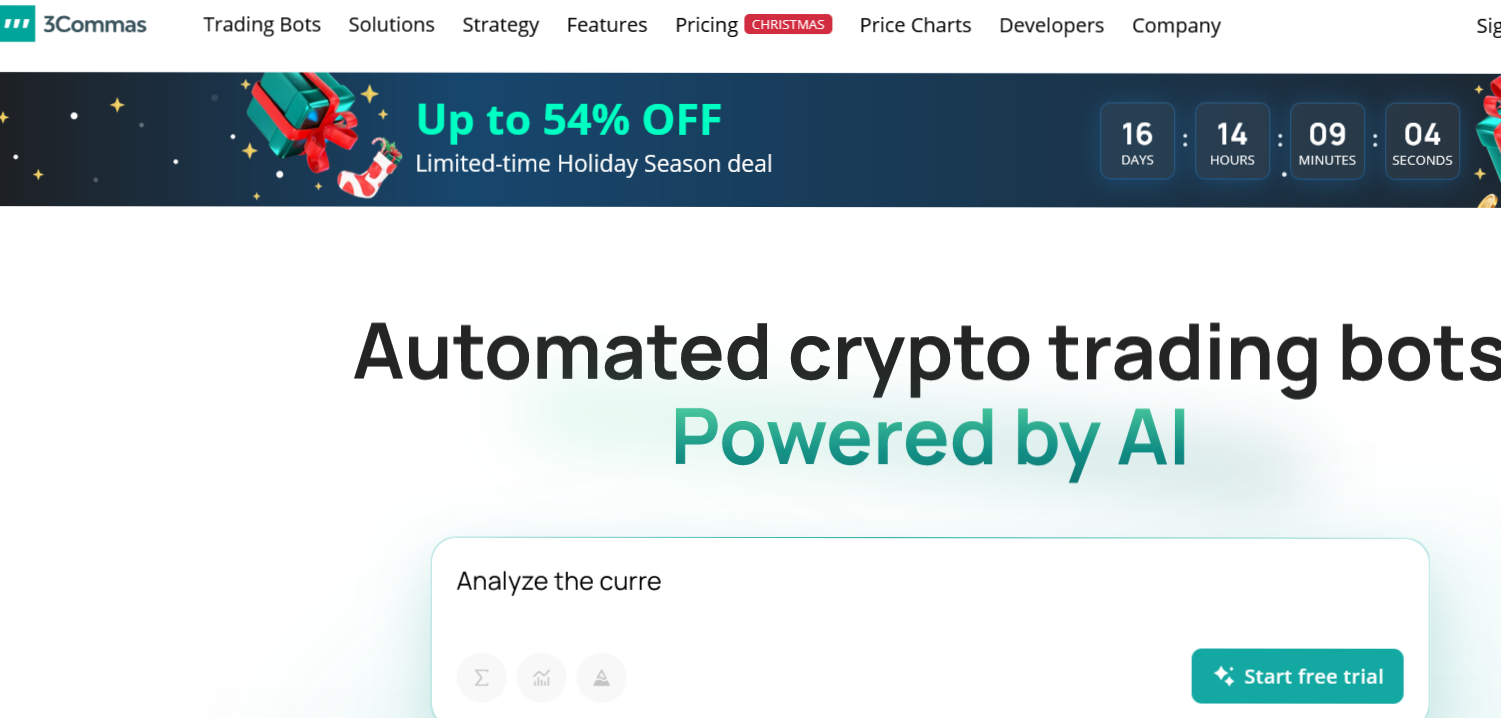
3Commas offers smart trading terminals, portfolio management, and automated bots with advanced features like trailing stop-losses and simultaneous trading across multiple exchanges.
Best For: Active traders managing larger portfolios who want sophisticated automation and portfolio management. Good for traders who trade on multiple exchanges simultaneously.
Key Features: Smart trading terminal with one-click orders across exchanges. Grid bots, DCA bots, and options bots. Portfolio analytics and rebalancing. Trailing stop-loss and take-profit. Paper trading mode for testing.
Limitations: Can be overwhelming for beginners due to extensive features. Subscription costs $22- $ 99 per month. Requires API connections to exchanges, which some users find technically challenging to set up.
4. Pionex

Pionex is a crypto exchange with 16 built-in free trading bots, making it the most accessible option for beginners.
Best For: Complete beginners who want to try bot trading without monthly fees or complex setup. Good for passive-income strategies such as grid bots and DCA.
Key Features: Grid trading bots that profit from volatility. DCA bots for automated buying. Arbitrage bots between different exchanges. Completely free to use (only pay normal trading fees). A simple interface designed specifically for bot trading.
Limitations: Limited to the Pionex exchange, can’t connect to other exchanges. Fewer customization options than dedicated bot platforms. Lower liquidity than major exchanges like Binance. Geographic restrictions in some countries.
5. Kryll
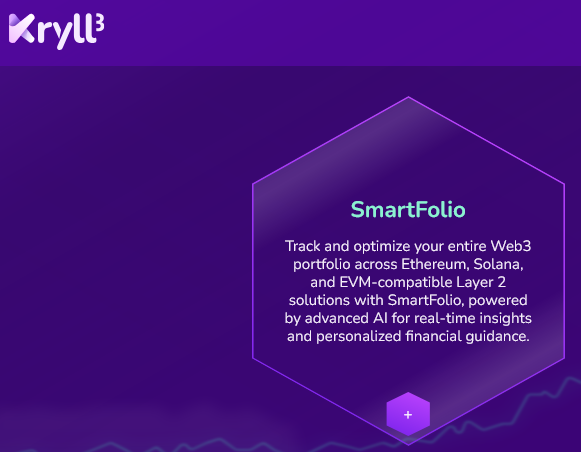
Kryll is a strategy marketplace where you can create, share, and rent automated trading strategies without coding.
Best For: Traders who want to build visual strategies without programming knowledge. Good for people who prefer designing custom strategies over using templates.
Key Features: Drag and drop strategy builder to connect blocks like LEGO to create trading logic. A marketplace where you can rent strategies from other traders. Built-in backtesting against historical data. Supports major exchanges.
Limitations: Uses a credit system in which each strategy execution incurs a credit cost. Strategy marketplace quality varies widely, as many strategies are unprofitable. The visual interface can become complex for advanced strategies.
Future Outlook: How Crypto AI Trading is Expected to Evolve
The next generation of AI trading will be significantly more sophisticated, moving from simple if-then bots to adaptive learning systems.
Deeper On-Chain Data Integration: Future AI will analyze blockchain data directly, tracking whale wallets, smart contract interactions, token flows, and network activity. This provides earlier signals than price and volume alone.
AI Trading Agents: Instead of preset rules, AI agents will make strategic decisions autonomously. You set goals such as “grow this portfolio 15% annually with a max 20% drawdown,” and it determines how to do so by switching strategies as markets change.
Cross-Platform Intelligence: AI will trade across DeFi protocols, centralized exchanges, and derivatives markets simultaneously, optimizing execution across the entire crypto ecosystem.
Human-AI Collaboration: Better interfaces will enable traders to communicate with AI in natural language and receive explanations for decisions. This transparency builds trust and helps humans learn from AI.
Success in future crypto markets will require both human strategic thinking and AI execution working together.
Summing Things Up
AI has transformed crypto trading from manual, emotional processes into systematic, data-driven operations. The tools are here, they work, and they are accessible to anyone willing to learn.
But AI isn’t a magic money printer. It amplifies whatever you put into it. Feed it good strategies with proper risk management, and it executes flawlessly. Feed it a poor configuration, and it amplifies losses just as efficiently.
Winners combine AI’s computational power with human judgment. Let AI handle mechanical tasks: monitoring markets, executing trades, managing risk parameters. You focus on strategic decisions and adapting to change.
If you are serious about crypto trading, you need to understand AI tools. Not because they are trendy, but because markets have evolved.
Want to stay ahead of the latest developments in crypto trading, AI tools, and market strategies? Join Dypto Crypto for comprehensive guides, strategy breakdowns, and cutting-edge techniques.
Sign up for the Dypto Crypto newsletter to get expert analysis, tool reviews, and trading insights delivered to your inbox.
Frequently Asked Questions
Are AI crypto trading bots worth it?
Yes, but with caveats. AI bots eliminate emotional trading, execute strategies consistently, and monitor markets 24/7. However, they are not guaranteed profit machines as success depends on strategy quality, proper configuration, and market conditions. Start with small capital, test thoroughly, and use bots for execution while you make strategic decisions.
Can AI bots adapt to market crashes or black swan events?
Not reliably. AI bots handle scenarios similar to their training data well but struggle with unprecedented events like the March 2020 COVID crash or FTX collapse. Most cannot predict or react appropriately to events they have never seen. This is why human oversight remains critical, you can recognize when conditions fundamentally change and pause bot operations.
Do I need programming skills to use AI crypto tools?
No. Most modern AI trading tools like Pionex, 3Commas, and CryptoHopper offer visual interfaces where you select strategies and set parameters without writing code. Programming skills help with advanced customization, but 90% of users don’t need them. You need trading knowledge and risk management more than coding skills.
Are AI tools safe from hacking or data errors?
No system is completely safe. Exchange API keys can be compromised, bot platforms can be hacked, and bugs can cause unintended trades. Mitigate risks by using API keys with restricted permissions (no withdrawal rights), enabling two factor authentication, and keeping only necessary funds on exchanges. Always monitor bots regularly and use stop losses as safety measures.
Disclaimer
This article is for educational and information purposes, and should not be considered financial advice. For more information visit our disclaimer page
About the Author