

“Don’t catch a falling knife” is one of the most famous warnings in trading, and for good reason. In crypto markets, where volatility is extreme and sentiment shifts in seconds, a falling knife represents a sharp, relentless price drop that tempts traders to buy too early, only to suffer deeper losses.
This article explores what the falling knife pattern really means, why it is so dangerous, and how traders can spot it before getting cut. You will learn to identify signs of a falling knife on charts, understand the psychological and structural forces behind these crashes, and develop practical strategies to navigate them safely. From technical indicators and volume spikes to risk management and scaling entries, we will break down the tools and tactics that separate disciplined traders from those who fall victim to panic.
Whether you are new to crypto or a seasoned trader, this guide will help you recognize falling knives, avoid costly mistakes, and approach volatile markets with confidence.
What a Falling Knife Means in Trading
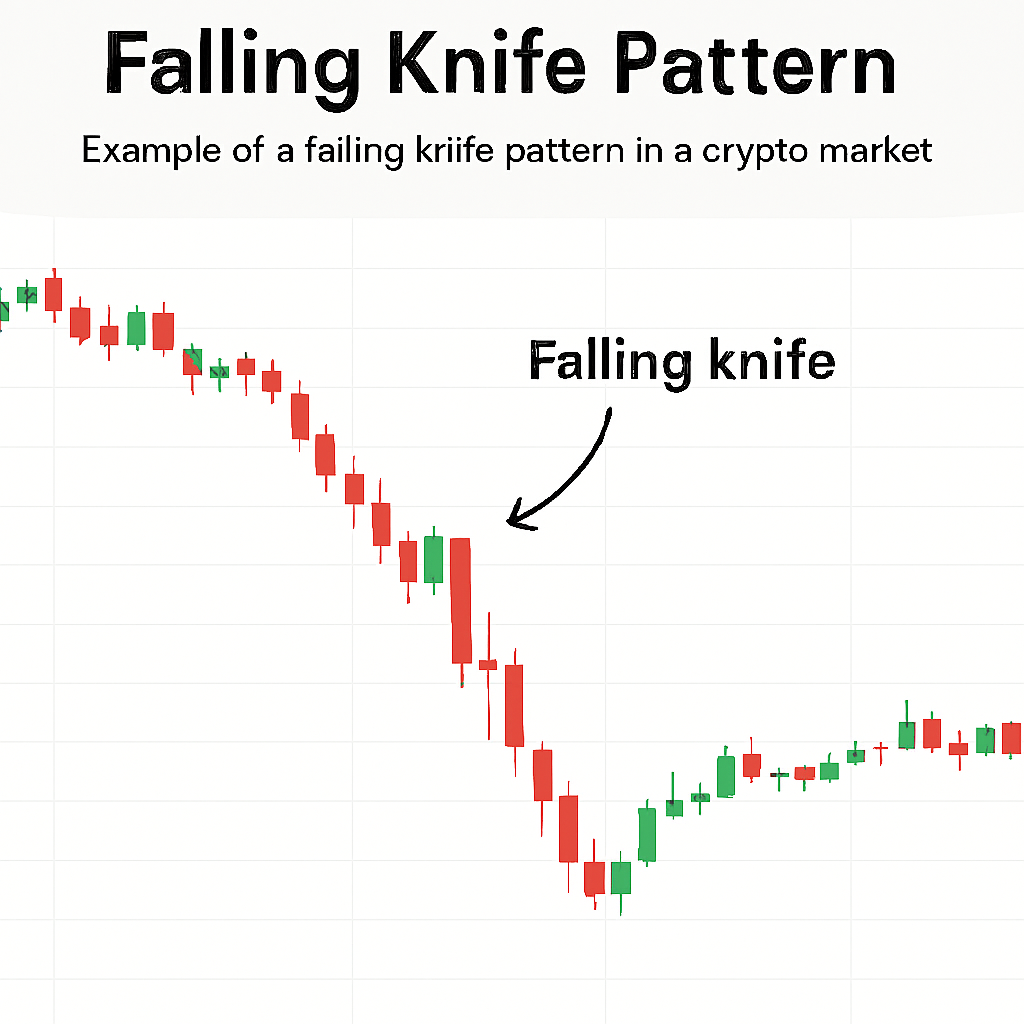
A falling knife refers to a sudden, sharp price drop in a cryptocurrency or other asset. It is not a formal chart pattern but a metaphor for extreme downward momentum. Just like grabbing a knife mid-fall risks injury, buying into a crashing market risks heavy losses. Traders are advised to wait until the asset stabilizes before entering.
It is triggered by negative news, regulatory crackdowns, hacks, or panic selling. Prices may rebound later, but catching the exact bottom is highly risky. It is often accompanied by high trading volume and fear-driven liquidation.
Traders fear or misinterpret it because of:
- Fear: The speed and severity of the drop can wipe out positions quickly.
- Misinterpretation: Some traders mistake the crash as a buying opportunity too early, leading to “catching the knife” and suffering further losses.
- Reality: Waiting for confirmation signals (support levels, reversal patterns, or reduced volatility) is safer than guessing the bottom.
Never catch a falling knife, as entering too early in a crash is dangerous. Waiting for stabilization or reversal signals reduces risk. Compared to stocks, crypto knives fall faster and harder due to sentiment-driven markets.
How to Identify a Falling Knife on Crypto Charts
In the volatile world of crypto trading, spotting a falling knife early can mean the difference between preserving capital and suffering steep losses. A falling knife refers to a rapid, aggressive price drop that slices through support levels, often triggered by panic selling, liquidations, or negative news. Unlike healthy dips, which tend to stabilize and respect technical levels, falling knives are marked by relentless downward momentum and structural breakdowns.
Traders must learn to distinguish between temporary pullbacks and true knife drops by analyzing price action, volume, indicators, and market depth. Below are key signals to help identify a falling knife in real time.
Spot Aggressive Red Candles and Broken Support
One of the earliest signs of a falling knife is the appearance of long red candlesticks, especially when they occur consecutively. These candles reflect strong selling pressure and a lack of buying interest. When multiple red closes form in a row, it signals that sellers are in control and buyers are stepping aside. More importantly, if these candles break cleanly below recent support zones, trendlines, or consolidation ranges, it’s a strong indication that the market is entering a falling knife phase.
This is not just a routine intraday pullback; it is a structural breakdown. Traders should be cautious when prices slice through key levels without hesitation, as this often precedes further downside.
Monitor Volume Spikes and Liquidation Clusters
Volume is the heartbeat of market conviction. During a falling knife, volume often spikes dramatically, reflecting panic and forced selling. In crypto derivatives markets, this is frequently accompanied by visible long liquidations, in which traders are stopped out or margin is called en masse. When sell volume dwarfs recent activity and liquidation clusters appear on platforms like Coinglass or Binance, it is a clear sign that the market is in distress.
These events are not just technical; they are psychological. Fear drives participants to exit positions rapidly, accelerating the drop. Traders should treat sudden volume surges and liquidation data as red flags, especially when they coincide with broken support and aggressive candles.
Utilize Moving Averages to Confirm the Downward Trend
Moving averages offer a powerful lens into trend strength and direction. During a falling knife, the price often slices below key moving averages, such as the 50-day or 200-day MA, on higher timeframes. What’s more telling is the failure to reclaim these levels after the initial drop. When price retests a moving average and gets rejected, it confirms that downside momentum remains strong.
This confluence of broken support and bearish MA behavior should be treated as a warning, not a buying opportunity. Traders who rely solely on “discounted prices” without trend confirmation risk catching the knife. Use moving averages to validate the broader trend before considering any entry.
Value of RSI and MACD During a Knife Drop
Momentum indicators such as RSI and MACD can help traders assess the intensity of a falling knife. During such drops, RSI often plunges into oversold territory, while MACD lines diverge sharply downward. However, oversold readings alone are not a buy signal. In fact, RSI can remain oversold for extended periods during strong downtrends.
Instead, traders should look for signs of slowing momentum, such as bullish divergence or a contracting MACD histogram. These signals suggest that selling pressure may be exhausting. Until then, indicators confirm that the knife is still falling. Patience is key; wait for momentum to shift before considering a reversal play.
Checking Order Books and Liquidity Gaps on Exchanges
Order book depth offers a real-time view of market resilience. During a falling knife, order books often thin out, with large sell walls and wide bid-ask spreads. This lack of liquidity allows prices to collapse quickly because few buyers are willing to absorb selling pressure. Traders should review exchange order books to assess whether the market can realistically absorb incoming sell volume.
If the bid side appears weak and fragmented, it’s a sign the price could continue to fall. Liquidity gaps act like trapdoors, as once the price falls through, it accelerates downward. Monitoring order book structure is essential for short-term risk management.
How to Differentiate a Healthy Dip From a True Falling Knife
Not all price drops are falling knives. Healthy dips typically respect trendlines, horizontal supports, or moving averages. They show balanced volume, with buyers stepping in quickly to stabilize the price. These dips often occur within an uptrend and resolve with higher lows. In contrast, falling knives break multiple levels fast, stay below them, and continue printing lower lows. Volume skews heavily toward sellers, and recovery attempts are weak or short-lived.
Traders must learn to distinguish between the two by analyzing structure, momentum, and market behavior. A healthy dip invites strategic entries; a falling knife demands caution and confirmation before any action.
What are The Key Reasons Behind a Falling Knife?
A falling knife in crypto markets doesn’t happen randomly; it is often the result of a perfect storm of fear, forced selling, and structural weaknesses. While price volatility is normal in crypto, a falling knife represents a far more aggressive and dangerous move. It is not just a dip; it is a breakdown. Understanding the root causes behind these sharp declines helps traders avoid premature entries and manage risk more effectively. Below are the most common triggers that turn a routine pullback into a full-blown falling knife.
Sudden Negative News or Sentiment
Crypto markets are highly sensitive to headlines. Sudden events such as exchange hacks, lawsuits against major projects, missed earnings reports from crypto firms, rug pulls, or coordinated FUD (fear, uncertainty, doubt) campaigns can instantly erode investor confidence. What starts as a routine dip can quickly escalate into a falling knife as traders rush to exit positions.
These events often catch the market off guard, leading to aggressive selling and a breakdown of technical support levels. The speed of information flow in crypto, especially on platforms like Twitter and Telegram, can shift sentiment within minutes, triggering panic and accelerating the decline.
Panic Selling Coupled With Herd Mentality
Fear spreads fast in crypto communities. When traders see others dumping positions, they often follow suit without fully assessing the situation. This herd mentality creates a self-reinforcing loop: one wave of selling triggers another, and the cycle continues. As prices fall, more traders panic, selling at any price just to escape further losses.
This behavior accelerates and deepens the decline, turning a manageable correction into a falling knife. Emotional contagion is especially strong in retail-driven markets, where traders rely heavily on social signals and sentiment rather than on fundamentals or technical analysis.
High Leverage and Forced Liquidations
Leverage is a double-edged sword in crypto. When prices fall sharply, overleveraged traders face margin calls and forced liquidations. These automatic sell orders flood the market, adding to the downward pressure. As liquidation levels are breached, cascading sell-offs occur, each triggering the next.
This mechanical selling intensifies the falling knife move, often pushing prices far below fair value. Platforms such as Binance, Bybit, and OKX display liquidation heatmaps that indicate where clusters of forced exits are likely to occur. Traders should monitor these zones closely, as they often coincide with sharp price declines and heightened volatility.
Impact That Follows Major Regulatory Changes
Regulatory shocks can send crypto markets into freefall. Sudden bans on trading, mining, or stablecoins; surprise tax rulings; or enforcement actions against major players can crush sentiment overnight. These events introduce uncertainty and fear, prompting investors to exit positions en masse. The result is a sharp, sustained sell-off that resembles a falling knife.
Unlike technical breakdowns, regulatory-driven knives are harder to predict and often more severe. They affect not just price but long-term confidence in the ecosystem. Traders should stay informed about global regulatory developments and treat sudden policy shifts as high-risk catalysts.
Role of Low Liquidity and Thin Order Books
In illiquid markets, even modest sell orders can cause outsized price drops. Thin order books, with few bids and large price gaps, create vulnerability. When a large sell order hits, it can “gap through” available bids, causing the price to collapse vertically. This lack of depth means the market cannot absorb selling pressure efficiently, leading to exaggerated moves that look like falling knives on the chart.
Traders should always check the order book depth before entering volatile assets. If the bid side is weak, the risk of a knife-like drop increases dramatically.
Algorithmic and High-Frequency Selling
Trading bots and high-frequency algorithms play a significant role in modern crypto markets. These systems react instantly to volatility, technical triggers, or news events by executing automated sell orders. During a falling knife, their speed and volume amplify the move. Algorithms may detect broken support, rising volatility, or liquidation clusters and respond by dumping positions.
This adds extra momentum to the downside, often overwhelming manual traders. While bots can provide liquidity in normal conditions, they accelerate panic during crashes. Traders should be aware that algorithmic selling can turn a fast drop into a relentless plunge.
Understanding The Risks of Catching a Falling Knife
Buying into a falling knife pattern is one of the riskiest moves a trader can make. While the temptation to “buy the dip” is strong, entering too early during a sharp crash often leads to deeper losses. Patience and confirmation are essential, as waiting for stabilization or reversal signals reduces the chance of emotional mistakes and capital destruction.
- Continued Price Drops: Prices rarely stop falling immediately after the first sharp decline. Entering too early can trap traders in positions that keep losing value. What looks like a bargain can quickly become a bigger loss if the knife keeps dropping.
- Capital Loss and Portfolio Damage: Buying during a falling knife often means buying at the market’s weakest point. Traders risk significant capital erosion if the asset fails to recover quickly. Large losses can reduce portfolio flexibility and limit future opportunities.
- Emotional Trading and Panic Decisions: Fear of missing out (FOMO) or the urge to “buy cheap” clouds judgment. Emotional entries often lead to panic exits when losses deepen. This cycle of impulsive buying and selling erodes discipline and confidence.
- False Signals and Misinterpreted Indicators: Oversold RSI or temporary green candles may trick traders into thinking a bottom is near. Without confirmation (trend reversal, support reclaim, volume balance), these signals are unreliable. Acting on false cues often leads to catching the knife rather than waiting for stabilization.
- Liquidity Traps and Thin Order Books: In crypto, thin liquidity can exaggerate price drops. Even small sell orders can push prices lower, leaving early buyers stuck. Traders who don’t check order book depth risk entering markets that cannot absorb heavy selling.
- Missed Patience Premium: Waiting for confirmation often means entering at a slightly higher price, but with far less risk. Patience allows traders to avoid emotional traps and align with genuine reversals. The “premium” paid for waiting is small compared to the losses from catching a knife too early.
Catching a falling knife is a gamble, not a strategy. Smart traders wait for confirmation, such as reclaimed support, reduced selling volume, or bullish divergence, before entering. Patience protects capital and ensures trades are made with clarity, not fear.
When It Might Be Worth Catching a Falling Knife
Catching a falling knife is almost always risky, but there are rare scenarios where it can be justified, provided traders use strict risk management and wait for confirmation signals. These situations typically involve markets where the drop is exaggerated by fear rather than fundamentals, or where technical indicators suggest exhaustion of selling pressure. Even then, caution is paramount: entering too early without protective measures can lead to heavy losses.
- Strong Fundamentals Supporting the Asset: Sometimes, a crypto project with solid fundamentals experiences a sharp sell-off due to temporary sentiment shocks. For example, a leading blockchain with strong adoption, developer activity, and revenue streams may suddenly crash following negative headlines. If the fundamentals remain intact, the drop could represent an opportunity rather than a long-term breakdown. Traders who recognize this distinction may cautiously enter, but only with stop-losses and position sizing that protect against further downside.
- Oversold Signals With Momentum Exhaustion: Indicators such as RSI and MACD can flag when selling pressure is overextended. If RSI plunges into oversold territory and shows bullish divergence (price making lower lows while RSI makes higher lows), it may indicate that sellers are losing momentum. Similarly, a contraction in the MACD histogram after a steep decline can signal slowing momentum. In these cases, catching the knife might be justified, but only if traders wait for confirmation candles or stabilization before entering. Oversold alone is never enough; confluence is key.
- False Panic Drops and Overreactions: Markets often overreact to rumors, FUD headlines, or temporary shocks. A false report of a hack, regulatory misinterpretation, or exaggerated social media panic can trigger a sharp but short-lived sell-off. Once the truth emerges, prices often rebound quickly. Traders who identify these false panic drops early may capture significant upside. However, this requires careful vetting of news sources and the discipline to exit if the panic proves real. Risk management here is non-negotiable.
Even in these rare scenarios, catching a falling knife should never be attempted blindly. Traders must use tight stop-losses to cap potential losses, enter with small position sizes to limit exposure, wait for confirmation signals such as reclaimed support, reduced sell volume, or bullish divergences, and avoid emotional trading, as patience and discipline are the difference between opportunity and disaster.
How to Navigate Falling Knives as a Trader
Navigating falling knives in crypto markets requires discipline, patience, and a clear framework. These sharp declines can tempt traders with the illusion of “buying cheap,” but without a structured approach, they often result in significant losses. The key is to decide whether to engage at all, and if so, to use technical signals, scaling strategies, and strict risk management to protect capital. Below are practical steps traders can follow when facing falling knife scenarios.
Decide If You Should Sit Out or Step In
The first decision traders must make is whether to participate at all. Not every falling knife is worth trading, and sometimes the best move is to sit out. If you lack a clear edge, strong experience, or confidence in your analysis, “no trade” is often the smartest choice. Watching from the sidelines allows you to observe market behavior without risking capital.
For newer traders, avoiding setups with extreme volatility can prevent emotional mistakes and unnecessary losses. Only step in if you have a well-defined plan, understand the risks, and are prepared to execute with discipline.
Use Technical Analysis and Indicators for Confirmation
Jumping into a falling knife after the first big red candle is a recipe for disaster. Traders should wait for confirmation signals before acting. These include signs of stabilization, such as a base forming, higher lows appearing, or support levels being reclaimed. Indicators such as RSI, MACD, and moving averages can help confirm whether momentum is slowing or a reversal is possible.
By waiting for these signals, traders avoid entering purely on hope or FOMO. Technical analysis provides data-driven evidence that the market may be ready to recover, reducing the risk of catching the knife too early.
It’s Generally Better to Scale In Slowly Instead of Going All-In
Rather than committing full capital at a single point in time, traders should scale into positions gradually. Splitting entries into smaller orders at different levels reduces exposure if the price continues to drop. This approach allows traders to average into a position while maintaining flexibility. Each partial entry should be paired with predefined invalidation levels to ensure risk is controlled at every stage.
Slowing scaling also helps manage emotions, as traders are less likely to panic when only a portion of their capital is at risk. This method balances opportunity with safety in volatile conditions.
Have Strict Risk Limits and Exit Rules in Place for Safety
Risk management is the cornerstone of surviving falling knives. Traders should define a maximum loss per trade and stick to it. Stop losses must be placed below key levels to protect against further downside, and exit plans should be established before entering the trade. These rules prevent emotional decision-making during sharp moves, where fear and greed can cloud judgment.
By setting strict limits, traders avoid catastrophic drawdowns and preserve capital for future opportunities. Safety comes from preparation; knowing when to exit is as important as knowing when to enter.
Real Examples of Falling Knife Patterns in Recent Crypto History
The most infamous falling knife patterns in crypto history include the LUNA collapse (2022), the FTX token (FTT) crash (2022), and the Bitcoin 65% drop in 2022. Each case showed sharp breakdowns, panic selling, and false bottoms that trapped traders who tried to “buy the dip.”
Terra (LUNA) Collapse – May 2022
- Key Chart Moments: LUNA traded at an all-time high of $116 in April 2022 before plunging to fractions of a cent within weeks. The chart showed consecutive long red candles breaking every support level, with no meaningful recovery attempts.
- Cause of the Fall: The collapse was triggered by the de-pegging of TerraUSD (UST), its algorithmic stablecoin. As UST lost its $1 peg, the mechanism designed to stabilize it triggered hyperinflation in LUNA tokens, flooding the market with supply.
- Why Traders Misjudged the Bottom: Many believed UST would quickly regain its peg and that LUNA’s fundamentals would hold. Instead, cascading liquidations and panic selling created one of the sharpest falling knife patterns in crypto history, wiping out over $60 billion in value.
FTX Token (FTT) Collapse – November 2022
- Key Chart Moments: FTT traded above $25 before collapsing to below $2 over the next few days. The chart showed vertical red candles as liquidity evaporated, with failed attempts at stabilization.
- Cause of the Fall: Triggered by revelations of balance sheet holes at Alameda Research and concerns about FTX’s solvency. Binance’s announcement that it would liquidate its FTT holdings accelerated the panic.
- Why Traders Misjudged the Bottom: Many assumed FTX was “too big to fail” and expected institutional support. Instead, forced liquidations and a loss of confidence led to a complete collapse, making FTT a textbook example of a falling knife.
Bitcoin’s 65% Drop – 2022
- Key Chart Moments: Bitcoin fell from ~$69,000 in late 2021 to below $20,000 by mid-2022. The chart showed relentless red candles, broken supports at $40k and $30k, and failed recovery rallies.
- Cause of the Fall: A combination of macroeconomic tightening (Fed rate hikes), the Terra collapse, liquidity crises across crypto lenders, and the FTX implosion.
- Why Traders Misjudged the Bottom: Many believed $30k was “rock-solid support” and rushed to buy dips. However, cascading liquidations, regulatory fears, and weak sentiment pushed BTC far lower, trapping early buyers.
Technical Indicators to Help Identify Falling Knives
Spotting a falling knife requires more than just watching price action. Traders can use technical indicators to assess whether a sharp drop is a temporary dip or a dangerous breakdown. Here are the most useful tools to evaluate risk before entering:
- Relative Strength Index (RSI) – Oversold Zones: RSI measures momentum by tracking the speed and magnitude of price changes. During a falling knife, RSI often plunges below 30 (oversold). However, oversold status alone is not a buy signal, as it can remain oversold for extended periods during strong downtrends. Look for bullish divergences (price making lower lows while RSI makes higher lows) as a sign that selling pressure may be easing. Wait for stabilization before acting.
- Moving Average Convergence Divergence (MACD) – Bearish Momentum: MACD tracks the relationship between two moving averages to highlight momentum shifts. Sharp downward MACD crossovers and widening histogram bars confirm strong bearish momentum. Watch for histogram contraction or MACD line convergence as early signs that selling may be slowing. Until then, MACD confirms the knife is still falling.
- Bollinger Bands – Volatility Expansion: Bollinger Bands measure volatility by plotting price relative to a moving average with upper and lower bands. Price often slices through the lower band during a knife, showing extreme volatility and selling pressure. A falling knife is confirmed when candles ride the lower band with no mean reversion. Only when the price stabilizes within the bands should traders consider entries.
- Volume Spikes – Panic and Forced Selling: Volume reflects the strength of market conviction. Sudden spikes in sell volume, often accompanied by liquidation clusters in derivatives markets, signal panic selling. Compare current sell volume to recent averages. If it dwarfs normal activity, the knife is likely underway. Wait for volume to normalize before considering a trade.
Don’t rely on a single indicator. Use confluence (RSI + MACD + volume + Bollinger Bands). Confirmation matters as oversold or volatility spikes are not buy signals without stabilization. Patience protects capital by waiting for a slowing momentum or a retest of support, reducing the risk of catching the knife too early. Technical indicators help traders diagnose falling knives, but they should be used as warning systems, not green lights for immediate entry.
Want to Get Better at Technical Analysis for Crypto? Dypto Crypto Signup is What You Need
Mastering technical analysis in crypto isn’t just about reading charts; it is about building confidence, spotting opportunities, and protecting your capital in volatile markets. From identifying falling knives to recognizing healthy dips, the right knowledge can transform how you trade and invest.
Dypto Crypto is designed to give you that edge. With structured learning, real-world examples, and a community of engaged traders, you will gain the skills to navigate crypto markets with clarity and discipline. Ready to sharpen your technical analysis skills and trade smarter? Join Dypto Crypto today to learn, engage, and grow alongside a community built for crypto traders like you.
Frequently Asked Questions
What does “don’t catch a falling knife” mean in crypto trading?
“Don’t catch a falling knife” in crypto trading warns against buying during a sharp price crash. It means prices can keep dropping even when they look cheap, leading to heavy losses. Traders should wait for stabilization or confirmation signals before rushing in, rather than acting out of fear or on false bargains.
How do I know if I’m buying a dip or catching a falling knife?
You are buying a dip if the price respects support, stabilizes, and shows balanced volume. You are catching a falling knife if it breaks multiple supports, prints lower lows, and sees selling volume spikes. Confirmation signals, like higher lows or slowing momentum, help distinguish safe entries from dangerous traps.
Can you profit from trading a falling knife pattern?
Yes, but it is rare and risky. Profiting from a falling knife requires precise timing, strong fundamentals, and confirmation signals like slowing momentum or reclaimed support. Without strict risk management, most traders suffer losses. Patience and discipline are essential before attempting to capitalize on such volatile moves.
What indicators help confirm a falling knife is bottoming out?
Indicators that suggest a falling knife may be bottoming include RSI showing bullish divergence, MACD histogram contraction, price reclaiming support or moving averages, and volume normalizing after panic spikes. Together, these signals hint that selling pressure is easing, but confirmation is essential before considering any entry.
Which indicators help identify the end of a falling knife?
Indicators that help spot the end of a falling knife include RSI showing bullish divergence, MACD lines converging, price reclaiming key moving averages or support, Bollinger Bands tightening after volatility, and volume normalizing. Together, these signals suggest that selling pressure is easing and that a potential bottom may be forming.
Disclaimer
This article is for educational and information purposes, and should not be considered financial advice. For more information visit our disclaimer page
About the Author