
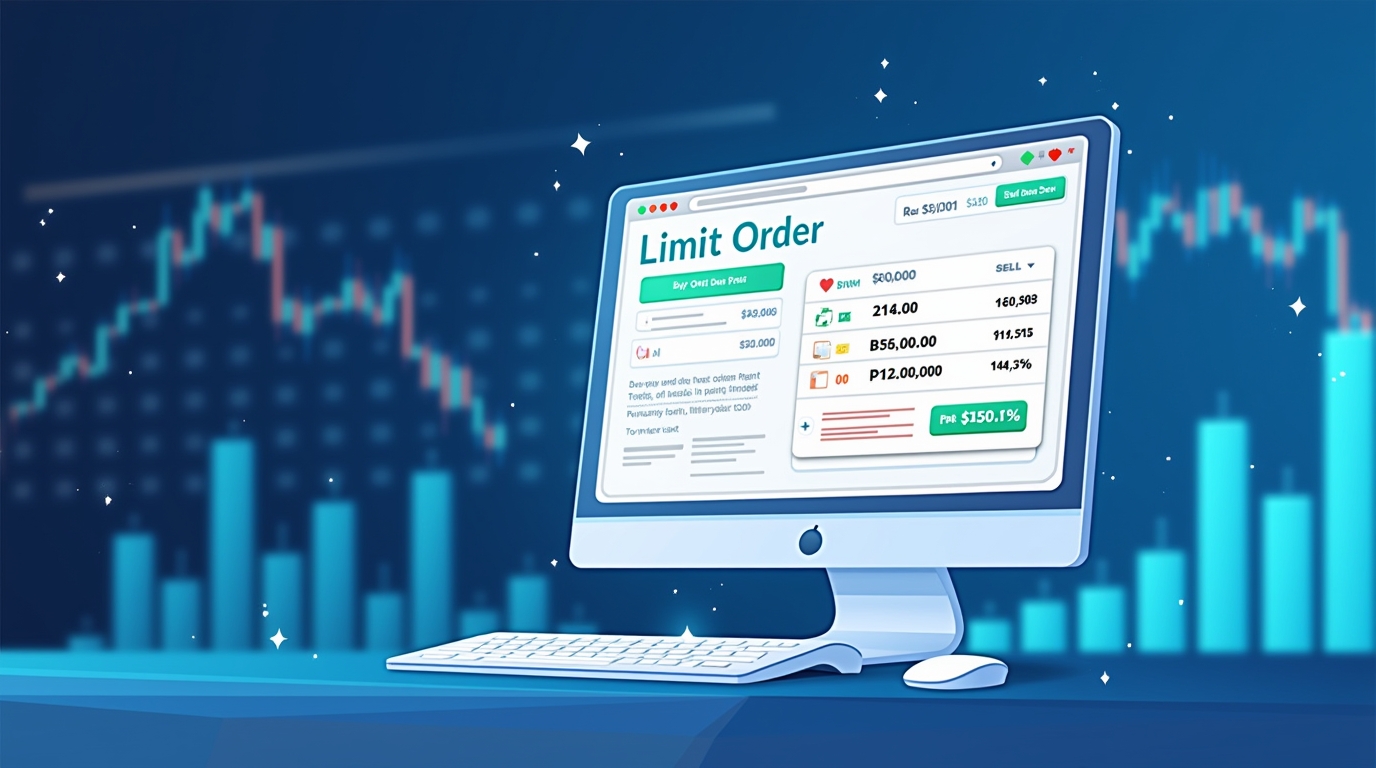
Ever wish you could buy crypto at the perfect price without constantly watching the market? That is exactly what a limit order lets you do. A crypto limit order is a trading instruction that tells your exchange to either buy or sell your coins, but only at the price you choose or better. Unlike market orders that execute instantly at whatever price is available, limit orders give you full control over your entry and exit points.
Whether you are trying to buy low, sell high, or avoid the chaos of sudden price swings, limit orders help you trade with precision and confidence. We will walk you through real-world examples, highlighting key benefits such as price control and risk management, and show you how to utilize them effectively on any crypto exchange.
Let’s dive in and unlock smarter ways to trade crypto.
What Is a Crypto Limit Order?
A limit order is a type of instruction you give to a crypto exchange to buy or sell a cryptocurrency at a specific price or better.
- You set the price you are willing to pay if you are buying, or accept if you are selling.
- The order only executes if the market reaches your chosen price.
Let’s suppose you want to buy 1 Bitcoin, but only if the price drops to $25,000. You place a limit buy order at $25,000. If Bitcoin reaches that price, your order will be processed. If not, it just waits.
Some major differences between a market order and a limit order include;
| Feature | Limit Order | Market Order |
| Execution Speed | Waits until the price matches your limit | Instant |
| Price Certainty | Yes, you choose the exact price | No, you get the best available price |
| Control | High, you control when and at what price | Low, you accept the current market price |
Use a limit order when you want price control and are willing to wait. However, use a market order when you want speed and are willing to accept the current price.
How Does a Limit Order Work?
Let’s break down how limit orders work in crypto trading using simple terms and examples.
- You Set a Price: For a buy limit, you choose the maximum price you are willing to pay, and for a sell limit, you choose the minimum price you are willing to accept.
- It Enters the Order Book: Your order joins a queue of other limit orders at that price level, and it waits for someone on the other side of the trade to match your price.
- Wait for the Match: If the market reaches your price, your order is filled. If not, it stays open. Sometimes for seconds, hours, or even days.
- Order Can Remain Unfulfilled: If the market never hits your price, the order stays pending or expires (depending on your settings).
Suppose you want to buy Ethereum (ETH), but only if the price drops to $1,500. However, the current price for ETH is $1,600. You place a limit buy at $1,500 for your order to enter the book and wait. If ETH drops to $1,500, your order gets filled. However, if ETH remains above $1,500, your order will remain unfilled.
Similarly, suppose you own Bitcoin (BTC) and want to sell it at $28,000; however, the current price for BTC is $27,500. You place a limit sell at $28,000 for your order to enter the book and wait. If BTC rises to $28,000, your order gets filled. However, if BTC remains below $28,000, your order will remain unfilled.
A limit order helps control risk by avoiding overpaying when buying and avoiding underselling when selling. You know the exact price at which you will trade, making it ideal for strategic entry and exit points in volatile markets.
Limit Orders vs. Market Orders: Key Differences
Understanding the difference between limit orders and market orders is crucial for effective crypto (or stock) trading. Here is a clear breakdown.
| Feature | Limit Order | Market Order |
| Execution Speed | Slower. Waits for your price to be matched | Instant. Executes at the current market price |
| Price Certainty | High. You choose the exact price | Low. You accept whatever price is available |
| Risk Exposure | Lower. Avoids bad prices during volatility | Higher. May get a worse price in fast markets |
| Best For | Strategic trades, price control, and patient investors | Quick trades and urgent buying/selling |
Use a Limit Order when;
- You want to buy/sell at a specific price
- You are not in a rush
- You want to avoid slippage when the price is moving against you
Use a Market Order when;
- You need to enter or exit a position immediately
- You are okay with the current price
- Speed matters more than price precision
How to Place a Limit Order on a Trading Platform?
Here is a beginner-friendly step-by-step guide to placing a crypto limit order on a trading platform. This will enable you to trade with greater control and reduced risk.
- Choose a Crypto Exchange: Select a reputable exchange, such as Binance, Coinbase, Kraken, or Bybit, and ensure it supports the cryptocurrency you wish to trade. Create an account and complete any required KYC (Know Your Customer) verification.
- Select the Trading Pair: Navigate to the “Markets” or “Trade” section. Select the pair you want to trade, such as BTC/USDT. The first currency is what you are buying or selling, and the second is what you are using to pay or receive.
- Enter Order Type: In the trading interface, select “Limit” as your order type. This indicates to the exchange that you want to set a specific price.
- Specify Price and Amount: Enter the exact price you want to buy or sell at, and then enter how much crypto you want to trade.
- Confirm and Monitor Order Execution: Click “Place Order” or “Submit,” and your order will be added to the order book, waiting for a match. You can monitor it under “Open Orders” or “Order History”.
Some terms to be aware of when placing a limit order on a trading platform include ‘pending order‘ and ‘partial fill‘. In the pending order, your limit order waits until the market hits your price. For partial fill, if only part of your order is matched, that portion is executed. The rest stays open. Suppose you want to sell 2 ETH at $1,600. Someone buys 1 ETH, that part is filled, but 1 ETH remains pending.
Advanced Limit Order Types in Crypto Trading
Let’s have a detailed look at what advanced limit order types are in crypto trading and why they are designed to help you trade smarter and manage risk better.
1. Stop-Limit Orders Vs Limit Orders
For a limit order, you set a price and wait for the market to reach it. However, for a stop-limit order, you add a trigger price (stop) that activates a limit order only when the market hits that trigger.
Suppose you won Bitcoin and want to sell if it drops to $26,000, but not lower than $25,800.
- Stop price: $26,000 (activates the order)
- Limit price: $25,800 (minimum you will accept)
If BTC reaches $26,000, your limit sell order will be placed at $25,800. Stop-limit orders are best suited for protecting profits, limiting losses, and avoiding panic selling in volatile markets.
2. Trailing Limit Orders
A trailing limit order adjusts your limit price as the market moves. You set a trailing amount in percentage (%) or dollars ($) behind the current price. Suppose you want to sell Ethereum with a trailing limit of $100. When ETH is at $2,000, then your trailing limit is $1,900.
However, if ETH rises to $2,200, then your limit moves to $2,100. If ETH drops to $2,100, your order is placed. It is best for locking in gains while letting profits run and automating smart exits without constant monitoring.
3. Conditional or OCO (one-cancels-other) Orders
You place two orders: one limit order and one stop-limit order. If one executes, the other is automatically canceled. Suppose you own BNB at $300 and want to take a profit at $330 and cut losses if it drops to $280.
You will set:
- Limit sell at $330
- Stop-limit sell: stop at $280, limit at $275
If BNB hits $330, you sell, and the stop-limit is canceled. If BNB drops to $280, the stop-limit is activated, and the $330 order is canceled. It is best to manage trades with clear exit strategies and avoid emotional decisions during price swings.
Benefits of Limit Orders
Limit orders provide traders with precision, control, and strategic flexibility, particularly in fast-moving cryptocurrency markets. Here is how they shine across key areas.
Volatility Protection
Limit orders provide shielding against rapid price swings, as crypto markets are famously volatile, where prices can spike or crash in seconds. Limit orders help you avoid buying too high or selling too low during sudden moves. Instead of reacting emotionally, your order waits for the price you’ve chosen.
Risk Tolerance
Limit orders allow you to define your comfort zone by specifying the price range within which you are willing to trade. This helps you stay on track with your strategy and avoid impulsive decisions. You can also use stop-limit orders to automate risk management.
Liquidity Provision
Limit orders add liquidity to the market while they sit in the order book, waiting to be matched. High-frequency trading (HFT) firms use them to profit from small price differences, and retail traders benefit by placing orders at strategic levels, often securing better prices than those obtained with market orders.
When to Use a Limit Order
Limit orders are powerful tools for crypto traders seeking control, precision, and protection in volatile markets. Here are practical scenarios where they work like a wonder.
Volatility Protection
Crypto prices can spike or crash in seconds, especially during significant news events or periods of low liquidity. A limit order helps you avoid buying at inflated prices or selling too low during these swings. Instead of reacting emotionally, your order waits for your chosen price.
Precise Entry/Exit
Limit orders let you pre-set your ideal entry or exit price. You don’t need to watch the market constantly, as the order executes only when your price is hit. This is especially useful for technical traders who base decisions on chart levels.
Strategic Trading
Limit orders support planned and patient trading, which is ideal for swing traders or long-term investors. You can place layered orders at different price levels to build or exit positions gradually. They also help automate your strategy without emotional interference.
Risk Associated With Using Limit Orders
While crypto limit orders offer control and precision, they also come with some risks, especially in fast-moving markets. Here are some things beginners should watch out for.
Market Gaps
In volatile markets, prices can skip over your limit price without triggering your order. This happens during market gaps and sudden jumps or drops between price levels. Your order remains unfilled because the price never quite reached your limit. Consider using stop-limit orders to better manage gap risks.
Partial Fills
If there is not enough volume at your limit price, only a portion of your order may be filled, and the rest stays pending until more matching orders arrive. This can disrupt your strategy, especially if you expected a full position. Monitor your open orders and adjust accordingly if needed.
Missed Opportunity
Limit orders wait for your price, but if the market moves quickly and reverses, you might miss out. This is common during news events or high volatility. You could have made a profit with a market order, but your limit order never triggered. Use alerts or combine with OCO orders to stay flexible.
Limit Orders in Institutional Trading
In institutional crypto trading, limit orders are essential tools for managing large volumes, minimizing costs, and executing trades with precision and accuracy. Here is how hedge funds and professional traders leverage them.
1. Managing Large Order Books
Institutions often trade millions of dollars worth of crypto, which can’t be executed in one go without disrupting the market. For this purpose, they use limit orders to break large trades into smaller chunks and place them strategically across the order book. This helps maintain market stability and avoids signaling their intent to other traders.
2. Reducing Slippage
Slippage occurs when the execution price differs from the expected price, which is more common in volatile markets or during large trades. Limit orders lock in a price, ensuring institutions don’t pay more or sell for less than intended. This is critical for funds with strict risk management protocols.
3. Optimizing Trade Execution
Institutions use algorithms to place limit orders based on real-time data, volume, and price trends. They often deploy smart order routing to find the best prices across multiple exchanges. Limit orders enable passive execution, thus reducing fees and improving the average entry/exit prices.
Final Thoughts
Limit orders are a powerful tool in crypto trading, offering precision, control, and protection in volatile markets. Whether you are a beginner or an institutional trader, they help you:
- Avoid overpaying or underselling during price swings
- Set exact entry and exit points for smarter execution
- Build strategic positions with layered or automated trades
- Manage risk with advanced types like stop-limit, trailing, and OCO orders
Want to learn more about Limiting Orders or crypto in general? Join Dypto-Crypto right now. We offer in-depth market analysis and beginner-friendly guides for newcomers. You can also sign up for our free weekly newsletter to satisfy your crypto needs.
FAQs (Frequently Asked Questions)
Q: Can a crypto limit order expire?
A: Yes, a crypto limit order can expire depending on how it is set up. You can choose GTC, Day Order, IOC, or FOK, all of which expire your limit order if certain conditions are not fulfilled.
Q: What happens if my limit order is not filled?
A: If your crypto limit order is not filled, it simply stays open waiting for the market to reach your specified price. Your order may remain pending, be partially fulfilled, or expire.
Q: Are there fees for using crypto limit orders?
A: Yes, most crypto exchanges charge fees for limit orders, but the amount and type can vary depending on how your order is executed.
Q: What is a partial fill in a limit order?
A: A partial fill in a limit order happens when only part of your order is executed, while the rest remains pending.
Disclaimer
This article is for educational and information purposes, and should not be considered financial advice. For more information visit our disclaimer page
About the Author